

For millions of people, this isn't a bad day. It's Tuesday.
ADHD gets talked about constantly, but a diagnosis alone rarely changes much. What actually shifts the trajectory for many people is finding a therapist who genuinely specializes in it — someone trained to work with how the ADHD brain actually functions, not just someone who's vaguely familiar with the condition.
This article breaks down what an ADHD therapist does, the three areas where specialized therapy creates real, measurable change, and what happens when people try to manage without that support.
Key Takeaways
- ADHD therapists use evidence-based approaches (especially CBT) validated for ADHD presentations
- Therapy addresses far more than focus: it reshapes routines, relationships, and self-concept
- Adults with ADHD lose an average of 22.1 excess days of role performance per year — therapy directly targets this gap
- Nearly half of adults with ADHD also live with an anxiety disorder; therapy addresses both
- Consistency matters more than speed : gains compound over time with regular attendance
What Is an ADHD Therapist?
An ADHD therapist is a licensed mental health professional — a counselor, psychologist, or clinical social worker — with specific training in assessing and treating Attention-Deficit/Hyperactivity Disorder across age groups.
The difference from a general therapist goes beyond recognizing ADHD symptoms. ADHD-specialized therapists use modalities that are clinically validated for how the ADHD brain actually works:
| Modality | What It Targets |
|---|---|
| Cognitive Behavioral Therapy (CBT) | Unhelpful thought patterns, planning difficulties, task avoidance |
| Behavioral interventions | Routines, environmental structure, habit formation |
| Psychoeducation | Understanding ADHD's neurological basis, reducing self-blame |
The role isn't to "fix" ADHD — it doesn't work that way. A skilled ADHD therapist helps clients build personalized systems and develop self-awareness so they can work with their brain — not spend every day fighting against it.
That distinction matters. Someone trained in generic talk therapy may recognize ADHD symptoms. An ADHD-specialized therapist knows which protocols are actually effective for this population — and applies them with fidelity.
Key Ways an ADHD Therapist Can Transform Your Life
The three areas below aren't abstract promises. They're where research consistently shows that targeted ADHD therapy produces measurable, real-world change.
Building Practical Coping Strategies That Actually Stick
ADHD's core challenge isn't laziness or lack of intelligence: it's executive dysfunction. Starting tasks, organizing steps, following through, managing time: these functions are neurologically harder for people with ADHD, and no amount of willpower reliably compensates for that.
An ADHD therapist works to identify where specifically the breakdown happens for each client. For one person, it's starting tasks. For another, it's transitioning between them. For another, it's the shame spiral that hits after missing a deadline, which then makes the next task even harder to start.
CBT for ADHD targets all of this directly:
- Challenging internalized beliefs like "I'm lazy" or "I'll never finish anything"
- Building external structure (reminders, routines, accountability loops) that compensates for weak internal regulation
- Breaking complex tasks into concrete, manageable steps
- Reducing the cognitive load of decision-making through repeatable systems
The research backing this is solid. A 2025 meta-analysis of 17 randomized trials found moderate effects of 0.52 and 0.58 across two symptom-rating outcomes favoring ADHD-focused CBT — a meaningful improvement when you consider that these are people who have typically struggled for years without targeted support.
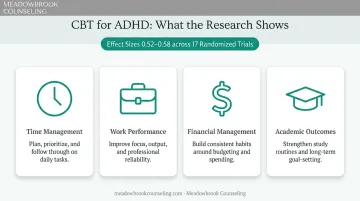
Life areas most affected:
- Time management and task completion
- Work performance and occupational functioning
- Financial management and household responsibilities
- Academic outcomes for adolescents and young adults
Adults recently diagnosed with ADHD — or those who've tried medication alone without behavioral support — often find this work the most clarifying. Medication can reduce symptom intensity, but it doesn't teach the skills. That's the gap therapy fills.
Strengthening Relationships and Communication
ADHD doesn't stay inside the individual. Impulsivity, forgetfulness, emotional reactivity, and difficulty sustaining attention in conversations ripple outward into marriages, friendships, parenting, and workplace dynamics.
Partners often describe feeling unheard, deprioritized, or exhausted by carrying the organizational load. For the person with ADHD, the experience tends to be guilt, defensiveness, and a persistent sense of trying hard but never being enough.
An ADHD therapist helps clients:
- Identify their specific relational patterns and triggers
- Communicate needs more clearly without defensiveness
- Develop concrete tools for managing impulsivity in heated moments
- Understand how ADHD symptoms are being perceived by others — and adjust accordingly
Research confirms this isn't a minor issue. Clinical studies find poorer marital adjustment and greater marital conflict in couples where one partner has ADHD, with recurring difficulties around perceived misunderstanding, emotional responses, and sustained communication.
Life areas most affected:
- Romantic relationships and marital satisfaction
- Parenting dynamics and co-parenting communication
- Workplace relationships and collaboration
- Social confidence and friendships
For adults whose ADHD wasn't identified until later in life, this work carries particular weight. Years of being labeled "unreliable" or "difficult" without explanation leave their own damage. Therapy provides both the context to understand those patterns and the tools to change them.
Rebuilding Self-Identity and Confidence
This is where ADHD therapy does its most underestimated work.
Many people arrive at therapy carrying years, sometimes decades, of accumulated shame. Every forgotten appointment, every incomplete project, every relationship strain has been filed away as evidence of a character flaw.
By the time they reach a therapist's office, the internal narrative is often brutal: I'm a failure. I can't do anything right. Something is deeply wrong with me.
That narrative is both false and damaging. ADHD-informed therapy creates space to separate the disorder from the person — to understand that the repeated "failures" were symptoms of a neurological condition, not evidence of moral inadequacy.
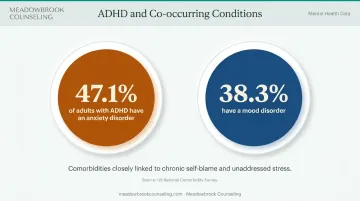
The stakes are high. Research from the US National Comorbidity Survey found that 47.1% of adults with ADHD had an anxiety disorder and 38.3% had a mood disorder — comorbidities that are closely tied to years of unaddressed self-blame and chronic stress.
What ADHD-informed therapy addresses in this area:
- Reframing the ADHD narrative from "what's wrong with me" to "how my brain works differently"
- Identifying genuine strengths that often coexist with ADHD — creativity, hyperfocus, big-picture thinking
- Building self-compassion as an active skill, not just a concept
- Developing a stable identity that isn't defined by struggles
Life areas most affected:
- Mental health stability and reduced anxiety
- Motivation and follow-through on goals
- Self-advocacy and willingness to ask for help
- Overall life satisfaction
For adults undiagnosed in childhood, years of academic struggles and social friction often compound into deep-seated shame by the time they reach adulthood. A diagnosis can explain the past. Therapy helps build something different going forward.
What Happens Without ADHD Therapy Support
Unmanaged ADHD rarely stays contained — it expands into more areas of life the longer it goes unaddressed.
What often starts as difficulty focusing or staying organized can escalate into:
- Job instability — ADHD is associated with 22.1 excess days of lost role performance annually, with executive-function deficits predicting occupational impairment
- Financial strain — population data link ADHD with higher rates of credit default and escalating financial distress
- Relationship erosion — recurring conflict, emotional dysregulation, and communication difficulties that compound without targeted intervention
- Burnout and mental health deterioration — a 2024 cross-sectional study found ADHD symptoms associated with job burnout, with executive-function deficits mediating part of that relationship
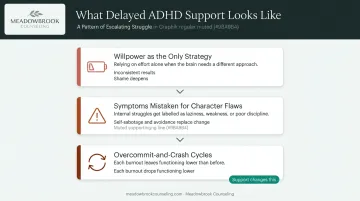
Delaying support tends to lock in three patterns:
- Willpower as the only strategy — it works inconsistently, and every failure deepens shame rather than building skills
- Symptoms mistaken for character flaws — which pushes people toward self-sabotage and avoidance instead of actual change
- Overcommit-and-crash cycles — each round of burnout takes longer to recover from, and functioning drops a little further each time
For many people, years pass before they connect these patterns to ADHD — and by then, the strain has spread across work, finances, relationships, and health simultaneously.
How to Get the Most From ADHD Therapy
Therapy works best when it's treated as a consistent practice, not a crisis resource.
Attendance matters more than people expect. Irregular sessions interrupt the momentum needed to practice skills, adjust strategies, and build on gains. Showing up consistently — even when life gets chaotic — is itself a form of behavioral practice.
Finding the right therapist makes a meaningful difference. Not every licensed therapist has ADHD-specific training. When evaluating options, ask directly about:
- Experience working specifically with ADHD clients
- Use of structured, ADHD-adapted CBT or behavioral approaches
- Familiarity with executive function challenges across age groups
Meadowbrook Counseling works with adults, adolescents, and children across multiple states, using a structured intake process to match clients with therapists trained in ADHD-specific approaches. Most major insurance plans are accepted — including Aetna, Cigna, BCBS, and UnitedHealthcare — and telehealth appointments are available for clients who need scheduling flexibility.
Between-session practice is where skills become habits. Skills covered in therapy only stick through consistent use outside the session. Tracking patterns between appointments, testing communication tools in real conversations, and noting what's working — and what isn't — gives your therapist sharper insight and moves progress forward faster.
Conclusion
An ADHD therapist doesn't just help someone cope better — they help shift how that person operates day-to-day, how they show up in relationships, and how they see themselves. Stronger skills reduce shame. Less shame improves relationships. Better relationships build the motivation to keep applying what's been learned. Each area feeds the next.
The changes aren't instant, but they compound. And they're the kind that stick.
If any part of this resonated, the next step doesn't have to be complicated. Meadowbrook Counseling works with individuals across Utah, Massachusetts, Texas, Washington, and several other states, through both in-person and telehealth appointments. Their intake team matches each person with a therapist suited to their specific ADHD needs. Reaching out is the only first step required.
Frequently Asked Questions
What type of therapist is good for ADHD?
Therapists trained in CBT, behavioral therapy, or psychoeducation tend to produce the strongest outcomes for ADHD clients. Specific ADHD experience matters more than general mental health training — ask potential therapists directly about their approach and how many ADHD clients they've worked with.
Can a PsyD diagnose ADHD?
A licensed psychologist holding a PsyD can conduct ADHD evaluations and diagnose the condition, provided it falls within their state's scope and clinical competence. Licensure requirements vary by state, so confirm scope directly with the individual provider.
How does the ADHD brain work?
ADHD involves differences in prefrontal cortical networks and catecholamine regulation — dopamine and norepinephrine — affecting attention, impulse control, and executive function. Early therapy often addresses this neurological basis directly, reframing the struggle as biological rather than a personal failing.
Is therapy enough for ADHD, or do I also need medication?
They serve different functions. Medication can reduce symptom intensity neurologically; therapy builds the behavioral and emotional skills that medication alone doesn't teach. Many people benefit from combining both, but therapy is also supported as a stand-alone option for those who decline or can't tolerate medication.
How long does it take for ADHD therapy to show results?
Some clients notice improvements in specific skills — time management, task follow-through — within a few months. Deeper shifts in self-identity and relational patterns typically take longer, and consistent attendance drives more progress than the pace of the work itself.
Can adults with ADHD benefit from therapy, even if they've learned to cope on their own?
Yes. Many adults develop workarounds that function partially but carry a high cost — chronic stress, burnout, or suppressed self-worth. Therapy replaces those exhausting compensation strategies with approaches that are actually sustainable and don't require constant effort to maintain.