

If that sounds familiar, you're not broken, and neither is your relationship. You're just stuck in a pattern that's hard to see from the inside.
Couples therapy isn't just for relationships on the brink of ending. It addresses everything from communication breakdowns to financial stress, parenting disagreements, and major life transitions. Timing matters more than most people realize. This guide covers exactly which issues couples therapy resolves, when to reach out, and how Meadowbrook Counseling's therapists can help.
Key Takeaways
- Couples therapy resolves issues ranging from communication and intimacy problems to financial conflict, infidelity, and life transitions
- Most couples wait 2.68 years after problems start before seeking help
- Active abuse or coercive control requires individual therapy and safety planning, not joint sessions
- The Gottman Method and Emotionally Focused Therapy (EFT) are the two most researched, structured approaches
What Issues Can Couples Therapy Resolve?
Couples rarely show up to their first session with a tidy, single complaint. Usually it's messier: a fight about dishes that's really about feeling unappreciated, or silence at dinner that's really about resentment nobody's named yet. A trained therapist's job is to spot the pattern underneath the argument.
Communication Breakdowns and Conflict Cycles
Most couples don't have a communication problem so much as a communication pattern that backfires. Common cycles include:
- Pursuer-distancer dynamics — one partner presses to talk through an issue while the other pulls away, which only intensifies the pursuit
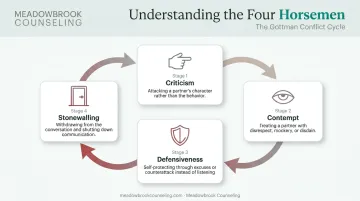
- Criticism-defensiveness loops — a complaint about specific behavior turns into an attack on character, which triggers excuses or counterattacks
- Stonewalling — one partner shuts down entirely, often because they're physiologically overwhelmed, not because they don't care
Gottman researchers call these interaction patterns the "Four Horsemen": criticism, contempt, defensiveness, and stonewalling. Importantly, these are cycles both partners feed into, not evidence that one person is simply "the problem."
Intimacy, Trust, and Connection
Emotional distance tends to build gradually. Couples stop sharing the small stuff, physical affection fades, and vulnerability starts to feel risky instead of safe. Therapy addresses:
- Emotional withdrawal and feeling like roommates instead of partners
- Physical disconnection and mismatched needs around intimacy
- Fear of being fully known or seen by a partner
- Trust repair after infidelity, including rebuilding a shared narrative about what happened and why
Practical Life Stressors
Day-to-day friction is often about logistics, not love. The most common flashpoints:
- Money — differing philosophies on spending, saving, or debt tolerance
- Parenting — disagreements on discipline, screen time, or division of labor
- Extended family — boundary conflicts with in-laws or blurred roles around holidays and involvement
Life Transitions and External Pressures
Big changes strain even solid relationships. Common triggers include:
- A new baby or major shift in family structure
- Job loss or a significant career change
- A cross-country move or retirement
- A health diagnosis or a death in the family
These moments don't have to escalate into lasting damage before a couple seeks help. Many couples use therapy proactively, before a small disagreement becomes a recurring wound. When past trauma is tangled up in the relationship, Meadowbrook Counseling's therapists tailor approaches like EMDR alongside couples work to address those trauma-related relational wounds directly.
When Should You Consider Couples Therapy?
The best time to start therapy isn't when separation feels imminent. It's when a pattern first starts disrupting your daily connection, before it calcifies into something harder to untangle.
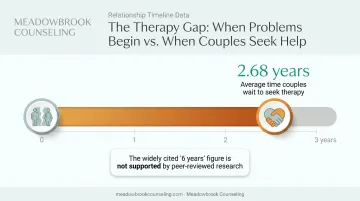
Here's the uncomfortable truth: most couples wait far longer than they should. Research tracking 270 people entering couples therapy found a mean gap of 2.68 years between when problems started and when couples actually sought help. That widely repeated claim that couples wait six years? The study's authors call it poorly supported.
Nearly three years of an unresolved pattern gives it plenty of time to become the relationship's default setting.
Signs It Might Be Time
Watch for these behavioral markers:
- Trouble calming down after fights — arguments leave you rattled for hours, not minutes
- The same argument, different day — you're resolving nothing, just cycling through it again
- Difficulty reconnecting after conflict — the fight ends, but the distance lingers
- Trouble naming what you need — you know something's wrong but can't say it directly
Therapy Isn't Just Damage Control
Not every couple in therapy is fixing a fracture. Plenty of couples in genuinely healthy relationships use it preventively, the same way you'd see a dentist before a cavity turns into a root canal. It sharpens communication skills before small issues compound.
Premarital counseling fits this same logic. Couples address finances, parenting philosophy, and role expectations before they become live conflicts, not after resentment has built up. Meadowbrook Counseling's therapists work with couples at both stages, whether you're addressing a pattern that's already taken hold or building stronger habits before problems start.
When Couples Therapy Isn't the Right Fit
Couples therapy assumes both partners have relatively equal footing and genuine safety to be honest. In abusive relationships, that assumption breaks down completely.
The National Domestic Violence Hotline is direct about this: "We do not encourage anyone in an abusive relationship to seek counseling with their partner. Abuse is not a relationship problem."
Why joint sessions can backfire:
- Disclosures made in session can later be used against the survivor
- An abusive partner may manipulate the therapeutic process itself
- Conjoint therapy assumes both people can speak freely, which coercive control eliminates
Clinical research draws a sharper distinction: situational conflict that escalates poorly is different from coercive controlling violence, sometimes called "intimate terrorism." A 2022 clinical review in an APA journal calls conjoint therapy strictly contraindicated in cases of coercive control, since treatment can actually increase danger.
If this describes your situation:
- Individual therapy and safety planning come first, not joint sessions
- Contact the National Domestic Violence Hotline at 1-800-799-7233 or text START to 88788
Abuse isn't the only factor that can derail joint sessions. Active, ongoing addiction or an affair that's still happening creates a similar imbalance, where one partner can't yet engage honestly. In these cases, individual therapy first gives couples work a real chance to succeed later. Meadowbrook Counseling's therapists can help determine which starting point fits your situation.
Which Therapy Approaches Resolve These Issues?
Most couples therapists don't wing it. They work from established, research-backed frameworks. Knowing what to expect from each helps you evaluate whether a therapist's style fits your situation, including the modalities Meadowbrook Counseling's therapists are trained in.
The Gottman Method
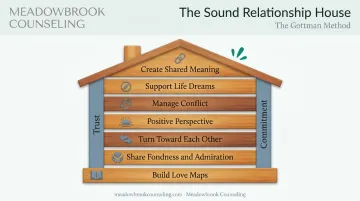
Built around what's called the "Sound Relationship House," this model has seven levels. These include building love maps, sharing fondness and admiration, turning toward each other, maintaining a positive perspective, managing conflict, supporting each other's dreams, and creating shared meaning. Trust and commitment form the structural walls holding it all together.
The approach relies on structured exercises to interrupt conflict cycles and rebuild friendship as the foundation. EFT takes a different angle on the same goal.
Emotionally Focused Therapy (EFT)
EFT is rooted in attachment theory. Instead of just managing surface arguments, it targets the underlying emotional needs, like fear of abandonment or feeling unseen, that actually drive the conflict.
A 2024 meta-analysis of 20 studies covering roughly 332 couples found a strong pre-to-post treatment effect (d = 0.93), with gains largely holding at follow-up. That's meaningful evidence, though it describes group averages, not a guarantee for any individual couple.
What About the 5-5-5, 7-7-7, or 2-2-2 Rules?
These informal exercises show up constantly online:
| Rule | Common format |
|---|---|
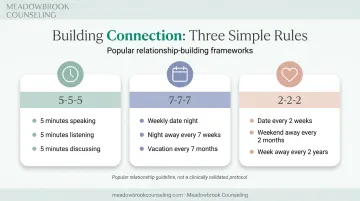
| 5-5-5 | Timed turns speaking and listening, five minutes each |
| 7-7-7 | Date night weekly, night away every 7 weeks, vacation every 7 months |
| 2-2-2 | Date every 2 weeks, weekend away every 2 months, week away every 2 years |
None of these have a documented clinical origin or research trial behind the exact numbers. They're popular heuristics, not evidence-based protocols. Therapists often use similar structured, timed exercises to build listening skills and reduce reactivity. The specific structure matters less than the consistency.
There's no single "best" approach for every couple. Ask a prospective therapist which framework they use and why, and how they tailor it to your relationship. Their answer tells you a lot about how sessions will actually run.
Getting Started with Couples Therapy
Before your first session, talk through two simple questions together: What prompted you to look for therapy now? What do you hope will feel different in six months?
Once you've talked through those questions, the next step is finding the right fit. Check credentials before booking, since not every therapist specializes in couples work. Look for:
- LMFT (Licensed Marriage and Family Therapist) — graduate training specifically in couples and family systems
- LCSW (Licensed Clinical Social Worker) with couples-specific training
- Licensed psychologist with relationship therapy experience
At Meadowbrook Counseling, therapists hold credentials such as LMFT and LAMFT alongside additional training in Gottman Method, EFT, and EMDR. This combination helps couples work through relational trauma with an approach grounded in both clinical research and hands-on experience.
Meadowbrook offers personalized therapist matching, insurance benefits verification before your first session, and locations across Utah, Washington, Arizona, Wisconsin, Massachusetts, and Texas, plus telehealth options for couples who prefer meeting remotely.
Frequently Asked Questions
What are common rules or exercises used in couples counseling (like the 5-5-5, 7-7-7, or 2-2-2 rules)?
These are informal structured communication exercises, such as timed speaking-and-listening turns or scheduled check-ins, designed to build listening skills and reduce reactivity. A licensed therapist can recommend a structure suited to your specific relationship.
What type of therapy is best for relationship problems?
There's no universal "best" option. The Gottman Method and EFT are the most widely used and researched approaches, but the right fit depends on your specific issues and goals.
How do we know if we've found the right couples therapist for us?
Both partners should feel equally heard, and the therapist's framework should make sense for your relationship's specific challenges. It's completely normal to consult with a few therapists before committing to one.
How long does couples therapy typically take to resolve issues?
Most couples attend for a few months to about half a year, though timelines vary based on issue complexity and consistency of effort. For example, EFT is often structured as an 8- to 20-session course.
Does insurance cover couples therapy?
Coverage usually depends on whether treatment is tied to a diagnosable, covered condition. Meadowbrook Counseling verifies your specific benefits before your first session, so you know your coverage upfront.
What if my partner refuses to go to therapy?
Starting with individual therapy is a solid option. It still gives you practical tools, and it sometimes helps a reluctant partner become more open to joint sessions later.