
This pattern usually has roots in childhood. Avoidant attachment is one of several insecure attachment styles first described by psychiatrist John Bowlby, whose attachment theory explains how early bonds with caregivers shape how we relate to others for the rest of our lives.
Understanding where this pattern started is often the first real step toward loosening its grip.
TL;DR
- Avoidant attachment usually develops from emotionally unavailable or overly strict caregiving during early childhood
- Common causes include neglect, inconsistent caregiving, criticism of emotional needs, and sometimes trauma or abuse
- Left unaddressed, it can strain adult relationships, self-esteem, and even physical health
- Attachment styles aren't permanent — therapy and self-awareness can help shift someone toward security
Common Childhood Causes of Avoidant Attachment
Avoidant attachment forms through repetition, not a single bad day. When a child repeatedly reaches for comfort and gets dismissal, criticism, or indifference instead, they learn a hard lesson early: needing someone isn't safe.
Over time, the child adapts by shutting down emotional expression and becoming self-sufficient — sometimes far earlier than developmentally appropriate.
Emotionally Unavailable or Dismissive Caregivers
A caregiver can be physically present and still be emotionally absent. Distracted, undemonstrative, or visibly uncomfortable with emotion, they teach a child a simple rule: expressing feelings doesn't get you anywhere.
Typical scenario: A child falls, scrapes a knee, and cries. Instead of comfort, the response is indifference or a flat "toughen up." The child learns to stop bringing their pain to the caregiver at all.
Research on infant-parent attachment backs this up directly. Ignoring, ridiculing, or reacting with annoyance to a child's distress is specifically linked to insecure-avoidant attachment. The child's outward calm isn't proof they're fine — it's an adaptation to an expectation that comfort won't come.
Inconsistent or Unpredictable Caregiving
When affection is unreliable, a child can't calibrate whether comfort will show up. Some kids respond by escalating their need for reassurance. Others, especially over time, stop asking altogether — it's safer than the gamble.
Picture this: a parent who's warm and playful one evening, then irritable and withdrawn the next, with no clear reason why.
Classic attachment research links unpredictable caregiving more strongly to anxious attachment than avoidant. Inconsistency layered with dismissiveness or coldness, though, can still push a child toward avoidant patterns as a protective strategy.
Overly Strict or Critical Parenting
Some caregivers don't ignore emotion — they punish it. Sadness gets mocked. Fear gets dismissed as weakness. Rules matter more than warmth.
Typical scenario: A child asks for help with something they're struggling with and gets scolded or ridiculed instead of supported.
This kind of environment teaches children that vulnerability has a cost. Self-reliance becomes armor. Suppressing emotion becomes the price of avoiding criticism.
Neglect, Abuse, or Early Trauma
Chronic neglect and physical, sexual, or emotional abuse sit at the more severe end of this spectrum. These experiences don't just teach a child that comfort is unreliable — they teach the child that caregivers can't be trusted for basic safety.
The numbers here are sobering. CDC analysis of survey data collected from 2011 to 2020 found that 63.9% of US adults reported at least one adverse childhood experience, and 17.3% reported four or more.
A meta-analysis of 55 studies covering nearly 4,800 children found that maltreated kids were substantially more likely to show disorganized attachment patterns than their peers, with effect sizes researchers consider very large.
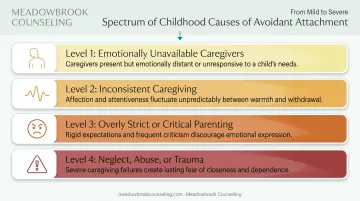
Important distinction: abuse and severe neglect are more often the pathway to fearful-avoidant or disorganized attachment — a more distressing presentation than straightforward dismissive avoidance. Not every avoidant adult experienced abuse, but nearly every severely disorganized adult experienced some form of chronic maltreatment.
Temperament and Genetic Predisposition
Beyond these environmental patterns, biology plays a role too — though a supporting one, not a starring one. Adult twin studies estimate that heritability accounts for roughly 36-39% of attachment avoidance, with environment explaining the rest.
A 2018 study linked a specific gene variant (COMT rs4680) to higher avoidance scores, but that finding hasn't been independently replicated. Some children may simply be more temperamentally sensitive to inconsistent or cold caregiving — but environment remains the primary driver.
Signs Avoidant Attachment From Childhood Is Showing Up in Your Adult Life
These early patterns don't stay in childhood. They resurface as recognizable habits, especially once relationships start to deepen.
Common signs include:
- Discomfort with closeness — physical or emotional intimacy feels overwhelming, even when you want connection underneath
- Withdrawing when things deepen — creating distance right as a relationship starts to feel real
- Difficulty naming feelings — struggling to identify or express what you actually need
- Excessive self-reliance — feeling uneasy asking for help, even when you're clearly struggling
- Mixed signals — pulling away from people you care about, even while wanting them close
This push-pull often plays out with partners who lean anxious, forming what researchers call the anxious-avoidant trap. In conflict, avoidant partners tend to withdraw, while an anxiously attached partner often responds by pursuing harder, creating a demand-withdraw cycle that reinforces both people's worst fears.
What Happens If Avoidant Attachment Goes Unaddressed
Left alone, avoidant attachment doesn't stay quiet. It tends to quietly erode relationship satisfaction — pushing partners away, then feeling the loneliness that follows, then repeating the cycle.
The consequences aren't only emotional. Research on marital conflict has linked avoidant attachment to real physiological costs, including:
- Relationship strain: A repeating push-pull cycle of distancing and loneliness
- Physiological stress: An 11% increase in inflammatory markers (interleukin-6) during conflict, compared to a supportive interaction
- Generational risk: Higher odds that a parent's attachment patterns get passed down to their child
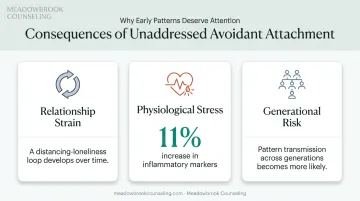
That inflammation marker isn't just a metaphor for "shutting down" — it's a measurable stress response in the body.
Research on intergenerational attachment transmission consistently shows that a parent's own attachment patterns predict their child's attachment style. Sensitive caregiving explains part of that link, but not all of it, meaning the cycle can continue quietly across generations.
Interrupting that pattern usually starts with understanding where it began — which is where therapy can help identify the specific childhood roots at play.
How to Heal Avoidant Attachment as an Adult
Here's the encouraging part: attachment style isn't a life sentence. It formed through repeated experience, and it can shift through new, repeated experience — especially with the right support.
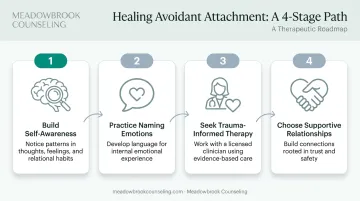
Build Self-Awareness Around Triggers
Notice what specifically triggers the urge to withdraw. Is it intimacy? Conflict? Someone depending on you? Naming the trigger in the moment is what interrupts the automatic reflex to retreat.
Practice Naming and Expressing Emotions
Small, low-stakes practices rebuild tolerance for vulnerability over time:
- Journal what you're feeling, even briefly, once a day
- Say one honest feeling out loud to a trusted person each week
- Notice physical sensations tied to emotion (tight chest, clenched jaw) as clues to what you're suppressing
Seek Trauma-Informed, Attachment-Focused Therapy
These daily practices help, but patterns wired in early childhood often need more than self-directed effort to fully shift. Approaches like EMDR, psychodynamic therapy, and trauma-focused CBT go after the early experiences that shaped the avoidant pattern in the first place, rather than just managing today's symptoms.
At Meadowbrook Counseling, EMDR-certified clinicians work with clients to process the childhood roots of attachment patterns in a way that feels safe and paced to the individual, using a pace set by the client rather than a fixed treatment timeline.
Choose Relationships That Support Growth
Surrounding yourself with people who are patient and securely attached — including a good therapist — gives your nervous system repeated proof that closeness doesn't have to end in disappointment. That proof, accumulated over time, is what actually updates old beliefs.
Tips for Long-Term Growth Toward Secure Attachment
Healing avoidant patterns is gradual, but a few consistent habits make the process easier to sustain:
- Stay consistent in your relationships and daily routines. Predictability helps recalibrate a nervous system that's used to uncertainty.
- Practice small acts of vulnerability regularly, rather than waiting to feel "ready" (readiness rarely arrives on its own)
- Check in with a therapist periodically. Attachment work isn't linear, and therapists trained in trauma-informed care, including Meadowbrook Counseling's EMDR practitioners, can help with course-correction along the way
- Remember the distinction: childhood causes explain the pattern. They don't have to define the rest of your story.
Frequently Asked Questions
What is the root cause of avoidant attachment?
It typically stems from a childhood caregiver who was emotionally unavailable, dismissive, or inconsistent. The child learns to suppress needs and rely on self-sufficiency instead of connection.
Do avoidants get attached?
Yes. People with avoidant attachment form real, deep attachments and want connection. Fear of dependency and vulnerability just causes them to suppress or downplay those feelings.
How to respond to an avoidant when they come back?
Give space without pressure, communicate calmly and directly, and avoid chasing or punishing the withdrawal. This builds trust instead of triggering more retreat.
Can avoidant attachment be healed in adulthood?
Yes. Attachment styles aren't fixed. Working with a therapist, building secure relationships, and practicing consistent self-awareness can shift someone toward a more secure style over time.
Is avoidant attachment always caused by abuse?
No. Abuse and severe trauma can cause it, but milder patterns like emotional neglect, dismissiveness, or inconsistent caregiving are far more common causes.
Can genetics play a role in avoidant attachment?
Some research suggests genetic factors may increase vulnerability, with heritability estimates around 36-39% for avoidance. Early caregiving environment still remains the primary driver.