

If you have ADHD, you've probably been told this is "just anxiety" or "just how your brain works." But for many people, there's another layer underneath: trauma. And when ADHD and trauma overlap, treating one without the other rarely gets you the relief you're looking for.
Research shows this connection is real, not rare. 70.4% of adults across 24 countries report experiencing at least one traumatic event in their lifetime, according to a study published in the journal Psychological Medicine. For people with ADHD, that number matters even more because their nervous systems are often already working overtime.
This article breaks down how ADHD and trauma interact, how to tell their symptoms apart, and what treatment actually helps when both are in the picture.
Key Takeaways
- ADHD and trauma frequently co-occur, each amplifying symptoms like emotional dysregulation and hypervigilance
- Overlapping symptoms like poor focus and impulsivity make accurate assessment essential before treatment
- Trauma-informed care that also accounts for neurodivergent needs works better than generic, one-size-fits-all therapy
- Body-based strategies paired with professional support, including EMDR, help regulate an overwhelmed nervous system
Understanding the ADHD-Trauma Connection
The relationship between ADHD and trauma runs in both directions. Neither one simply causes the other, but each one can make someone more vulnerable to developing the other.
ADHD often leads to years of rejection, punishment, or being misunderstood, at school, at work, in relationships. That repeated pain can accumulate into something that functions like trauma. Meanwhile, childhood trauma can alter brain development in ways that produce ADHD-like symptoms: poor concentration, restlessness, and trouble regulating emotions.
The research backs this up:
- A 2022 meta-analysis of 70 studies with almost 4 million participants found adverse childhood experiences (ACEs) were associated with higher odds of an ADHD diagnosis, at an odds ratio of 1.68, according to a systematic review in PMC
- A genetic and sibling study found ADHD was linked to a significantly higher risk of later PTSD, with a hazard ratio of 2.37 in sibling comparisons, per research published in PMC
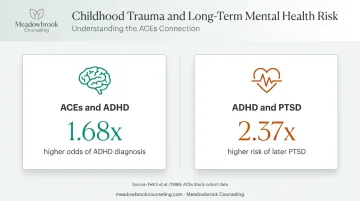
Neither study proves direct causation. But together, they make a strong case for screening for both conditions rather than assuming one explains everything.
Rejection, Shame, and a Late Diagnosis
Many adults with ADHD describe something clinicians call Rejection Sensitive Dysphoria, or RSD: overwhelming emotional pain after a perceived failure or rejection. It's not a formal diagnosis, but it's a common experience.
Years of feeling "too much" or "not enough" can compound into chronic shame. For adults diagnosed with ADHD later in life, there's often grief mixed in too, grief over misunderstood school years, broken relationships, or jobs lost to symptoms nobody named correctly.
Why the Nervous System Gets Stuck
That shame and grief aren't just emotional; they're rooted in biology. ADHD brains tend to have underactive prefrontal cortex regulation. Trauma, meanwhile, is linked to heightened amygdala and insula sensitivity. Put those together, and you get a nervous system that overreacts to stress and struggles to calm back down.
Every time that stress response fires, whether it's a slammed door or a critical text message, the body treats it like a real threat. Repeat that enough times, and it creates fixed patterns: muscle tension, defensive habits, a body that's braced for impact even when nothing is wrong.
This is exactly why treating only ADHD, or only trauma, tends to fall flat. If you medicate the ADHD but never address the trauma, the nervous system stays reactive. If you do trauma therapy but ignore the ADHD, attention and impulsivity issues keep undercutting progress. Effective care typically means working with a therapist trained in both trauma-informed approaches and ADHD, since the two conditions feed each other in ways that single-focus treatment can miss.
ADHD or Trauma? Untangling Overlapping Symptoms
Symptoms That Look Alike
Here's where things get confusing, for clients and clinicians alike. Both conditions can produce:
- Difficulty concentrating and staying on task
- Poor working memory
- Emotional dysregulation and quick frustration
- Interrupted or unrefreshing sleep
- Impulsivity and restlessness
- Strained relationships
Without a careful assessment, it's easy for a clinician to misread trauma symptoms as "just ADHD," or vice versa. The two aren't mutually exclusive. They frequently coexist, and missing one means treatment addresses only half the picture.
A few clues point more toward trauma:
- Flashbacks or intrusive memories
- Active avoidance of certain people, places, or reminders
- Hypervigilance that spikes around specific triggers
If symptoms appeared before age 12 and show up consistently across every setting, ADHD is more likely the primary driver. If symptoms followed a specific event and come with intrusion or avoidance, trauma deserves a closer look.
The 4 F's: Trauma Response Patterns in ADHD
You may have heard of fight, flight, freeze, and fawn. These aren't ADHD symptoms — they're survival responses that show up in anyone with a dysregulated nervous system. They tend to hit harder in people whose systems are already running hot.
Here's how they often look in practice:
- Fight - Sudden irritability or impulsive outbursts that feel disproportionate to the trigger
- Flight - Restlessness, fidgeting, or an urge to physically leave a stressful situation
- Freeze - Shutting down, going blank, or dissociating mid-conversation
- Fawn - People-pleasing, over-apologizing, or masking true feelings to keep the peace
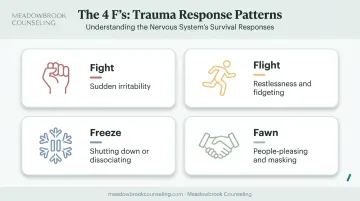
Recognizing these patterns can be a relief. It reframes reactions that felt like personal failures — those "why did I just snap like that?" moments — as an adaptive nervous system doing exactly what it learned to do. That's a different starting point than shame, and it's exactly the kind of untangling a trauma-informed assessment is designed to help with.
Practical Strategies for Managing Trauma with ADHD
You don't need a clinical degree to start regulating your nervous system. Small, consistent practices make a real difference, especially when they're tailored to how your brain actually works.
Build body awareness. Throughout the day, pause and notice physical sensations, tight shoulders, a warm face, tingling hands. Over time, this creates a personal map of what regulation feels like versus what dysregulation feels like. You'll start catching dysregulation earlier, before it spirals.
Create flexible structure. Predictable routines lower chronic stress activation. But rigid systems often collapse against ADHD-related inconsistency. Build routines with built-in flexibility: a morning anchor habit instead of a fifteen-step checklist.
Grounding and Physical Regulation
Try grounding techniques. These signal "all clear" to an overwhelmed nervous system:
- Slowing your speech or movement deliberately
- Intuitive movement, like swaying, stretching, or walking
- Deep, slow breathing (even one minute counts)
Address the basics. Sleep, nutrition, and movement regulate both ADHD symptoms and trauma responses. The CDC includes physical activity and consistent sleep as part of standard ADHD management, and the same habits calm an overactive stress response.
Practice self-compassion. Swap "What's wrong with me?" for "What happened to me, and how does my brain and body respond?" That shift alone changes how you relate to your own reactions.
None of this replaces professional support. Self-regulation skills work best when reinforced by a therapist trained in both trauma and ADHD, someone who can help you apply these strategies to your specific patterns rather than practicing them alone in a vacuum.
Trauma-Informed Treatment Approaches That Work
Trauma-informed ADHD care means therapy that takes trauma seriously while adjusting pacing, structure, and expectations for attention and sensory needs. It's not generic trauma therapy applied to someone who happens to have ADHD. It's built differently from the start.
EMDR: Reprocessing Without Reliving
Eye Movement Desensitization and Reprocessing (EMDR) is one of the most well-supported treatments for trauma. Both the World Health Organization and the American Psychological Association recognize it as an effective approach for processing traumatic memories.
At Meadowbrook Counseling, EMDR-certified clinicians like Rosario Toral work with clients navigating ADHD and trauma together. EMDR helps the brain reprocess distressing memories without requiring lengthy verbal retelling, which can be especially helpful for clients who struggle with sustained narrative recall.

Somatic and Body-Based Approaches
For clients who find talk therapy alone overwhelming or hard to sustain, somatic therapy offers another path forward. It works with physical sensations, like tension, breath, or posture, rather than relying solely on talking through the trauma narrative. This can lower the risk of re-traumatization, since the nervous system, not just the story, becomes the focus of healing.
Trauma-Focused CBT, Adapted for Attention
Where somatic work centers the body, trauma-focused CBT (TF-CBT) centers structured thinking, adapted to fit attention needs through:
- Shorter sessions with built-in breaks
- More psychoeducation and written summaries
- Gradual exposure paced to attention capacity, not a fixed timeline
Where Medication Fits In
Alongside these therapy approaches, medication can play a supporting role. ADHD medication can sometimes make trauma-focused therapy more accessible, since better focus and emotional regulation mean a client can engage more fully in session. This should always be a conversation with a prescriber alongside your talk therapy, not a decision made in isolation.
Finding the Right Trauma-Informed Therapist
Not every therapist screens for both conditions. That's a problem, because missing one half of the picture usually means stalled progress.
When looking for a provider, ask:
- Do you screen for both ADHD and trauma history, or just one?
- What's your experience working with neurodivergent clients?
- Are you trained in EMDR, somatic therapy, or trauma-focused CBT?
Getting clear answers to these questions upfront saves time and prevents mismatched care. Meadowbrook Counseling's intake team handles this screening directly, matching clients with providers experienced in EMDR and trauma-focused CBT across multiple states, plus verifying insurance before the first session. Both in-person and telehealth options are available depending on location.

Frequently Asked Questions
What is the best therapy for ADHD and trauma?
There's no single "best" therapy, but EMDR, trauma-informed CBT, and somatic therapy tend to be most effective when adapted for ADHD's attention and sensory needs. ADHD medication alongside talk therapy can also improve outcomes.
What are the 4 F's of ADHD?
The 4 F's (fight, flight, freeze, fawn) are trauma response patterns, not ADHD symptoms. They show up frequently alongside ADHD because both involve nervous system dysregulation.
What is trauma-informed ADHD?
It's an approach to ADHD care that recognizes how trauma history shapes symptoms and behavior. It prioritizes safety, pacing, and validation instead of treating ADHD as an isolated issue.
Can trauma cause ADHD-like symptoms?
Yes. Childhood trauma can alter brain development in ways that mimic ADHD symptoms, including poor concentration and emotional dysregulation. This is why accurate assessment matters so much.
How do I know if it's ADHD or trauma?
A comprehensive assessment with a clinician who understands both conditions is the only reliable way to tell them apart. Self-diagnosis based on symptoms alone is often inconclusive since so many symptoms overlap.
Can ADHD and trauma be treated at the same time?
Yes. Treating both concurrently, rather than one after the other, tends to produce better, longer-lasting outcomes.
If you're navigating ADHD and trauma at the same time, you don't have to figure it out alone. Meadowbrook Counseling can match you with a therapist experienced in EMDR and trauma-informed care, with insurance verification to help you get started.