

Many survivors describe feeling like they're losing their minds. Obsessive thoughts. Constant checking. A body that won't stop bracing for the next blow. If this sounds familiar, you're not overreacting. You're not "too sensitive." Your nervous system is doing exactly what it evolved to do.
This article breaks down the essential, evidence-based tools that help survivors move from crisis to stability, and eventually, to growth. Healing from betrayal trauma is a structured process, not something you simply "get over" with enough time or willpower.
Key Takeaways
- Betrayal trauma often produces PTSD-like symptoms, including intrusive thoughts, hypervigilance, and shattered self-trust
- Stabilizing your nervous system must come before deeper trauma processing or relationship decisions
- EMDR and trauma-focused therapies help your brain reprocess traumatic memories, so triggers lose their grip
- Self-compassion and boundary-setting rebuild the self-trust betrayal takes away
- Professional, trauma-informed support shortens the crisis phase far faster than facing it alone
Understanding Betrayal Trauma: Why It Feels Like PTSD
Clinicians increasingly recognize that betrayal trauma produces symptoms mirroring Post-Traumatic Stress Disorder. Your brain registers the loss of relational safety as a survival-level threat, not just an emotional disappointment.
Researchers studying betrayed partners have found substantial trauma symptom burdens. In one study of wives of partners with sexual addiction, 50% scored in the moderate-to-severe or severe symptom range, and 71.7% reported severe functional impairment after disclosure (Steffens and Rennie, 2006). A separate study of young adults who experienced infidelity found 45.2% reported symptoms meeting the threshold for probable infidelity-related PTSD (Roos et al., 2019).
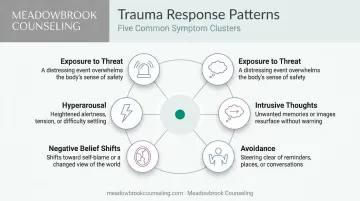
The Five Symptom Patterns Clinicians Watch For
Betrayal trauma symptoms tend to cluster into patterns similar to PTSD:
- Exposure to threat - discovery itself functions as a shock to the nervous system
- Intrusive thoughts - unwanted images, memories, or "flashes" of discovery moments
- Avoidance - dodging reminders, conversations, or places tied to the betrayal
- Negative belief shifts - "I can't trust anyone," "I'm not enough," "I'll never feel safe again"
- Hyperarousal - jumpiness, irritability, trouble sleeping or concentrating
Daily Signs and Symptoms of Betrayal Trauma
Survivors commonly report obsessive checking of phones or accounts, sudden swings between rage, numbness, and grief, and intrusive images that surface at random moments. Concentration suffers. Sleep becomes unreliable.
Because these symptoms operate at a survival level, generic talk therapy or jumping straight into couples counseling often falls short. Effective care typically starts with trauma-informed treatment, such as the EMDR and trauma-focused approaches used at Meadowbrook Counseling, before addressing the relationship itself. These reactions aren't weakness. They're your nervous system protecting you from further harm, exactly as it's designed to do.
Essential Tool #1: Regulating Your Nervous System
Stabilization, not forgiveness and not decision-making, is the true first stage of healing. Calming your nervous system has to happen before any deeper processing work can stick.
Betrayal disclosure triggers a fight/flight/freeze response. That response doesn't just fire once. It can resurface months later, triggered by a smell, a text notification, or an offhand comment. Because these triggers are unpredictable, having grounding tools ready matters as much as understanding why they happen.
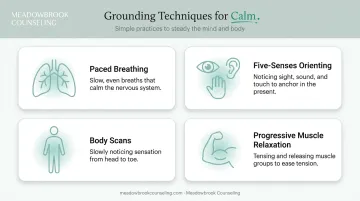
Grounding Techniques That Interrupt Panic
Therapists commonly teach:
- Paced breathing - slowing your exhale to activate the body's calming response
- Five-senses orienting - naming five things you see, four you feel, three you hear, two you smell, one you taste
- Body scans - moving attention slowly through the body to notice tension without judgment
- Progressive muscle relaxation - tensing and releasing muscle groups to discharge stored tension
Where Betrayal Lives in the Body
Many survivors describe a tight chest, nausea, or a literal "punch to the gut" feeling. Naming and locating these sensations, rather than pushing them away, reduces their intensity over time.
Basic stabilization habits matter more than they get credit for:
- Consistent sleep, even when your mind won't quiet down
- Regular nourishment, since skipping meals worsens dysregulation
- Reduced exposure to triggering content or conversations during acute crisis
A trauma-trained therapist can help you build a personalized regulation toolkit tailored to your specific triggers. At Meadowbrook Counseling, clinicians experienced in trauma and EMDR work alongside clients to strengthen these self-help techniques with professional guidance.
Essential Tool #2: EMDR and Trauma-Focused Therapies
Once your nervous system has some stability, trauma-focused therapies help you actually process what happened instead of just managing symptoms.
EMDR: Helping the Brain "Unstick" Traumatic Memories
EMDR, or Eye Movement Desensitization and Reprocessing, is a structured eight-phase therapy. It helps the brain reprocess traumatic memories tied to discovery moments, specific images, or triggering details that keep replaying.
A 2024 systematic review of EMDR research covering 16 studies found 11 reported EMDR outperformed control conditions for PTSD relief (PMC, 2024). The goal isn't to erase the memory. It's to help the brain file it away so triggers stop hijacking your day.

TF-CBT: Challenging the Self-Blame Spiral
Trauma-Focused Cognitive Behavioral Therapy helps identify and challenge distorted beliefs that betrayal often plants, like:
- "If I were more attractive, this wouldn't have happened"
- "I should have seen it sooner"
- "This is somehow my fault"
Rather than urging you to "just move on," TF-CBT gives your brain a structured way to examine these beliefs and replace them with something closer to the truth.
At Meadowbrook Counseling, EMDR-certified clinicians like Rosario Toral, ACMHC, tailor these approaches to each client's specific history rather than applying a one-size-fits-all protocol.
Healing through these modalities is not linear. Expect breakthrough days and hard days. Both are a normal part of trauma integration, not a sign that something's going wrong.
Essential Tool #3: Self-Compassion and Rebuilding Self-Trust
Betrayal doesn't just damage trust in your partner. It shatters trust in yourself. "I don't trust my own judgment anymore" is one of the most common things survivors say, and rebuilding that trust is a cornerstone of recovery.
Self-compassion is often the missing piece in this rebuilding process. Psychologist Kristin Neff's research identifies it as a learnable skill built on three components:
The Three Pillars of Self-Compassion
- Mindfulness - noticing painful thoughts without getting swallowed by them
- Self-kindness - treating yourself the way you'd treat a friend in pain
- Common humanity - recognizing that suffering, even this kind, connects you to others rather than isolating you

A 2021 meta-analysis of 12 studies found self-compassion-focused interventions were linked to meaningfully lower post-traumatic stress symptoms (PMC, 2021). It won't undo what happened, but it changes how you relate to your own pain.
A Practical Exercise
Try journaling with this prompt: "What did I sense but dismiss?"
This isn't about assigning blame to yourself. It's about gently reconnecting with your intuition, one honest observation at a time, without the harsh inner critic piling on.
A trauma-informed therapist can help you work through this exercise safely, especially when old memories or self-blame surface unexpectedly.
Essential Tool #4: Boundaries and Reconnecting with Your Body
Healthy boundaries help you reclaim agency. You get to decide what feels safe and what doesn't, rather than feeling pressured to monitor your own recovery or forgive on someone else's timeline.
The Body-Mind Disconnect After Sexual Betrayal
Sexual betrayal often creates a specific kind of disconnection: numbness, aversion to touch, or hyperarousal that shows up out of nowhere. Trauma-informed therapists recognize this pattern as a common response to betrayal trauma, one that affects both the nervous system and sense of sexual identity.
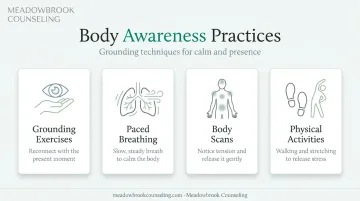
Gentle body-awareness practices can help rebuild a sense of safety in your body, at your own pace. There's no timeline to rush. A few starting points:
- Grounding exercises, such as naming five things you can see or feel right now
- Slow, paced breathing to calm nervous system activation
- Body scans that let you notice sensations without judgment
- Physical activities like walking or stretching that reconnect movement and safety
Therapists trained in EMDR and other trauma-focused modalities can guide this work at a pace that matches your readiness, rather than pushing you toward a predetermined goal.
Whether you stay in the relationship or leave it, boundary work and body reconnection remain essential. Neither depends on the outcome of the relationship itself.
Finding the Right Support System
Healing from betrayal trauma requires professional, trauma-informed support. Not silence. Not willpower. Not pressure to "move on" because enough time has passed. The right therapist makes the difference between feeling stuck and actually moving forward.
What to Look For in a Therapist
- Direct experience treating betrayal trauma, not just general relationship issues
- Training in trauma-focused modalities like EMDR or TF-CBT
- A personalized approach rather than a one-size-fits-all protocol
- Willingness to work at your pace, not a predetermined timeline
Meadowbrook Counseling offers personalized, evidence-based trauma therapy at locations across the country, including Utah, Washington, Arizona, Wisconsin, Massachusetts, and Texas. A dedicated intake team helps match clients to the right therapist and verifies insurance benefits before your first session, so financial uncertainty doesn't add to an already overwhelming situation.
Frequently Asked Questions
How do you recover from betrayal trauma?
Recovery starts with stabilization, followed by trauma processing (such as EMDR), rebuilding self-trust, and boundary work. A trauma-informed therapist trained in EMDR, like those at Meadowbrook Counseling, can guide this process, which unfolds gradually rather than all at once.
What is PTSD from betrayal trauma?
Betrayal trauma can produce PTSD-like symptoms including intrusive thoughts, hypervigilance, avoidance, and negative shifts in self-belief. This happens even though the threat is relational rather than physical.
How do you regulate your nervous system after betrayal?
Grounding techniques like paced breathing, five-senses orienting, and consistent sleep and nourishment routines help calm acute distress. A personalized toolkit built with a licensed therapist typically outperforms self-help alone.
Where do you feel betrayal in the body?
Common physical sensations include chest tightness, nausea, or a "gut punch" feeling. Naming these sensations, rather than avoiding them, is part of somatic healing.
How long does it take to heal from betrayal trauma?
Healing timelines vary widely from person to person. The process is non-linear, with good days and hard days, but consistent trauma-informed support shortens the acute crisis phase.
Can a relationship survive sexual betrayal?
Survival is possible with full transparency, accountability, and consistent behavior over time. But healing, whether the relationship continues or ends, starts with the betrayed partner's own recovery.