

If that sounds familiar, you've probably wondered whether traditional talk therapy can actually break the cycle, or just help you talk about it more articulately.
Relational Life Therapy (RLT) is a direct, action-oriented model developed by therapist Terry Real that's built specifically to interrupt these patterns fast. It's not the same as generic "relational therapy," and that distinction matters more than most people realize. This guide explains what RLT actually is, how it works, how it compares to other approaches, and what to look for when finding the right kind of support.
Key Takeaways
- RLT is a distinct model developed by Terry Real, different from general "relational therapy" or Relational-Cultural Theory
- It treats relationships as cycles of harmony, disharmony, and repair, focusing heavily on skillful repair
- Therapists take an active, opinionated stance rather than staying neutral
- RLT requires both partners to commit to honesty and isn't recommended when active abuse is present
- Whether or not a therapist is RLT-certified, evidence-based couples training matters most
What Is Relational Life Therapy?
RLT is a structured therapeutic model that blends systemic therapy, feminist psychology, and mindfulness practices to help couples build what Terry Real calls "full-respect living" — a relationship dynamic rooted in relational justice, where neither partner consistently dominates or defers.
Here's where people get confused: RLT is often lumped in with "relational therapy" in general, or with Relational-Cultural Theory (RCT), developed by psychologist Jean Baker Miller. These are not the same thing.
- Relational therapy is a broad umbrella term for any therapy centered on connection and attachment, and it can apply to individuals, couples, or families
- RCT is a broader psychological philosophy about human connection, not a structured couples treatment model
- RLT is Terry Real's specific, branded framework with defined phases, techniques, and a formal certification process
RLT's core lens views relationships as a repeating cycle: harmony, disharmony, and repair. Most couples get stuck in disharmony or avoid it altogether. RLT teaches partners to move through the repair phase deliberately, rather than sweeping conflict under the rug or letting resentment build.
At Meadowbrook Counseling, therapists who specialize in couples counseling often draw on this same repair-focused approach to help partners break unhealthy patterns.
History and Founder: Terry Real
Terry Real, a licensed clinical social worker, founded the Relational Life Institute (RLI) in March 2002 after decades of specializing in relationship issues and male depression. He's written several influential books, including I Don't Want to Talk About It (1997), How Can I Get Through to You? (2002), The New Rules of Marriage (2007), and Us (2022).
RLT is used in both couples and individual work. Therapists interested in practicing it go through a formal, multi-level certification program through the Relational Life Institute, involving structured training hours and supervised practicum work.
Core Principles and How RLT Works
RLT rests on a few interlocking ideas that shape everything from how sessions are structured to what the therapist actually says out loud.
One-Up, One-Down, and the "Same-As" Stance
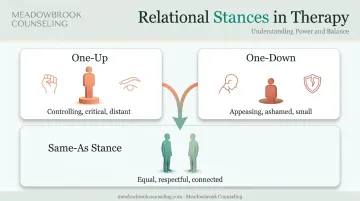
In most conflict cycles, one partner slips into a "one-up" position (grandiose, critical, controlling), while the other falls into a "one-down" position (shamed, small, appeasing).
RLT's goal is helping both partners land in a "same-as" stance, where neither one is above or below the other. Both feel equally valued and equally responsible for the relationship's health.
Psychological Patriarchy
The one-up and one-down positions rarely appear at random. Terry Real coined the term "psychological patriarchy" to describe how cultural gender conditioning shapes this dynamic, often invisibly. Men are frequently taught to suppress vulnerability and lead with control, while women are often conditioned to over-function emotionally and under-assert their needs. RLT names these patterns directly instead of treating them as personality quirks.
Joining Through the Truth
Naming patterns like psychological patriarchy out loud requires a therapist willing to speak directly, which brings us to RLT's signature move. Rather than staying detached, the RLT therapist practices "joining through the truth": direct, compassionate confrontation of what's actually happening in the room.
- The therapist points out patterns in real time instead of waiting for clients to discover them on their own
- Feedback stays specific and honest rather than softened into vague reflections
- Connection comes through honesty, and diplomacy never substitutes for it
This marks a sharp departure from the traditional therapeutic posture of neutrality. RLT therapists take sides, not one partner over the other, but the relationship's health over both partners' habitual defenses.
The Three-Phase RLT Process
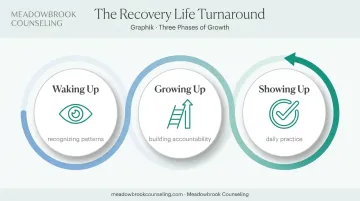
RLT generally moves through three broad phases:
- Waking Up — Partners learn to recognize destructive patterns that have become invisible through repetition, often tracing them back to family history or cultural conditioning they never questioned before.
- Growing Up — This phase builds emotional regulation, honest communication, and personal accountability. Each partner examines their own contribution to the conflict cycle instead of only pointing at the other.
- Showing Up — New patterns get reinforced through daily practice: rituals of connection, consistent use of RLT tools, and intentional repair after inevitable slip-ups.
Progress through these phases isn't always linear. Couples often cycle back through "waking up" moments even after months of "showing up" work, and that's expected, not a failure.
RLT vs. Other Therapy Approaches
Since "relational therapy" gets used loosely online, it's worth being precise: RLT is a specific type of couples-focused therapy, while "relational therapy" is the broader umbrella term that can apply to individual or couples work centered on connection and attachment.
RLT vs. CBT
| Aspect | CBT | RLT |
|---|---|---|
| Primary focus | Individual thought patterns | Interpersonal dynamics between partners |
| Therapist stance | Guided, structured, neutral | Active, direct, opinionated |
| Core method | Restructuring cognitive distortions | Confronting relational harm directly |
| Cultural lens | Minimal | Central (gender conditioning, patriarchy) |
Cognitive Behavioral Therapy helps individuals identify and restructure distorted thinking. RLT, by contrast, zooms out to the relationship system itself — how two people's conditioning collides, and how to repair the fallout that collision leaves behind.
Session Length and Structure
Traditional therapy typically runs the familiar 50-minute weekly session. RLT sessions commonly run longer, often around two hours, giving the therapist room to work through a conflict in real time rather than just discussing it abstractly. Combined with the more active, opinionated therapist stance, RLT sessions can feel noticeably more intense than a standard counseling hour.
What Not to Say in Couples Therapy
RLT's "joining through the truth" philosophy comes with some practical guardrails for what not to bring into the room:
- Avoid contempt — eye-rolling, sarcasm, or dismissive language shuts down repair before it starts
- Skip blame-only language: "You always..." statements put your partner on the defensive instead of inviting accountability
- Don't use the therapist as a referee — sessions aren't structured to declare a winner
- Resist scorekeeping — bringing up a list of past grievances derails the actual repair work
RLT sessions are built around personal accountability, not proving your partner wrong. Couples who walk in ready to own their part, rather than win the argument, tend to get the most out of this approach.
Who Can Benefit From RLT
RLT tends to help couples and individuals dealing with a specific cluster of issues:
- Communication breakdowns: recurring misunderstandings that escalate quickly
- Chronic conflict — the same argument on repeat, just with different triggers
- Trust and betrayal recovery, meaning rebuilding after infidelity or broken commitments
- Intimacy problems — emotional or physical disconnection over time
- Power imbalances, where one partner consistently dominates decisions or emotional space
RLT also addresses individual issues that show up within the relational context, including:
- Male depression (a specialty of Terry Real's since early in his career)
- Anxiety tied directly to relationship dynamics
- Family-of-origin wounds that resurface in adult partnerships
RLT works best for couples willing to engage directly and honestly — it asks a lot of both partners. It's generally considered less suitable when there's active abuse in the relationship, or when one partner has already decided to leave.
In those situations, individual support or a different therapeutic approach is usually more appropriate — something Meadowbrook Counseling's intake team can help identify when matching clients with the right therapist.
Finding the Right Therapist for Your Relationship
Whether or not a therapist carries a specific RLT certification, what matters most is finding someone trained in evidence-based, relationship-focused modalities who can create a space safe enough for both partners to be honest.
At Meadowbrook Counseling, couples therapy and marriage counseling are offered across offices in states including Utah, Washington, Arizona, Wisconsin, Massachusetts, and Texas. Therapists draw on relationship-focused approaches such as:
- Gottman Method for structured conflict and communication work
- Emotionally Focused Therapy (EFT) for attachment-based repair
- Internal Family Systems (IFS) for individual parts work within the relationship
- EMDR for relational or betrayal trauma

Each of these covers similar ground as RLT, including attachment, repair, and personal accountability, even when the specific label differs.
Meadowbrook's intake team helps match individuals and couples with therapists experienced in these relationship-focused approaches, with insurance verification handled before your first session.
Before committing to any therapist, ask a few direct questions:
- What's your specific training in couples work? Get the modality name, not just "relationship experience."
- How are your sessions structured? Length, frequency, and whether both partners attend together matter.
- Have you worked with issues like ours before? Betrayal, chronic conflict, and intimacy problems each require different skill sets.
Frequently Asked Questions
Is relational therapy a type of couples therapy?
Not exactly. "Relational therapy" is a broad approach usable with individuals, couples, or families. RLT specifically was designed with couples and relationship dynamics as its primary focus.
What is the difference between relational therapy and CBT?
CBT targets individual thought and behavior patterns. Relational therapy, and RLT specifically, focuses on interpersonal dynamics, communication patterns, and the overall health of the relationship.
What should you not say in couples therapy?
Avoid contempt, blame-only language, and trying to get the therapist to take sides. Productive sessions rely on honesty and personal accountability from both partners, not a verdict.
How long does RLT typically take to show results?
Many clients notice shifts within a handful of sessions. Lasting change, though, requires ongoing practice from both partners well beyond the therapy room.
Can RLT work if only one partner is willing to participate?
Yes, to a degree. Changing one partner's patterns can still shift the overall relationship system, even without full participation from the other partner.
Is Relational Life Therapy covered by insurance?
Coverage depends on the provider's licensure and diagnosis codes rather than the modality's specific name. Many practices, including Meadowbrook Counseling, verify your benefits before the first session so you know your costs upfront.