Sound familiar? Most couples aren't fighting about the text. They're fighting about something much older.
Attachment theory explains why small moments trigger outsized reactions. It traces back to the bonds we formed with caregivers as infants, bonds that quietly shape how we experience closeness, distance, and threat in every relationship since. Couples therapists increasingly use this framework, not to diagnose personalities, but to understand what's really driving the same argument couples have had 200 times.
This article breaks down the four attachment styles, how they play out in real relationships, and how attachment-focused couples therapy, particularly Emotionally Focused Therapy (EFT), helps partners build something more stable than "just communicating better."
Key Takeaways
- Attachment styles form in childhood and resurface in adult conflicts over chores, texting, and intimacy
- Most fights aren't about the surface issue, but unmet needs for safety and connection
- Attachment patterns can shift toward security through corrective relationships and therapy
- EFT is among the most researched couples therapy models, with recent meta-analyses showing strong outcomes across hundreds of couples
What Is Attachment Theory?
Psychiatrist John Bowlby first laid out attachment theory in his 1969 work Attachment and Loss, describing how infants build "internal working models" — mental blueprints for predicting whether caregivers will respond to their needs. Mary Ainsworth's research team tested this in their landmark 1978 Strange Situation studies. They watched how infants reacted to separation and reunion with caregivers, then classified the patterns that emerged.
Psychologists Cindy Hazan and Phillip Shaver extended this to adult romantic love in 1987, proposing that the same attachment system guiding infant-caregiver bonds also governs how adults experience trust, jealousy, and intimacy in romantic partnerships. That link between childhood bonding and adult romance is the foundation couples therapists still build on today.
It's a Pattern, Not a Personality Type
Here's what surprises most people: attachment isn't fixed. Someone might feel completely secure with one partner and anxious with another.
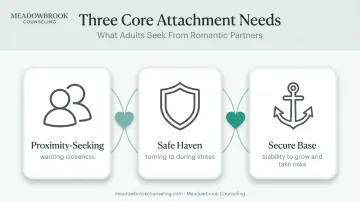
Adults still seek three things from romantic partners, mirroring what children need from caregivers:
- Proximity-seeking — wanting closeness, physically or emotionally
- A safe haven — a person to turn to during stress or fear
- A secure base — stability that allows someone to take risks and grow
Can Attachment Styles Really Change?
Yes. A 2016 study following 32 couples through EFT found that relationship-specific attachment avoidance decreased over the course of treatment, and partners who completed key emotional breakthroughs (what EFT calls "blamer-softening" events) also saw reductions in attachment anxiety.
Change isn't automatic, though. It requires:
- Awareness of your own triggers and patterns
- A corrective experience — proof that reaching out doesn't lead to rejection
- Repetition with a supportive partner or therapist until the new pattern feels safer than the old one
The Four Attachment Styles in Relationships
Couples therapists assess attachment style early on, not to slap a label on someone, but to understand what's fueling the same fight on repeat. Psychologists Bartholomew and Horowitz's 1991 model organizes these styles along two dimensions: anxiety and avoidance.
Secure Attachment
Securely attached partners are comfortable with both closeness and independence. They communicate needs directly and recover from conflict relatively quickly.
- Comfortable expressing vulnerability without fear of rejection
- Able to self-soothe and lean on a partner when needed
- Report higher relationship satisfaction on average
This is the model both partners work toward in therapy, not a personality you either have or don't.
Anxious Attachment
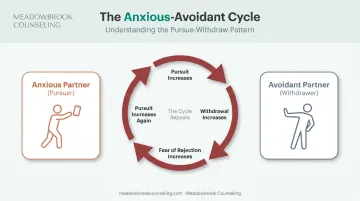
Anxiously attached partners fear abandonment and seek constant reassurance. Under stress, this often shows up as pursuit behavior: repeated texting, checking in, or needing immediate responses.
In distressed couples, this frequently creates the "pursuer" role in what therapists call the pursue-withdraw cycle, where one partner chases connection while the other retreats.
Avoidant Attachment
Avoidantly attached partners feel uneasy with too much closeness. They tend to be highly self-reliant and often withdraw during emotionally charged conversations.
This creates the flip side of the same cycle: the "withdrawer" role. The more the anxious partner pursues, the more the avoidant partner pulls back, which only intensifies the anxious partner's fear of rejection.
Disorganized Attachment
Disorganized (sometimes called fearful-avoidant) attachment involves wanting closeness while simultaneously fearing it. This pattern is often linked to inconsistent or frightening caregiving in childhood, and longitudinal attachment research connects early adverse caregiving environments to later attachment difficulties.
Because trauma is frequently present, this style typically benefits from trauma-informed care layered alongside standard attachment-based couples work, not swapped in for it. Meadowbrook Counseling's therapists often pair this approach with EMDR when early trauma is contributing to the pattern.
Recognizing Attachment Distress in Your Relationship
A few signs suggest attachment, not surface logistics, is driving the conflict:
- The same argument resurfaces repeatedly, regardless of the "topic"
- One partner consistently pursues while the other consistently withdraws
- Recovery from hurt feelings takes days instead of hours
Therapists sometimes call these patterns "attachment protests," the nervous system's way of signaling disconnection. It's not proof you're incompatible. It's proof your attachment systems are activated.
How Attachment Theory Is Applied in Couples Therapy
Dr. Sue Johnson developed Emotionally Focused Therapy (EFT) in the 1980s specifically to target the emotional bond between partners, not just teach better communication scripts. The idea: if you can change the underlying attachment dynamic, the surface arguments often resolve on their own.
The Therapy Process
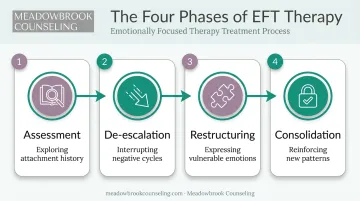
EFT's canonical model runs through three stages, though many clinicians describe it in four practical phases:
- Assessment — the therapist explores each partner's attachment history and how it shows up in the current relationship
- De-escalation — identifying and interrupting the negative cycle (like pursue-withdraw) that keeps both partners stuck
- Restructuring — helping partners express the vulnerable emotions underneath the anger, so bids for connection land differently
- Consolidation — reinforcing the new pattern through practice and recognizing early warning signs of slipping back into old habits
Some clinicians use structured tools like the Couple Attachment Interview, a research-backed method for mapping attachment representations within a specific relationship, though this varies by therapist and practice.
At Meadowbrook Counseling, therapists often layer additional evidence-based modalities into this process. For couples where past trauma is affecting present-day security, clinicians may integrate EMDR alongside attachment-focused work.
This combined approach addresses the individual trauma wound and the relational pattern side by side, rather than treating them as separate problems.
Does Attachment-Focused Therapy Actually Work?
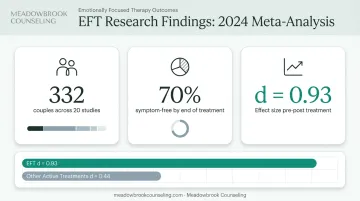
The research backs this up. A 2024 meta-analysis of 20 studies covering 332 couples found EFT produced a pre-post effect size of d = 0.93, with meaningful gains even compared to other active treatments (d = 0.44).
Key findings include:
- 70% of couples were symptom-free by the end of treatment
- EFT outperformed other active treatment approaches on average outcomes
- A small 2013 fMRI study of 23 distressed couples found brain-level changes after treatment
In that fMRI study, simple partner handholding changed how partners' brains processed threat signals after EFT. Touch became a more effective calming cue than before treatment. That's a narrow lab finding, not proof EFT fixes all stress, but it points to something real: therapy can change how partners physically soothe each other, not just how they talk.
Finding the Right Therapist for Attachment-Focused Couples Therapy
Not every couples therapist practices attachment-based work. General communication coaching and attachment-focused therapy are different tools solving different problems, so knowing the difference matters when choosing a provider.
Look for therapists who:
- Have specific training in EFT, Gottman Method, or another attachment-based modality (not just "couples counseling" broadly)
- Can speak clearly about how they'd approach your specific pursue-withdraw pattern
- Have experience with trauma-informed care if past wounds are part of the picture
Meadowbrook Counseling was built around this kind of matching process, connecting couples with therapists experienced in evidence-based, personalized approaches. Several integrate EFT, Gottman Method, IFS, or EMDR depending on what a couple needs.
The practice also verifies insurance benefits before the first session. This removes one of the biggest barriers to starting care: uncertainty over cost.
With offices across Utah, Massachusetts, Idaho, Texas, Florida, Colorado, Wisconsin, Washington, and Arizona, plus telehealth options, couples don't need to live near a major city to access this kind of specialized support.
Frequently Asked Questions
What therapy is best for attachment styles?
Emotionally Focused Therapy (EFT) is the most researched, widely-used approach for addressing attachment patterns in couples. EMDR and Internal Family Systems (IFS) can help address underlying individual trauma that complicates attachment security.
Can attachment styles change over time?
Yes. Consistent corrective relational experiences, whether through therapy or a securely attached partner, can shift someone from an insecure pattern toward greater security over time.
How do I know what my attachment style is?
Pay attention to how you respond to closeness, conflict, and distance in relationships. Do you seek reassurance, pull away, or feel steady? Therapists typically assess this more formally in early sessions.
How long does attachment-focused couples therapy take?
Timelines vary, but many couples see meaningful progress within roughly 8 to 20 sessions, depending on relationship history and how complex the underlying patterns are.
Is EFT the same as attachment-based couples therapy?
Not quite. EFT is one specific, well-researched model within the broader category of attachment-based couples therapy. Other approaches also draw on attachment theory without following EFT's exact structure.
Does insurance cover couples therapy for attachment issues?
Coverage varies significantly by plan and provider. Meadowbrook Counseling verifies your insurance benefits before your first session, so you know what to expect financially before starting treatment.