Many families struggle to understand this. A loved one might be visibly underweight yet insist they look "fine" or even "too big." That disconnect can feel frightening and confusing for everyone involved, including the person living inside it.
This guide breaks down what body image looks like in anorexia, the signs worth watching for, why the distortion happens, and how therapy can help rebuild a healthier relationship with food and self-perception.
Key Takeaways
- Anorexia involves a genuine misperception of body size, not simply a desire to be thinner
- Negative body image both fuels anorexia and keeps it going once it starts
- Behavioral, physical, and emotional warning signs often appear before a formal diagnosis
- Evidence-based therapy, including CBT, can help rebuild body image even after weight is restored
What Is Body Image, and How Does It Connect to Anorexia?
Body image is more than a passing thought about appearance. It's the combination of what someone perceives, believes, and feels about their own body, along with the behaviors that follow from those feelings. This starts forming in childhood, long before most people ever diet.
Healthy body image means accepting your body's shape and size, even on off days. Negative body image looks different: persistent shame, anxiety, and self-consciousness about how you look, regardless of what your body actually looks like.
Anorexia takes this a step further. According to the National Eating Disorders Association, body image disturbance is a defining clinical feature, not a peripheral symptom.
Distortion, Not Just Dissatisfaction
This is where anorexia diverges from ordinary body insecurity. Someone with anorexia often has a genuine perceptual misfire, believing they're larger than they are even at a critically low weight.
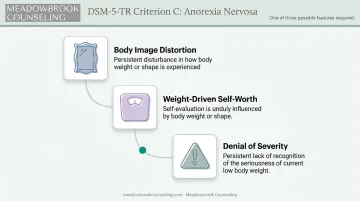
This distortion is written directly into the diagnostic criteria. The DSM-5-TR lists it as one of three possible features under Criterion C:
- Body image distortion: A persistent misperception of one's own shape or size
- Weight-driven self-worth: Letting body weight or shape determine self-esteem
- Denial of severity: Failing to recognize the medical seriousness of being underweight
Clinical studies using body-size estimation tasks have found that people with anorexia consistently overestimate their own width compared to control groups, though these come from small research samples rather than universal figures.
This measurable perceptual difference is what separates anorexia from typical dieting or appearance insecurity, not vanity or stubbornness.
What Does Anorexia Look Like? Recognizing the Signs
Anorexia rarely announces itself with one obvious symptom. Instead, it shows up as a cluster of physical, behavioral, and psychological signs that build over time.
Physical Signs
The body keeps a record of prolonged restriction, even when someone insists they're okay. Watch for:
- Noticeable weight loss or persistently low weight for the person's build
- Fatigue, dizziness, or fainting spells
- Hair thinning or dry, yellowish skin
- Sensitivity to cold, even in warm environments
- Irregular heartbeat or low blood pressure
The medical stakes are real. Mayo Clinic identifies heart complications and suicide as the leading causes of anorexia-related death, and one clinical report found bradycardia (an abnormally slow heart rate) in 68% of a small sample of adolescents with anorexia.
Bone density loss is common too, raising fracture risk well beyond what's typical for someone's age.
Behavioral Signs
Behavior often shifts before anyone notices the weight change. Common patterns include:
- Skipping meals or claiming to have already eaten
- Rigid food rituals, such as cutting food into tiny pieces or eating in a specific order
- Avoiding social situations that involve food
- Compulsive or excessive exercise, even when injured or exhausted
- Lying about how much (or how little) was eaten
Psychological and Body Image Signs
This is where the distortion lives. Look for an intense fear of weight gain that doesn't respond to reassurance, frequent mirror-checking or body measuring, and a running internal monologue that's harshly critical of appearance.
Here's the part families often miss: someone can look "fine," even underweight-but-functional, and still be in serious danger. Severity isn't visible on the outside. And anorexia doesn't have one look. It affects people of any gender, size, age, or background, though research shows a lifetime prevalence of 0.9% in women and 0.3% in men, with a typical onset around age 18.
Recognizing these signs is the first step. Because anorexia is rarely something someone can will themselves out of, a licensed therapist trained in eating disorder treatment can help identify severity and guide next steps toward recovery.
How Distorted Body Image Fuels the Anorexia Cycle
Body image distortion doesn't just sit quietly in the background. It actively drives the disorder forward through a reinforcing loop.
Here's how it typically plays out:
- Negative body image creates intense anxiety about size or shape
- Restriction (or excessive exercise) temporarily eases that anxiety
- Weight loss reinforces the behavior, making it feel "successful"
- Starvation itself intensifies rigid thinking and distorted self-perception
- The cycle repeats, often getting harder to break each time
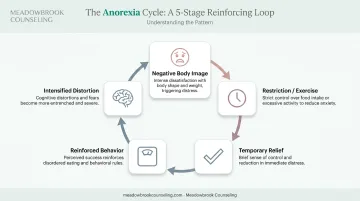
A systematic review of body image disturbance found consistent evidence linking cognitive-affective body dissatisfaction to both the onset and persistence of anorexia. This evidence is largely observational, though: dissatisfaction alone doesn't cause anorexia. It's one piece of a larger puzzle.
Why It Doesn't Just Disappear With Weight Restoration
Here's something that surprises a lot of families: gaining weight back doesn't automatically fix body image. Research on adolescents with anorexia found that perceptual body-size overestimation improved with treatment and weight gain, but often remained elevated compared to peers without the disorder.
This matters clinically. Body image work needs to be its own treatment focus, not an assumed side effect of nutritional recovery.
The Comparison Culture Problem
Social media doesn't cause anorexia on its own, but it can pour fuel on an existing fire. A meta-analysis covering over 55,000 participants found a moderate link between online social comparison and worse body image or disordered eating outcomes. Pro-anorexia content specifically has been tied to lower self-esteem and more disordered attitudes in people already vulnerable.
Because this cycle can take hold before someone meets full diagnostic criteria, addressing body image concerns early matters. A therapist trained in eating disorder treatment can help interrupt the loop before restriction and distorted self-perception become further entrenched.
Risk Factors That Increase Vulnerability
No single factor causes anorexia. It's typically a mix of biology, environment, and experience. That said, certain factors show up repeatedly in the research:
- Family dynamics: Frequent comments about weight or appearance, even well-meaning ones, can increase risk
- Trauma history: A meta-analysis of 30 studies found childhood maltreatment associated with roughly 1.89 times higher odds of developing anorexia
- Appearance-focused activities: Certain sports and performance environments emphasize leanness in ways that can heighten body dissatisfaction
- Societal and cultural pressure: Weight stigma and diet culture normalize disordered behaviors, making early warning signs harder to spot
Families are not to blame for causing anorexia. Research consistently shows they're often the most valuable ally in recovery, which is why family-inclusive approaches are a core part of treatment.
Some groups carry a disproportionate burden:
| Population | Finding |
|---|---|
| Adolescent girls | 46% report body dissatisfaction vs. 26% of adolescent boys |
| LGBTQIA+ youth | 9% report an eating disorder diagnosis; another 29% suspect one undiagnosed |
| Athletes | Roughly 19% screen positive for disordered eating across 177 studies |
These numbers reflect risk, not destiny. Plenty of people in these groups never develop anorexia, and plenty outside them do. Understanding your own risk factors, rather than fearing them, is often the first step toward getting the right support.
Treatment: How Therapy Helps Rebuild Body Image and Recovery
Effective treatment has to work on two tracks at once: stabilizing physical health and untangling the distorted beliefs driving the behavior. Neither alone is usually enough.
Therapy Approaches That Target Body Image Directly
Cognitive Behavioral Therapy (CBT), particularly the enhanced version known as CBT-E, directly targets the overvaluation of shape and weight, along with the checking and avoidance behaviors that keep distortion alive. One adolescent-focused review found roughly 50% of patients reached remission at 12-month follow-up using this approach.
EMDR can help process trauma or deep-seated beliefs that feed body dissatisfaction, particularly when past experiences (bullying, abuse, or harsh comments about appearance) sit underneath the current distortion. The research base here is still developing: one randomized study of 86 eating disorder inpatients found EMDR added to residential care improved some body-image outcomes.
Still, the evidence isn't strong enough yet to call EMDR a stand-alone treatment for anorexia. It works best as part of a broader plan, not a replacement for it.
Both approaches address different layers of the same problem:
- CBT-E works well for challenging distorted thoughts about shape and weight through structured, skills-based sessions
- EMDR helps when past trauma or harsh comments about appearance are fueling the distortion
- Many treatment plans combine both, using CBT-E as the primary approach and EMDR to address underlying trauma
Finding the Right Support
Finding a therapist trained in these specific modalities is often the hardest part of getting started. At Meadowbrook Counseling, therapy for eating disorders and body image concerns is available across office locations in Utah, Washington, Arizona, Wisconsin, Massachusetts, and Texas, along with telehealth options. The practice's intake team works to match clients with therapists experienced in the modalities that matter most here, including CBT and EMDR, based on individual history and needs.

Because anorexia can require medical monitoring alongside outpatient therapy, discuss your specific situation directly with the intake team to confirm the level of care fits your needs.
Before your first session, Meadowbrook's team can help verify your insurance benefits, since coverage for eating disorder treatment can vary by plan and provider. A quick consultation is the fastest way to find the right fit and understand what your plan covers.
Frequently Asked Questions
What is an anorexic person's body image?
A person with anorexia often perceives their body as larger than it actually is, paired with an intense fear of weight gain. This dissatisfaction typically persists regardless of actual weight or size.
What does anorexia look like?
Anorexia looks like a mix of physical signs (weight loss, fatigue), behavioral signs (food restriction, excessive exercise), and psychological signs (fear of weight gain, body checking). These signs can appear very differently from person to person.
Can someone with anorexia have a positive body image?
It's uncommon but possible, particularly in early stages or later in recovery. Most people experience persistent body dissatisfaction until it's directly addressed through treatment.
Is body image distortion in anorexia the same as body dysmorphic disorder?
They're related but distinct. Body image distortion in anorexia centers specifically on weight and shape tied to eating behaviors, while body dysmorphic disorder typically involves preoccupation with other perceived appearance flaws.
How can I help a loved one who shows signs of anorexia and body image distortion?
Start with gentle, non-judgmental conversations and avoid commenting on weight or appearance, even positively. Encourage them to connect with a mental health professional, such as a therapist experienced in eating disorder treatment, and call 988 if you need immediate guidance on how to start.
Does body image improve with eating disorder treatment?
Yes, with consistent evidence-based therapy, body image can improve over time. It typically requires focused, ongoing work that goes beyond weight restoration alone.