

Whether it's childhood neglect, ongoing domestic violence, or a chaotic upbringing where safety never quite existed, complex trauma—often called CPTSD—builds up over time. That's part of why it feels so different from "typical" PTSD, and why standard trauma treatment sometimes falls flat.
Many people in therapy for complex trauma describe feeling stuck. Overwhelmed. Or caught in an internal tug-of-war: part of me wants to heal, part of me is terrified of what healing might mean.
That internal conflict isn't a treatment failure. It's actually useful information. Combining EMDR with parts work, such as Internal Family Systems (IFS), gives therapists a way to work with that conflict instead of around it. At Meadowbrook Counseling, EMDR-certified therapists use this kind of integrated approach to help clients process trauma at a pace their nervous system can actually tolerate.
Key Takeaways
- Complex trauma stems from repeated or prolonged adversity and often needs a more layered treatment approach than single-incident PTSD
- Standard EMDR can fall short for CPTSD clients who lack the stable, positive memories the model relies on for reprocessing
- Parts work helps identify protective and wounded parts of self, making trauma reprocessing feel safer
- Combining EMDR with IFS-style parts work can reduce dissociation and resistance during sessions
- Healing from complex trauma is achievable with the right pacing, modality, and therapist fit
Understanding Complex Trauma: What It Looks Like and Why It's Different
Complex trauma, or CPTSD, develops from repeated or prolonged traumatic experiences rather than a single event. Think childhood abuse, ongoing neglect, domestic violence, or years spent in an unpredictable or unsafe environment.
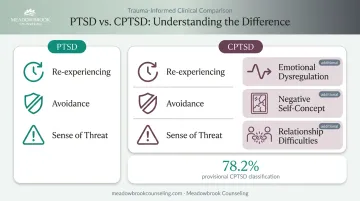
The ICD-11 draws a clear line between PTSD and CPTSD. Both involve re-experiencing symptoms, avoidance, and a sense of ongoing threat. CPTSD adds three more layers: difficulty regulating emotion, a persistently negative self-concept, and trouble sustaining relationships.
Common Signs of Complex Trauma
- Emotional dysregulation: swinging between numbness and overwhelm
- Chronic shame or a deep sense of being "broken"
- Difficulty trusting others or maintaining close relationships
- Dissociation, or feeling disconnected from your body or surroundings
- Hypervigilance, even in safe environments
- Negative self-beliefs that persist despite evidence to the contrary
CPTSD shows up more often in clinical settings than many people realize. One 2021 study of 458 Australian military members seeking PTSD treatment found that 78.2% received a provisional CPTSD classification, compared to 21.8% for PTSD alone. That's a treatment-seeking sample, not a general population figure, but it reflects what therapists see constantly: complex trauma is common among people who show up for help, and it often shows up as an internal split rather than a single symptom.
Many clients with this history also describe conflicting internal experiences: one part desperately wanting connection, another bracing for rejection or harm. That internal split is often the missing piece in why standard, single-method treatment can stall. Complex trauma frequently needs longer timelines and more than one therapeutic tool working together.
Why Standard EMDR Alone Can Fall Short for Complex Trauma
EMDR is built on the Adaptive Information Processing (AIP) model. The basic idea: the brain has a natural system for processing distressing experiences, but sometimes a memory gets "stuck," still carrying its original emotional charge, beliefs, and body sensations.
EMDR helps the brain link that stuck memory to more adaptive information already present in the person's system. Here's the catch for complex trauma survivors: if your childhood was the source of the wounding, you may not have much adaptive information to link to. Developmental disruptions during formative years can mean the healthy beliefs, safety, and self-worth EMDR relies on simply weren't built yet. Without that foundation, Phase 4 reprocessing can ask the brain to reach for resources that were never installed in the first place.
Where Clients Get Stuck in Standard EMDR
Phase 4 of EMDR, the active reprocessing stage, asks clients to hold a disturbing memory in mind while staying present enough to track their reactions. For complex trauma survivors, this is exactly what their nervous system learned to avoid.
Signs a client isn't ready for standard reprocessing include:
- Dissociating or "checking out" during sessions
- Emotional flooding that feels unmanageable
- Avoiding or canceling sessions before difficult work
- Feeling numb or blank when trying to access the target memory
The International Society for the Study of Trauma and Dissociation has documented real risks when unmodified EMDR is used too early with highly dissociative clients: breached dissociative barriers and rapid destabilization are among the most serious. That doesn't mean EMDR should be withheld from complex trauma clients. It means preparation, pacing, and sound clinical judgment matter. Meadowbrook Counseling's EMDR-certified therapists build this pacing into treatment planning from the first session.
What Is Parts Work? Understanding Internal Family Systems (IFS)
Parts work rests on a simple premise: we're not one unified voice inside. We're made up of different "parts," shaped by our experiences, that take on protective or wounded roles.
IFS, developed by Richard Schwartz, gives language to this internal landscape, and it's a framework many trauma-informed therapists—including those at Meadowbrook Counseling—use alongside EMDR to help clients understand what's driving their reactions.
The Core Concepts
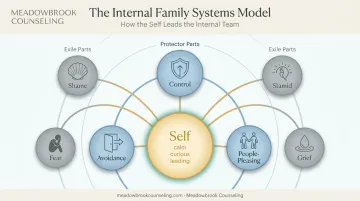
- Self: The core, unharmed essence in every person—calm, curious, and capable of leading the internal system
- Protector parts: Guard against pain, sometimes through control, avoidance, or people-pleasing
- Exile parts: Hold the original wounds—shame, fear, grief—often pushed into hiding because they feel too overwhelming
A helpful analogy: think of your internal system like a sports team without a coach. When parts are running the show unsupervised, you get chaos—one part sabotaging what another part just built. When Self is leading, the team plays with cooperation and direction instead of infighting.
A common myth: parts work tries to get rid of difficult parts. It doesn't. Even the part of you that pushes people away or numbs out with distraction is trying to protect you. IFS helps that part trust that it can step back into a healthier role, not disappear entirely.
Parts work also isn't reserved for severe trauma. The same framework helps with everyday anxiety, self-criticism, and stress—most people have an inner critic or an avoidant part long before trauma enters the picture.
How EMDR and Parts Work Combine for Deeper Healing
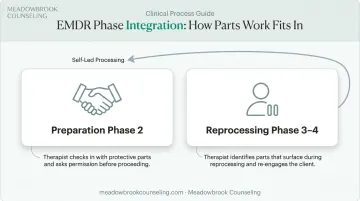
Integrating parts work into EMDR essentially adds a layer of consent. Instead of moving straight into reprocessing, the therapist checks in with protective parts first.
Preparation Phase (Phase 2)
Before any trauma memory gets targeted, the therapist helps the client identify which parts feel protective of that memory and why.
- What is this part afraid will happen if we process this memory?
- Does it need reassurance, or more time, before agreeing to step back?
Building this trust upfront often prevents mid-session shutdowns once reprocessing begins.
Reprocessing Phase (Phase 3–4)
If a client dissociates, goes blank, or gets stuck looping on the same distressing content, a parts-informed therapist doesn't push through it. They might gently ask, "I wonder if a part of you showed up just now?"
That single question can shift a client from frozen to re-engaged, because it names what's happening without judgment.
This approach doesn't replace EMDR's eight-phase structure. It makes that structure more responsive to each client's internal system. Research on the combined approach is still early—EMDRIA's 2024 review notes that direct EMDR-IFS evidence currently consists mainly of case studies, not large controlled trials.
One frequently cited case illustrates this early evidence: a client with PTSD, depression, and anxiety received intensive EMDR combined with ego-state work, a related parts-based method. After 25.5 treatment hours, depression scores dropped from 46 to 4 within six months. It's one case, not proof of a universal outcome, but it shows the kind of clinical results driving interest in this integration.
What to Expect in Treatment and Finding the Right Therapist
Healing from complex trauma isn't fast. That's worth saying plainly, because a lot of people quit therapy expecting quick relief and feel defeated when it doesn't arrive in six sessions.
Instead, progress tends to show up in smaller, cumulative shifts. With the right approach, that progress typically looks like:
- Fewer dissociative episodes over time
- Increased capacity to feel difficult emotions without shutting down
- More stable relationships and reduced reactivity
- A gradual shift from shame-based self-talk to something more compassionate
Not Every EMDR Therapist Works This Way
EMDR certification alone doesn't guarantee parts-work integration. Some therapists follow the standard protocol exclusively; others incorporate IFS, ego-state work, or somatic approaches depending on the client's presentation. If you have a history of dissociation or complex trauma, it's worth asking directly whether a therapist modifies EMDR for that population.
Before booking, consider asking a prospective therapist:
- Do you adapt EMDR protocols for clients with dissociation or complex trauma?
- Do you integrate parts-work approaches like IFS or ego-state therapy when needed?
- How do you pace sessions for clients with a history of trauma?
At Meadowbrook Counseling, EMDR-certified therapists like Rosario Toral use evidence-based, individualized approaches shaped around each client's trauma history rather than a one-size-fits-all script. The practice also offers insurance verification support before your first session, so cost concerns don't become another barrier to starting care.
Frequently Asked Questions
How effective is EMDR for complex trauma?
EMDR can be effective for complex trauma when the standard protocol is modified for pacing, dissociation, and readiness. Research supports EMDR for PTSD broadly, but combining it with other approaches is often recommended for CPTSD specifically.
Can you heal from complex PTSD?
Yes. Healing is possible with consistent, trauma-informed treatment, though the timeline varies depending on your history and how long the trauma occurred. Progress is often gradual but measurable.
What does complex trauma look like?
Common signs include emotional dysregulation, chronic shame, relationship difficulties, dissociation, and persistent negative self-beliefs. These symptoms usually stem from repeated or prolonged adversity rather than one incident.
What is parts work in therapy?
Parts work helps clients understand and collaborate with different aspects of their inner experience, such as protective parts and wounded or "exiled" parts. The goal is internal cooperation, not eliminating any part of yourself.
How does combining EMDR with parts work differ from standard EMDR?
The combined approach adds steps to check in with protective parts before and during trauma reprocessing. This makes the process more collaborative and often more tolerable for clients with complex trauma.
Is EMDR safe for people who dissociate or have complex trauma?
Yes, when delivered by a therapist trained to assess dissociation and adjust pacing accordingly, such as the EMDR-certified clinicians at Meadowbrook Counseling. Unmodified, standard-pace EMDR can be destabilizing for highly dissociative clients, which is why therapist training matters.