
Introduction
Eating disorders affect more adults than most people realize. A nationally representative study of over 36,000 U.S. adults found lifetime prevalence rates of 0.80% for anorexia nervosa, 0.28% for bulimia nervosa, and 0.85% for binge eating disorder — numbers that translate to millions of people navigating these conditions well into adulthood.
Adults face a particular obstacle, though: eating disorders are widely perceived as conditions affecting teenagers. That assumption keeps many adults undiagnosed for years. Weight stigma, provider bias, and the competing demands of work and family all push treatment further out of reach.
This guide walks through the main disorder types, the therapies with the strongest evidence behind them, how levels of care work in practice, and what taking a first step toward treatment looks like for adults.
Key Takeaways
- Eating disorders in adults are treatable, and full recovery is achievable with the right care
- CBT and IPT are the most guideline-supported therapies; DBT, ACT, and EMDR serve as evidence-based adjuncts
- Treatment intensity — from weekly outpatient sessions to residential programs — is matched to clinical need, not diagnosis alone
- Lisdexamfetamine (Vyvanse) is the only FDA-approved medication specifically for binge eating disorder in adults
- Co-occurring conditions like anxiety, depression, and trauma are common and should be addressed alongside eating disorder treatment
Recognizing Eating Disorders in Adults: Types and Signs
The Four Main Diagnoses
Adults can develop or sustain any of the primary eating disorder diagnoses:
| Disorder | Core Features |
|---|---|
| Anorexia Nervosa (AN) | Severe food restriction, intense fear of weight gain, distorted body image; complications include cardiac and bone health issues |
| Bulimia Nervosa (BN) | Recurring binge-purge cycles (vomiting, laxatives, fasting, compulsive exercise) at least weekly |
| Binge Eating Disorder (BED) | Recurrent binge episodes with loss of control and significant distress, without compensatory behavior |
| ARFID | Restrictive intake driven by sensory aversions or fear of adverse consequences — not body image concerns |
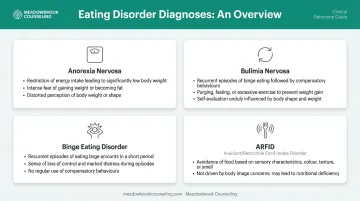
BED is actually the most prevalent, with lifetime estimates of 0.85% in U.S. adults, compared to 0.80% for AN and 0.28% for BN.
Warning Signs Adults Often Dismiss
Adults tend to rationalize behaviors that warrant clinical attention. Watch for:
- Secretive eating or hiding food
- Rigid, inflexible food rules that intensify over time
- Using food restriction or bingeing to manage stress, anxiety, or major life transitions
- Compulsive exercise that feels driven by guilt rather than enjoyment
- Significant distress around meals, restaurants, or social eating situations
Why Co-Occurring Conditions Matter
Eating disorders almost always occur alongside other mental health conditions. Data from 9,282 U.S. adults found that lifetime anxiety disorders affected 47.9% of people with AN, 80.6% with BN, and 65.1% with BED. Depression rates were similarly elevated across all three diagnoses.
That level of overlap has direct treatment implications. Co-occurring anxiety or depression affects which therapies are prioritized, whether medication is part of the plan, and how recovery is sequenced — which is why professional evaluation matters before beginning treatment.
Evidence-Based Therapies for Eating Disorder Treatment
Cognitive Behavioral Therapy (CBT)
CBT is the most extensively researched therapy for eating disorders in adults, and the American Psychiatric Association recommends it as a primary treatment for both BN and BED. It targets distorted thinking patterns around food, body image, and self-worth — and works to replace them with more accurate, flexible beliefs.
Enhanced CBT (CBT-E) is a transdiagnostic adaptation developed specifically for eating disorders. It addresses not just food behaviors but the psychological mechanisms — perfectionism, low self-esteem, interpersonal difficulties — that maintain the disorder across diagnoses.
Dialectical Behavior Therapy (DBT)
DBT was originally developed for borderline personality disorder, but its core skills translate directly to eating disorder treatment. The focus is on:
- Identifying and managing intense emotions without turning to food as a coping tool
- Surviving difficult moments without bingeing, purging, or restricting
- Navigating relationships without triggering eating disorder behaviors
DBT is particularly relevant for adults dealing with co-occurring mood disorders or a history of self-harm alongside disordered eating.
ACT, IPT, and Trauma-Focused Approaches
Acceptance and Commitment Therapy (ACT) helps adults identify what genuinely matters to them and learn to sit with uncomfortable thoughts about food and body image without acting on them destructively. It's especially useful for adults who have struggled with eating disorders for years and feel stuck in cycles that standard CBT hasn't fully broken.
Interpersonal Psychotherapy (IPT) addresses how relationship conflicts, life transitions, and grief contribute to eating disorder behaviors. The APA recommends CBT or IPT — individually or in groups — for BED, and IPT also has solid evidence for BN.
For adults whose eating disorder is rooted in past trauma, EMDR (Eye Movement Desensitization and Reprocessing) may be integrated into treatment. A 2024 systematic review of 14 studies found preliminary evidence of symptom reduction, though the evidence base is smaller than CBT's.
EMDR works best as an adjunct to — not a replacement for — primary eating disorder therapy. Clinicians at Meadowbrook Counseling are trained in EMDR, which can be relevant when trauma underlies disordered eating patterns.
Levels of Care: From Outpatient to Residential Treatment
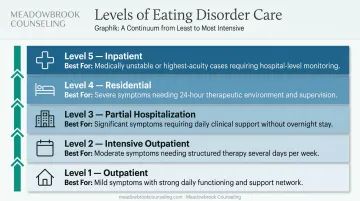
Eating disorder treatment exists on a continuum. The right starting point depends on medical stability, symptom severity, and personal circumstances — not on how "serious" someone believes their eating disorder is.
The Five Levels of Care
| Level | What It Involves | Best For |
|---|---|---|
| Outpatient (OP) | Weekly individual therapy sessions; patient lives independently | Medically stable adults with moderate symptoms |
| Intensive Outpatient (IOP) | Multiple sessions per week across therapy and skills groups | Adults who need more support but can maintain work/family obligations |
| Partial Hospitalization (PHP) | Structured day programming (~5 days/week, 6–8 hours/day) including individual therapy, group therapy, nutrition counseling, and supervised meals | Adults needing significant structure without overnight care |
| Residential | 24-hour therapeutic support in a nonhospital setting | Adults unable to interrupt harmful behaviors independently |
| Inpatient | Hospital-level medical and psychiatric stabilization | Acute medical complications requiring immediate intervention |
What Determines Placement
Clinicians weigh multiple factors when recommending a level of care:
- Medical instability (vital signs, cardiac concerns, weight trajectory)
- Psychiatric symptoms and suicide risk
- Frequency and severity of compensatory behaviors
- Prior treatment history and response
- Home environment and available support
- Geographic access to specialty care
These factors matter more than weight alone. An adult with BED may need residential-level support even without a low BMI, while someone with AN may be appropriate for outpatient care if they're medically stable and making consistent progress.
Meadowbrook Counseling provides outpatient eating disorder treatment. For adults whose evaluation points to a higher level of care, the right next step is connecting with a provider who specializes in that level — and getting a proper clinical assessment to determine where to start.
Medication and Nutritional Support in Eating Disorder Treatment
Medication as an Adjunct
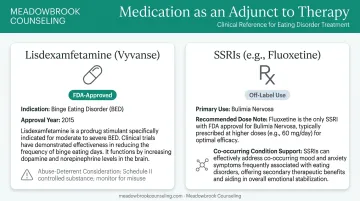
Medication does not replace therapy for eating disorders, but it can meaningfully support recovery in specific contexts:
- Lisdexamfetamine (Vyvanse): FDA-approved on January 30, 2015, for moderate-to-severe binge eating disorder in adults — the only medication with this specific indication. It is not approved or recommended for weight loss and carries a boxed warning for abuse potential.
- SSRIs (particularly fluoxetine at 60 mg daily): Recommended by the APA for adult bulimia nervosa, typically combined with eating-disorder-focused CBT. SSRIs also help manage co-occurring anxiety and depression.
Prescribing decisions always require individual clinical assessment. Because Meadowbrook Counseling is a therapy-focused practice, adults who need medication management would typically coordinate with a prescribing physician or psychiatrist alongside their therapy work.
Medication is one piece of a larger puzzle. Nutritional support works alongside it to address the physical and behavioral dimensions of recovery.
The Role of Registered Dietitians
A registered dietitian (RD) with eating disorder specialization is a core member of effective treatment teams. Nutrition counseling with an RD addresses:
- Establishing regular, structured eating patterns
- Correcting nutritional deficiencies
- Rebuilding a flexible, non-fearful relationship with food
- Coordinating meal planning with the goals of psychotherapy
When therapy, medical monitoring, and nutritional support work together, each element reinforces the others — which is why coordinated care between providers matters as much as any individual treatment.
What to Expect in Eating Disorder Recovery
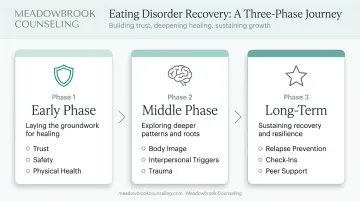
Recovery from an eating disorder is not a straight line. A 2023 rapid review reported overall recovery estimates of roughly 52% for AN, 50–52% for BN, and 60–64% for BED, with follow-up periods and recovery definitions varying across studies. A 22-year longitudinal cohort found that recovery continued well past the 9-year mark — meaning the window for improvement doesn't close.
Early Phase: Building a Foundation
The first weeks of treatment are often uncomfortable. Adults are disrupting long-established coping behaviors, which can feel destabilizing before it feels relieving. The focus during this phase is:
- Building trust with the treatment team
- Establishing basic safety around food and eating
- Addressing immediate physical health concerns
Slow, incremental progress is the norm here — not the exception.
Middle Phase: Deeper Work
Once stability improves, therapy shifts toward the psychological roots of the disorder. This is where modalities like EMDR, ACT, and deeper CBT work tend to play a larger role. Adults begin to separate food from shame — learning to eat without the constant mental negotiation that defined earlier patterns.
This phase often targets:
- Body image distortions and distorted self-evaluation
- Interpersonal triggers — conflict avoidance, people-pleasing, isolation
- Unresolved trauma that the eating disorder was managing
Long-Term Recovery and Relapse Prevention
Symptom relief marks progress, not completion. Active treatment eventually gives way to maintenance — and that transition requires its own structure. A 2025 systematic review estimated that about 26% of people who recover from an eating disorder experience a relapse, which is why a concrete prevention plan matters from the start.
Long-term maintenance often includes:
- Periodic therapy check-ins
- Peer support groups
- A clear plan for recognizing early warning signs
- Identified steps to take if behaviors begin returning
Taking the First Step: How to Start Eating Disorder Treatment
Getting an Initial Evaluation
The first step is a comprehensive clinical assessment — typically through a primary care physician or a licensed mental health professional. This evaluation reviews eating behaviors, weight history, compensatory behaviors, psychiatric symptoms, physical health concerns, and any co-occurring conditions.
You do not need to have a "severe" eating disorder to deserve evaluation. If food and eating are causing distress, affecting daily life, or impacting physical health, that's enough reason to seek professional input.
Navigating Common Barriers
Knowing you need help and actually reaching out are two different things. Adults often delay treatment because of practical and emotional obstacles:
- Insurance uncertainty: Meadowbrook Counseling verifies your insurance benefits before your first session and accepts major plans including Aetna, BCBS, Cigna, UnitedHealthcare, and several Medicaid plans. You can call 801-655-5450 or visit meadowbrookcounseling.com/contact to confirm your coverage.
- Fear of judgment: A trained eating disorder therapist won't shame you for what you're experiencing. The initial conversation is about understanding your situation — nothing more.
- Not knowing what to say: Stating simply that you've been struggling with your relationship with food — and that it's affecting your life — is more than enough to begin.
Crisis Resources
If you or someone you know is in acute distress:
- ANAD Helpline: 1-888-375-7767 (Monday–Friday, 9 a.m.–9 p.m. Central Time) — emotional support and treatment referrals
- 988 Suicide & Crisis Lifeline: Call or text 988, available 24/7
- NEDA: Offers a free confidential screening tool and treatment directory at nationaleatingdisorders.org/get-help
Frequently Asked Questions
How do you deal with an eating disorder?
Dealing with an eating disorder requires professional support — therapy, medical monitoring, and often nutritional counseling. CBT and DBT are the most evidence-supported starting points, though the right approach depends on the specific diagnosis and any co-occurring conditions.
What should I expect in eating disorder recovery?
Recovery is gradual and non-linear, involving therapy, nutritional restoration, and emotional healing. Most adults see meaningful progress over months, with ongoing support often continuing well into a maintenance phase.
What medication is used for binge eating disorder?
Lisdexamfetamine (Vyvanse) is the only FDA-approved medication specifically for moderate-to-severe binge eating disorder in adults. SSRIs may also be prescribed to address co-occurring anxiety or depression, typically alongside therapy.
Can adults fully recover from an eating disorder?
Yes. Full recovery is possible at any age and any stage of illness. Research shows that many adults achieve lasting recovery when underlying psychological factors are addressed consistently — including those who have struggled for years.
What is the difference between outpatient and residential treatment for eating disorders?
Outpatient treatment involves therapy sessions a few times per week while the person lives at home. Residential treatment provides 24-hour structured care (meals, supervision, and intensive therapy) for adults who cannot safely manage harmful behaviors in an unstructured setting.
How do I know if I need professional help for an eating disorder?
If eating behaviors are causing distress, interfering with daily functioning, or affecting your physical health, a professional evaluation is appropriate. A therapist or physician can assess whether a diagnosis is present and recommend the right level of care. Early outreach leads to better outcomes — waiting until things feel unbearable is never a requirement.