
Trauma, anxiety, depression, and everyday life stressors can feel isolating, but effective, evidence-based therapy exists to help. The challenge? Sorting through a maze of acronyms like CBT, EMDR, and DBT to figure out what actually applies to you.
This guide breaks down how these conditions show up, which therapy approaches have real evidence behind them, and how to find a therapist who fits. We'll also touch on how Meadowbrook Counseling approaches personalized care for clients working through these exact challenges.
Key Takeaways
- Trauma, anxiety, and depression often share symptoms, but each has distinct root causes requiring different treatment
- CBT and EMDR show the strongest evidence for trauma and anxiety, while DBT and ACT aid emotional regulation
- The relationship with your therapist predicts outcomes as much as the specific technique used
- Life stressors like divorce or grief don't need a formal diagnosis to justify seeking therapy
Understanding Trauma, Anxiety, Depression, and Life Stressors
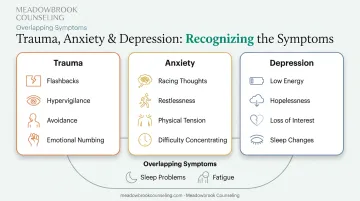
These conditions overlap more than most people realize. Sleep problems, irritability, fatigue, and trouble concentrating show up across trauma, anxiety, and depression alike. That overlap is exactly why guessing at a diagnosis rarely works.
Signs You May Be Struggling with Trauma
Trauma responses tend to look different from garden-variety stress. Common signs include:
- Flashbacks or intrusive memories that feel like they're happening again
- Hypervigilance — feeling constantly on edge or scanning for danger
- Emotional numbness or feeling disconnected from others
- Avoidance of people, places, or conversations tied to the event
- Negative self-image, including shame or guilt that doesn't match the situation
Trauma exposure alone doesn't equal PTSD, but the neurological impact is real. A 2023 scoping review found PTSD is consistently associated with reduced hippocampal volume and altered amygdala function, which affects how the brain encodes fear and processes emotional memory.
Some of these brain differences may even predate the trauma itself, making them vulnerability markers rather than pure damage. A trauma-informed therapist can help determine what's happening and why.
Signs You May Be Struggling with Anxiety or Depression
Anxiety and depression pull in almost opposite directions.
Anxiety tends to be future-focused:
- Racing thoughts about what might go wrong
- Restlessness or feeling keyed up
- Physical tension, trembling, or a racing heart
- Worry that's hard to control and spreads across situations
Depression tends to be more about absence than overactivity:
- Persistent sadness or a flat, empty mood
- Loss of interest in things you used to enjoy
- Low energy that sleep doesn't fix
- Hopelessness or difficulty concentrating
Signs Life Stressors Are Taking a Toll
Not every struggle fits neatly into a diagnosis, and that's fine — not every hard season needs one to justify getting help. Divorce, job loss, grief, a new baby, or a big move can all trigger real distress.
The American Psychological Association names these life transitions as common, legitimate reasons people seek psychotherapy. Therapy is just as valuable for navigating change as it is for managing crisis, which is why Meadowbrook Counseling's therapists work with clients across this full range, from PTSD and clinical depression to the disorientation of a major life transition.
How Trauma, Anxiety, and Depression Overlap (and Differ)
Here's the simplest way to separate them:
- Trauma is rooted in the past
- Anxiety is worried about the future
- Depression is stuck in a persistent low present
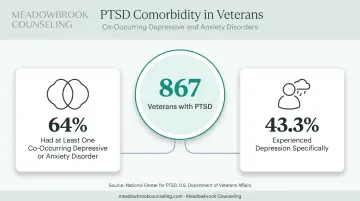
In practice, these rarely stay in their own lanes. Research on treatment-seeking veterans found that among 867 people with PTSD, 64% had at least one co-occurring depressive or anxiety disorder. Depression alone showed up in 43.3% of that sample. This overlap is why a proper intake assessment matters more than symptom-guessing.
A thorough assessment helps a therapist determine:
- Which condition is driving the others (trauma often needs to be addressed before depression symptoms fully resolve)
- Whether symptoms meet criteria for a formal diagnosis or reflect situational distress
- Which modality is likely to help fastest, based on your specific symptom pattern
Skipping this step and jumping straight to "I think I need EMDR" or "I probably just need CBT" can mean months of therapy aimed at the wrong target.
Evidence-Based Types of Therapy That Work
No single therapy works for everyone. Effective treatment fits your symptoms, your history, and honestly, your personality. Someone who wants structure and homework will respond differently than someone who needs a gentler, body-based approach first.
Cognitive Behavioral Therapy (CBT)
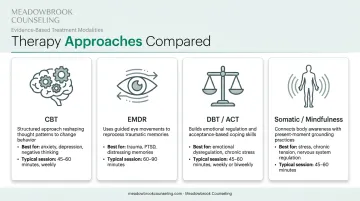
CBT identifies negative thought patterns and helps you reframe them. It's one of the most researched therapies available, widely used for anxiety, depression, and — in its trauma-focused form — PTSD.
- Structured and often short-term (many protocols run 8-15 sessions)
- Involves homework and active skill practice between sessions
- UK clinical guidelines specify 12-15 weekly sessions for generalized anxiety disorder and 8-12 sessions for adult trauma-focused CBT
EMDR (Eye Movement Desensitization and Reprocessing)
EMDR uses guided eye movements while a client briefly focuses on a traumatic memory, helping the brain reprocess it so it stops feeling as raw. It's not talk therapy in the traditional sense — it's more physiological, which is part of why it can reduce flashbacks and emotional distress relatively quickly.
Clinical guidelines from the VA and Department of Defense place EMDR among the top three strongly recommended manualized treatments for PTSD, alongside Cognitive Processing Therapy and Prolonged Exposure.
That physiological quality is exactly what draws clients who don't want to relive their trauma out loud in session. At Meadowbrook Counseling, EMDR-certified therapist Rosario Toral works with clients using this approach, drawing on her clinical training alongside experience as a certified Peer Recovery Specialist.
Dialectical Behavior Therapy (DBT) and Acceptance and Commitment Therapy (ACT)
DBT focuses on emotional regulation and distress tolerance, useful when emotions feel too big to manage. A pilot study found DBT skills training improved emotion regulation and anxiety symptoms in adults with high emotional dysregulation, though the evidence base here is still developing compared to PTSD-specific therapies.
ACT takes a different angle: acceptance of difficult thoughts paired with values-based action. A meta-analysis of 39 randomized controlled trials involving 1,821 participants found ACT outperformed control conditions across mixed diagnoses, with a moderate effect size.
Therapists often reach for DBT or ACT when the goal is building day-to-day coping skills rather than processing one specific traumatic event.
Somatic and Mindfulness-Based Approaches
Trauma and chronic stress don't just live in thoughts — they show up in the body as tension, a clenched jaw, or a stomach that's always in knots. Somatic approaches work directly with that physical experience.
Mindfulness-based approaches, meanwhile, help calm an overactive nervous system by building present-moment awareness instead of getting swept into future worry or past pain. A meta-analysis of 39 studies with 1,140 participants found mindfulness-based therapy produced meaningful reductions in anxiety and mood symptoms, with effect sizes around 0.6 for both, though clinicians generally rank it alongside — rather than ahead of — first-line PTSD treatments like EMDR and CBT.
How to Choose the Right Therapy and Therapist for You
There's no universal "best" therapy. The right fit depends on your preferences and where you're starting from.
Ask yourself:
- Do I want structure and practical tools, or deeper exploration of long-standing patterns?
- Am I ready to talk about painful memories directly, or do I need a gentler entry point first?
- Do I respond better to talk-based work, or does a body-based approach feel more accessible?
The therapeutic relationship itself is one of the strongest predictors of successful outcomes, often mattering more than the specific technique used. A large-scale meta-analysis covering 295 studies and more than 30,000 patients found a consistent link between therapeutic alliance and outcomes across treatment approaches and countries. Trust and collaboration matter enormously.
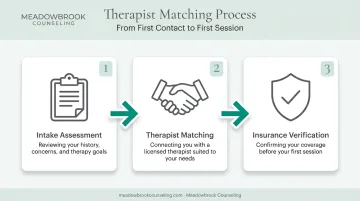
That's why a solid intake process matters before you ever start "doing the work." A good provider will:
- Start with an intake assessment covering your history, symptoms, and goals
- Match you with a therapist whose specialty fits your specific concerns
- Confirm the modality makes sense given your comfort level and readiness
At Meadowbrook Counseling, a dedicated intake team works to match clients with therapists suited to their specific needs — whether that's trauma-focused EMDR work, CBT for anxiety, or couples counseling. The team also verifies insurance benefits before your first session, so you're not stuck guessing what you'll owe. With offices across multiple states and telehealth options available, getting matched with the right specialist doesn't require overhauling your schedule.
What to Expect When You Start Therapy
The first few sessions usually aren't about diving straight into your hardest memories. They're about building rapport and helping your therapist understand your history and goals.
A few honest truths about what comes next:
- Progress isn't always linear. Clients often describe sudden gains, temporary plateaus, and stretches where things feel harder before they feel better. That's a normal part of processing difficult emotions, not a sign something's wrong.
- It's okay to switch therapists. Finding the right match matters more than sticking with one person or method out of politeness. If a session leaves you feeling unheard after giving it a genuine try, say something. Meadowbrook Counseling's intake team can help match you with a different therapist if needed.
- Consistency helps, but patience helps more. Structured therapies like CBT often show meaningful benefits within 12-16 weeks, though timelines vary based on symptom severity and how consistently you attend sessions.
Frequently Asked Questions
What therapy is best for trauma and anxiety?
CBT and trauma-focused CBT are commonly recommended for anxiety, while EMDR is often preferred for trauma involving flashbacks or intrusive memories. The best choice ultimately depends on your specific symptoms and comfort level with different approaches.
How long does therapy take to work for anxiety or depression?
Many structured therapies like CBT show measurable benefits within 12-16 weeks, with 12-15 weekly sessions. Timelines vary based on symptom severity and individual response.
Can therapy help with life stressors even without a diagnosed mental health condition?
Yes. Therapy is valuable for major life transitions like divorce, grief, job loss, or new parenthood, even without a formal diagnosis. You don't need to meet clinical criteria to benefit from support.
Is online therapy as effective as in-person therapy for trauma and anxiety?
Research generally supports comparable effectiveness for many conditions, with some studies finding videoconference PTSD treatment matches in-person outcomes. Meadowbrook Counseling offers both in-person and telehealth options for flexibility.
Will my insurance cover therapy for trauma, anxiety, or depression?
Most insurance plans include some mental health coverage, though specifics vary by plan, network, and location. Meadowbrook Counseling's team verifies your benefits before your first session so there's no guesswork about costs.
How do I know if a therapist is the right fit for me?
Feeling comfortable, trusting your therapist, and feeling genuinely heard in the first few sessions are strong indicators of good fit. If that's missing after a fair try, it's completely reasonable to request a different therapist.