Introduction
The worry doesn't announce itself. It's there when you wake up — something about a work deadline, your health, a conversation from yesterday. Tomorrow it'll be something else. For people living with Generalized Anxiety Disorder, this cycle runs continuously, even when nothing is actually wrong.
GAD is more than ordinary stress. It's persistent, hard to control, and exhausting in ways that are difficult to explain to someone who hasn't experienced it. Many people spend years managing physical symptoms — headaches, tension, disrupted sleep — before anyone connects them to anxiety.
This guide walks through what GAD actually is, how it gets diagnosed, and the full range of treatment options available, from therapy and medication to daily habits that support recovery.
Key Takeaways:
- GAD involves excessive, uncontrollable worry across multiple life areas for six or more months
- CBT is the most evidence-supported psychological treatment for GAD
- SSRIs and SNRIs are first-line medications, but therapy alone works well for many people
- Lifestyle changes support treatment — they don't replace it
- Getting help early leads to better outcomes; you don't need to wait until symptoms become severe
What Is Generalized Anxiety Disorder?
GAD is defined in the DSM-5 as excessive anxiety and worry about multiple areas of life — work, health, relationships, finances — occurring more days than not for at least six months, with difficulty controlling the worry. To meet the diagnostic threshold, adults must also experience at least three of six associated symptoms and show clinically significant distress or impairment in daily functioning.
Normal Worry vs. GAD
Everyone worries. The difference with GAD is proportion and persistence. A person without GAD might worry about a job interview for a few days; someone with GAD worries about their job, their health, their family, and a dozen other things simultaneously — for months on end, even without a specific trigger. The worry feels unmanageable and intrusive, disconnected from actual circumstances rather than proportionate to them.
Who Is Affected
According to the NIMH, 5.7% of U.S. adults will experience GAD at some point in their lifetime, with 2.7% affected in any given year. Women are diagnosed at nearly twice the rate of men — past-year prevalence is 3.4% for females versus 1.9% for males. Symptoms most commonly emerge in the early thirties, though GAD can develop at any age. Understanding who GAD affects — and how it's diagnosed — shapes the treatment decisions covered throughout this guide.
Recognizing GAD Symptoms: Mental and Physical Signs
GAD produces two overlapping categories of symptoms. Both matter for diagnosis, and both cause real impairment.
Psychological Symptoms
- Persistent, excessive worry that jumps across topics
- Difficulty controlling or stopping the worry
- Restlessness or feeling keyed up or on edge
- Irritability that's hard to explain
- Trouble concentrating, or mind going blank
Physical Symptoms
These are frequently overlooked or attributed to unrelated medical causes:
- Muscle tension and unexplained aches
- Chronic fatigue
- Headaches
- Sleep disturbances — trouble falling asleep, staying asleep, or waking unrefreshed
- Heart palpitations and sweating
These physical symptoms are often what prompts someone to seek help first. A person dealing with constant tension headaches and fatigue may spend months chasing a medical explanation before anxiety enters the picture.
Research from a Canadian primary-care sample found that only 52.5% of patients with GAD had received professional recognition of their condition in the prior year — a gap largely driven by how often GAD presents through physical complaints first.
How GAD Is Diagnosed
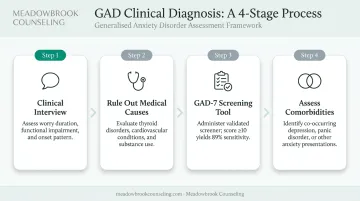
Diagnosis involves more than recognizing the symptoms. A mental health clinician or primary care provider will:
- Conduct a clinical interview — exploring the nature, duration, and scope of worry, and how much it interferes with daily functioning
- Rule out medical causes — thyroid disorders, cardiovascular conditions, and substance use can all mimic anxiety symptoms and need to be considered
- Use validated screening tools — the GAD-7 questionnaire is widely used; at a score of 10, it achieves 89% sensitivity and 82% specificity for detecting GAD
- Assess for comorbidities — GAD frequently co-occurs with other conditions that can complicate the clinical picture
Common Co-occurring Conditions
GAD frequently co-occurs with other disorders, which shapes treatment planning:
- Major depression: Present in 71% of primary-care patients with GAD in one study
- Substance use disorders: Nearly half of people with lifetime GAD also have a lifetime substance use disorder
- Panic disorder: Affects roughly 1 in 4 people with GAD, making combined screening standard practice
When these overlaps are identified early, clinicians can sequence or combine treatments — for example, addressing depression alongside anxiety rather than treating each in isolation.
Psychotherapy for GAD: The Foundation of Treatment
Psychotherapy is where most GAD treatment begins, and CBT is the most thoroughly studied option available.
How CBT Works for GAD
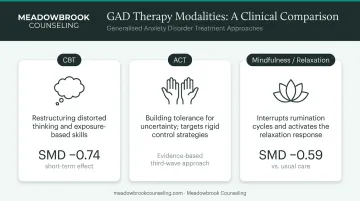
A 2024 network meta-analysis published in JAMA Psychiatry examined 65 randomized controlled trials involving over 5,000 adults. CBT outperformed usual care with a standardized mean difference of -0.74 short-term and -0.60 at 3–12 months — moderate-certainty evidence of durable benefit.
CBT for GAD has two core components:
- Restructuring distorted thinking: Targets patterns like catastrophizing and threat overestimation, replacing them with more accurate, balanced perspectives
- Reducing avoidance through exposure: Structured skills practice helps anxiety stop narrowing what someone can do and where they can go
NICE guidelines recommend 12–15 weekly sessions as a standard course, with flexibility based on individual progress.
Other Effective Modalities
CBT has the strongest evidence, but other approaches contribute meaningfully to treatment:
- ACT (Acceptance and Commitment Therapy): Builds tolerance for uncertainty rather than fighting against anxious thoughts — useful for people who struggle with rigid control strategies
- Mindfulness-based approaches: Help interrupt rumination cycles and shift attention away from worry spirals
- Relaxation training: Structured progressive muscle relaxation showed SMD -0.59 versus usual care in the same meta-analysis — lower certainty, but clinically useful
A Note on Combination Treatment
The research here is less straightforward than commonly assumed. One direct trial found that adding CBT to venlafaxine XR produced no significant advantage over medication alone for GAD. This doesn't mean combination treatment is never appropriate (particularly for partial responders or those with strong preferences), but the assumption that combined treatment is always superior isn't well-supported for GAD specifically. CBT monotherapy has clear, durable evidence and is a legitimate standalone option.
At Meadowbrook Counseling, therapists work across all of these evidence-based approaches — CBT, ACT, DBT, EMDR, and mindfulness — matching the method to each person's symptoms, history, and goals rather than applying a one-size-fits-all model.
Medication Options for Generalized Anxiety Disorder
For moderate-to-severe GAD — or when therapy alone isn't providing enough relief — medication can be an effective part of treatment.
First-Line Options: SSRIs and SNRIs
These are the medications with the strongest evidence and guideline support for GAD:
| Medication | Class | FDA GAD Approval |
|---|---|---|
| Escitalopram (Lexapro) | SSRI | Yes |
| Paroxetine (Paxil) | SSRI | Yes |
| Sertraline (Zoloft) | SSRI | Not for GAD specifically |
| Duloxetine (Cymbalta) | SNRI | Yes |
| Venlafaxine XR (Effexor) | SNRI | Yes |
SSRIs and SNRIs work by increasing the availability of serotonin and norepinephrine — neurotransmitters involved in mood regulation. Effects aren't immediate; improvement typically takes several weeks, and dosage adjustments are common. Staying on medication long enough matters: across six GAD relapse-prevention studies, people who stopped antidepressants after responding were 4.2 times more likely to relapse over 8–52 weeks.
Buspirone
Buspirone is a non-habit-forming anxiolytic sometimes used as an alternative or add-on when SSRIs aren't well tolerated. It targets the 5-HT1A receptor rather than serotonin reuptake, takes 2–4 weeks to reach full effect, and doesn't carry benzodiazepine-associated risks of dependence.
Benzodiazepines: Short-Term Only
Benzodiazepines relieve anxiety quickly, but they're not suitable for long-term GAD management. Risks include:
- Physical dependence
- Withdrawal symptoms
- Rebound anxiety when stopped
- Cognitive effects and sedation
NICE guidelines advise against routine benzodiazepine use for GAD. When used at all, they should be limited to short-term crisis management under close clinical supervision.
All medication decisions should be made collaboratively with a prescribing clinician, with regular follow-up to monitor effectiveness and side effects. Since Meadowbrook Counseling's therapists focus on psychotherapy rather than prescribing, clients who may need medication are encouraged to discuss this with their primary care provider or a psychiatrist alongside their therapy work.
Lifestyle and Self-Help Strategies to Manage GAD
These strategies won't resolve GAD on their own, but they make a meaningful difference as part of a broader treatment plan.
Exercise
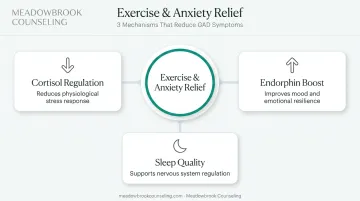
A feasibility trial involving 30 women with GAD found that both aerobic and resistance training improved clinical anxiety severity compared to a waitlist. Regular movement works through several mechanisms relevant to anxiety:
- Regulates cortisol levels and reduces physiological stress responses
- Boosts endorphins, improving mood and emotional resilience
- Improves sleep quality, which in turn supports nervous system regulation
The most important factor is consistency. Finding a routine you'll actually maintain matters more than intensity.
Sleep and Diet
- Sleep: Irregular sleep worsens anxiety. Consistent sleep and wake times — even on weekends — support nervous system regulation
- Caffeine and alcohol: Both worsen anxiety symptoms. Mayo Clinic advises limiting or avoiding them, along with nicotine and recreational substances
- Nutrition: A balanced diet supports overall mental health; skipping meals or heavy sugar consumption can amplify anxious feelings
Relaxation and Mindfulness Practices
- Progressive muscle relaxation
- Deep breathing exercises
- Yoga (in one trial of 226 adults, yoga outperformed stress education but didn't match CBT's effectiveness)
- Meditation and mindfulness
These tools train the nervous system toward a calmer baseline. They work best when practiced consistently and used alongside professional treatment, not as replacements for it.
When and How to Seek Professional Help for GAD
If any of the following apply, it's time to reach out:
- Worry has been persistent and hard to control for six or more months
- Anxiety is interfering with work, relationships, or sleep
- Physical symptoms are affecting daily functioning
- Self-help strategies aren't providing enough relief
- The worry feels disproportionate but you can't stop it
There's no need to wait until things become severe. Earlier intervention typically means faster, more complete recovery.
Meadowbrook Counseling offers evidence-based anxiety therapy across multiple states, including Utah, Idaho, Washington, Massachusetts, Arizona, Colorado, Florida, Texas, and Wisconsin, with both in-person and telehealth options available. The intake team helps match new clients with therapists based on their specific concerns, treatment preferences, and insurance — so you know your costs before the first session.
Meadowbrook Counseling offers evidence-based anxiety therapy across multiple states — Utah, Idaho, Washington, Massachusetts, Arizona, Colorado, Florida, Texas, and Wisconsin — with both in-person and telehealth options available. The intake team matches new clients with therapists based on their specific concerns, treatment preferences, and insurance coverage, so you know your costs before the first session.
Many major insurance plans are accepted, including Aetna, Cigna, UnitedHealthcare, BCBS, TriCare, and Medicaid. To get started, call 801-655-5450 or visit meadowbrookcounseling.com/contact.
Frequently Asked Questions
How do you deal with generalized anxiety disorder?
The most effective approach combines professional therapy — particularly CBT — with medication when appropriate, and consistent self-care habits like regular exercise, healthy sleep, and relaxation practice. Most people need more than one of these elements working together, especially for moderate-to-severe symptoms.
What are the physical symptoms of generalized anxiety disorder?
The most common physical symptoms are muscle tension, chronic fatigue, headaches, sleep disturbances, heart palpitations, and sweating. These often appear alongside the psychological symptoms and are frequently mistaken for other medical conditions, which can delay diagnosis.
Is GAD curable, or does it require lifelong management?
GAD is highly treatable, and many people achieve significant or full remission. One national longitudinal study found that 41.1% of respondents with GAD reached full remission within three years. Some people need ongoing strategies to maintain their gains, but the outlook with proper care is strong.
How long does treatment for GAD typically take to work?
CBT typically shows meaningful improvement within a few months of consistent weekly sessions. SSRIs and SNRIs begin working in several weeks, though full effects can take longer depending on symptom severity and individual response.
Can GAD be treated without medication?
Yes. CBT monotherapy has strong evidence for GAD, and NICE guidelines explicitly offer it as an alternative to medication based on patient preference. Medication may be added when symptoms are more severe or therapy alone isn't enough.
When should I see a therapist for anxiety?
When anxiety is persistent, feels hard to manage on your own, or is interfering with daily life — work, sleep, relationships — it's worth reaching out. You don't need to wait until things reach a crisis point; earlier help typically leads to better outcomes.