Here's some context that might help: an estimated 19.1% of U.S. adults experience an anxiety disorder in any given year, according to NIMH data. That's roughly one in five adults. You're not walking into something rare or strange.
This guide walks through exactly what happens, from your first phone call through months of ongoing sessions, so you know what to expect before you ever sit down with a therapist.
Key Takeaways
- Your first session is an assessment, not treatment—expect paperwork and questions, not fixes.
- Ongoing sessions follow a loose structure: check-in, focused work, wrap-up, typically 45-50 minutes.
- Therapists blend approaches like CBT, exposure therapy, and EMDR based on your specific anxiety.
- Some people notice shifts within a handful of sessions, but a full course of treatment often runs longer.
- Fit with your therapist matters as much as the technique they use.
What Happens in Your First Anxiety Therapy Session
Your first session is intake, not treatment. Nobody hands you a fix for anxiety in hour one, and that's by design. Therapists need to understand your history before they can help you change anything.
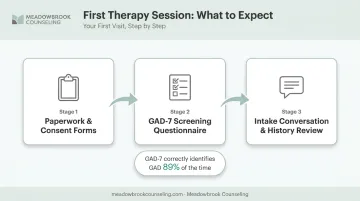
Expect paperwork first. Before or at the start of the session, you'll typically complete:
- Privacy policy acknowledgments (HIPAA notices)
- Treatment consent forms
- Intake questionnaires covering your history and current concerns
Many therapists also use brief screening tools to establish a baseline. The GAD-7, a seven-question anxiety screener, is common in outpatient settings. A study published in JAMA Internal Medicine found it correctly identifies generalized anxiety disorder 89% of the time when scores cross a set threshold. This isn't a diagnostic label slapped on you. It's a starting point your therapist can measure future progress against.
Topics Your Therapist Will Likely Cover
The conversation usually moves through:
- What brought you in and what you're hoping to get out of therapy
- Your specific anxiety symptoms and known triggers
- Medical and family history, including any prior mental health treatment
- Work, school, and relationship context
- What you've already tried to manage the anxiety on your own
You won't get through everything, and that's fine. Therapists guide this conversation. You don't need a script or a perfectly organized story.
Just as your therapist guides the conversation, this first meeting is also your chance to steer it toward what matters to you. Ask about their approach, their experience with anxiety specifically, and how they'll measure whether therapy is actually working.
What a Typical Ongoing Anxiety Therapy Session Looks Like
Once intake wraps up, sessions shift gears. You move from telling your story to actively working on it.
A typical session opens with a check-in: How was your week? Any anxiety spikes? Anything specific come up that you want to talk through? This isn't small talk. It's the therapist gathering real-time data on what's happening in your life right now.
From there, most sessions follow a consistent rhythm:
- Check-in (5-10 minutes): mood, week's events, any homework review
- Focused work (25-35 minutes) — the core therapeutic technique for that session
- Wrap-up (5-10 minutes): recap and plan for the coming week
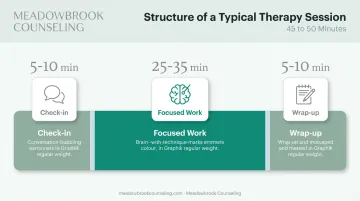
According to the American Psychological Association, a typical psychotherapy session runs 45-50 minutes. That's a general norm, not a strict rule every practice follows.
What "Focused Work" Actually Involves
Depending on your therapist's approach, this middle chunk might include:
- Reviewing a thought log or homework from the previous week
- Identifying cognitive distortions in real time (catastrophizing, mind reading)
- Practicing a grounding or breathing exercise together
- Walking through a step on your exposure hierarchy
Between-session homework, like thought records or graded exposure exercises, is standard in CBT-based practice. The VA's brief-CBT provider manual treats the thought record as a core tool, assigned between sessions and reviewed at the next one. Therapists at Meadowbrook Counseling draw on these same evidence-based modalities, tailoring the mix of techniques to what each client is working through.
One honest note: some discomfort during sessions is normal. Anxiety treatment often means leaning into thoughts or situations you've been avoiding. That's uncomfortable by design, but it's always paced to what you can handle.
Common Therapy Techniques Used to Treat Anxiety
Most therapists don't rely on a single method. They blend approaches based on your specific anxiety type, history, and what's actually working session to session. At Meadowbrook Counseling, therapists draw from a wide bench of evidence-based modalities, including DBT, Internal Family Systems, and Motivational Interviewing, layered on top of the core approaches below.
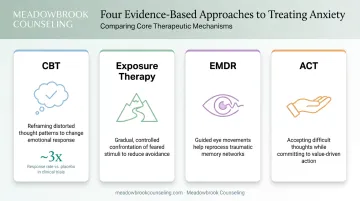
The four most common approaches include:
- CBT — restructures distorted thought patterns
- Exposure Therapy — gradually confronts feared situations
- EMDR — processes trauma-related distress
- ACT — builds acceptance of anxious thoughts rather than fighting them
Cognitive Behavioral Therapy (CBT)
CBT sessions focus on catching distorted thought patterns, like catastrophizing, mind reading, or overgeneralizing, and replacing them with more grounded alternatives. It's the most heavily researched anxiety treatment available.
A meta-analysis of 41 randomized placebo-controlled trials found CBT produced a moderate treatment advantage for anxiety disorders, with clients nearly three times more likely to respond compared to placebo (Carpenter et al., 2018). That's a group-level statistic, not a promise for any one person, but it's strong evidence.
Exposure Therapy
Exposure therapy involves gradually and systematically facing anxiety triggers, always therapist-guided and never all at once. You and your therapist build a fear hierarchy together, ranking situations from mildly uncomfortable to most feared, then work through them at a pace you can tolerate.
The APA recognizes exposure as a scientifically demonstrated treatment component across phobias, panic disorder, social anxiety, GAD, and PTSD. The logic is straightforward: avoidance provides short-term relief but keeps fear alive long-term. Controlled, repeated exposure breaks that cycle.
EMDR and Other Approaches
When anxiety is rooted in trauma, some therapists use EMDR (Eye Movement Desensitization and Reprocessing) to help process distressing memories. Meadowbrook Counseling has EMDR-certified therapists on staff, including Rosario Toral, who works specifically with trauma processing alongside anxiety and mental health challenges.
Not every anxious thought traces back to trauma, though, which is where Acceptance and Commitment Therapy (ACT) takes a different angle entirely. Instead of challenging anxious thoughts head-on, ACT teaches you to notice them without getting tangled up in the fight. A trial of 128 adults with anxiety disorders found ACT produced improvements comparable to CBT overall (Arch et al., 2012), though some outcomes favored CBT slightly. It's a solid option, particularly for people who've found that arguing with their anxious thoughts just feeds them.
How to Prepare for an Anxiety Therapy Session
You don't need a polished presentation. A few loose notes go a long way.
- Jot down recent symptoms, triggers, or a specific event from the week
- Prepare 2-3 questions about your therapist's experience, session structure, or how they measure progress
- Stay open, even about topics that feel embarrassing or uncomfortable
Therapy works best when you share freely instead of filtering, since holding back the messiest parts usually just slows down progress on your anxiety. Most therapists, including Meadowbrook Counseling's team, use intake conversations to help you find the right fit before diving into deeper work.
How Long Before Anxiety Therapy Starts Working
Many people notice small shifts in perspective within the first several sessions. Deeper symptom relief usually takes longer.
Research offers some useful benchmarks, even though timelines vary by person:
- A 1986 dose-effect study of over 2,400 psychotherapy patients found 50% showed measurable improvement by eight sessions, rising to 75% by 26 sessions. This covers general psychotherapy, not anxiety specifically, but it's a widely cited reference point.
- UK clinical guidance (NICE) recommends a 12-15 session course of CBT for generalized anxiety disorder. U.S. providers, including Meadowbrook Counseling therapists, often follow similar session ranges for structured, evidence-based anxiety treatment.
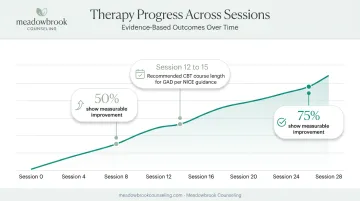
Progress isn't a straight line. As you start addressing avoided topics or situations, anxiety can feel more noticeable for a while. That's not a sign therapy isn't working. It's often a sign you're doing the harder, necessary part.
Finding the Right Therapist for Your Anxiety
The technique matters, but who's sitting across from you matters just as much. A synthesis of 295 studies covering more than 30,000 patients found a consistent link between therapeutic alliance and treatment outcomes (Fluckiger et al., 2018). Fit isn't just about liking your therapist. It's about agreeing on goals and feeling like you're working with someone, not just talking at them.
Finding that fit starts with a few practical factors worth weighing before your first session:
- Specialization — has this therapist actually treated anxiety before, and with what methods?
- Insurance coverage — does your plan cover sessions, and what's the copay?
- Location and format — in-person, telehealth, or both?
Meadowbrook Counseling handles a lot of this legwork before you even book an appointment. Their intake team matches you with a therapist based on your specific concerns, while the billing team verifies insurance benefits in advance, including out-of-network situations.
Meadowbrook accepts major carriers such as Aetna, Blue Cross Blue Shield, Cigna, UnitedHealthcare, Medicaid, and TriCare, with offices across Utah, Washington, Arizona, Wisconsin, Massachusetts, and Texas.
Frequently Asked Questions
What type of counseling is best for anxiety?
CBT and exposure therapy have the strongest research support for anxiety overall. That said, the best fit depends on your specific diagnosis, your history, and personal preference, which is worth discussing directly with a therapist.
Can I overcome anxiety without medication?
Many people manage anxiety successfully through therapy alone, particularly with CBT or exposure-based approaches. Others find a combination of therapy and medication works better for them, especially with panic disorder.
How can I accept anxiety and not fight it?
Acceptance and Commitment Therapy uses mindfulness techniques to help you notice anxious thoughts without struggling against them. The goal is reducing the internal fight, since resisting anxiety often makes it louder.
What happens in the very first anxiety therapy session?
The first session centers on intake: paperwork, consent forms, and getting to know your history, symptoms, and goals. Active treatment techniques typically start in later sessions. Many practices, including Meadowbrook Counseling, verify your insurance beforehand and match you with a therapist suited to your needs, so this first meeting focuses purely on you.
Is it normal to feel worse before feeling better in anxiety therapy?
Yes, especially with exposure-based work. Temporary discomfort often means you're confronting avoided thoughts or situations, which is part of how the treatment works, not a sign of failure.
How long does anxiety therapy usually take?
Some people notice shifts within a handful of sessions, while a full CBT course often runs 12-15 sessions or longer. Timelines vary based on anxiety severity, therapy type, and how consistently you attend.