If this sounds familiar, you're not alone, and you're not imagining it.
Panic disorder creates a brutal cycle: attacks lead to fear of attacks, which leads to avoiding anything that might trigger one. Over time, that avoidance can shrink your world. The good news is that Cognitive Behavioral Therapy (CBT), now available through online sessions, offers a well-researched way out that doesn't require you to depend on medication alone.
Key Takeaways
- CBT directly targets the thought-sensation cycle that fuels panic attacks, not just the symptoms
- Online CBT (iCBT) produces results comparable to in-person therapy for panic disorder, according to multiple clinical studies
- Most treatment courses run 8-12 structured sessions combining education, cognitive work, and exposure
- A licensed therapist tailors the approach to your specific triggers and history
- Meadowbrook Counseling connects you with insurance-covered, CBT-trained therapists through secure telehealth sessions
Understanding Panic Disorder and Why CBT Targets It
A single panic attack isn't a diagnosis. It's panic disorder when attacks become recurrent and unexpected, and when you start dreading the next one enough that it changes your behavior. Maybe you avoid the freeway. Maybe you skip parties. That persistent worry, lasting a month or more, is what separates panic disorder from a one-off scare.
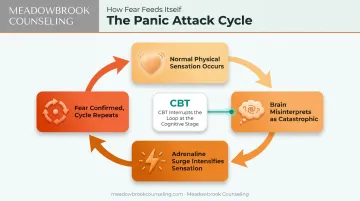
Here's the mechanism that keeps the cycle spinning: your body produces a normal physical sensation, like a slightly elevated heart rate from climbing stairs. Your brain misreads it as catastrophic. That misinterpretation triggers adrenaline. The adrenaline intensifies the sensation, which confirms your fear and triggers even more adrenaline. Within minutes, you're in a full panic attack over what started as nothing.
CBT works because it interrupts this exact loop.
Common Triggers and Warning Signs
Panic attacks typically involve a cluster of physical symptoms that feel far more dangerous than they actually are:
- Racing or pounding heart
- Shortness of breath or a choking sensation
- Sweating, trembling, or chills
- Dizziness or lightheadedness
- A sense of detachment from reality (dissociation)
The problem is hypervigilance. Once you've had one attack, your brain starts scanning constantly for these sensations, which makes them easier to notice and easier to misread. Left unaddressed, this often leads to avoiding the places or situations linked to past attacks. That avoidance can gradually expand into agoraphobia, where entire categories of daily life, driving, shopping, leaving the house, start feeling unsafe.
This isn't a rare problem. According to the National Institute of Mental Health, 2.7% of U.S. adults experienced panic disorder in the past year, with women affected at more than double the rate of men (3.8% versus 1.6%). Lifetime prevalence sits at 4.7%.
Why Medication Alone Often Falls Short
Benzodiazepines like Xanax or Klonopin can stop a panic attack fast. That speed is exactly why they get prescribed so often, and exactly why they're risky as a long-term plan.
Mayo Clinic notes that benzodiazepines can become habit-forming, leading to physical or psychological dependence, which is why they're generally intended for short-term use only. Research on combining these medications with exposure-based therapy has also raised concerns that they may interfere with the actual learning process exposure therapy depends on, potentially undermining long-term progress. Most clinical guidelines reflect this caution: a review of prescribing guidance found that 15 of 19 major guidelines don't recommend benzodiazepines as a first-line option for panic disorder.
CBT doesn't carry those dependency risks, and it builds skills you keep using long after treatment ends. Meadowbrook Counseling offers CBT for panic disorder through telehealth, so you can start this work from wherever you're avoiding least.
The CBT Process for Treating Panic Disorder
CBT breaks the connection between physical sensations, catastrophic thoughts, and panic behavior. It's structured, it's skills-based, and it follows a logical progression rather than open-ended talk therapy.
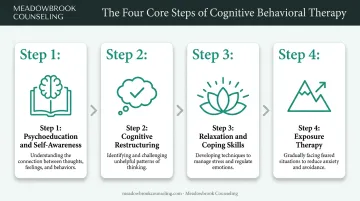
Step 1: Psychoeducation and Self-Awareness
Your therapist starts by explaining what's actually happening in your body during a panic attack. A racing heart during panic isn't a sign of cardiac arrest; it's adrenaline doing exactly what it's designed to do. Understanding this defuses a lot of the fear before you even start working on it directly. You'll also begin tracking the pattern connecting your thoughts, physical sensations, and behaviors in real time.
Step 2: Cognitive Restructuring
Next comes identifying the catastrophic thoughts driving your fear: "I'm going to pass out," "I'm losing control," "This is a heart attack." From there, you learn to challenge them with evidence. Over time, these thoughts get replaced with more accurate, less alarming interpretations.
Step 3: Relaxation and Coping Skills
A few core techniques help lower your baseline anxiety between sessions:
- Diaphragmatic breathing to correct shallow, panic-inducing breathing patterns
- Progressive muscle relaxation to release physical tension
- Grounding techniques to stay anchored in the present moment
Step 4: Exposure Therapy (In-Vivo and Interoceptive)
This is where CBT does its heaviest lifting. In-vivo exposure means gradually facing real situations you've been avoiding: driving on the highway, standing in a crowded store, or sitting through a meeting. Interoceptive exposure means deliberately triggering panic-like sensations on purpose, such as spinning in a chair to induce dizziness, so you learn firsthand that the sensation itself won't hurt you.
Research on component analysis of panic-focused CBT found that including interoceptive exposure was associated with better treatment outcomes and higher acceptability among patients.
Standard protocols typically run 11 to 12 weekly sessions, and most people reach lasting remission. If symptoms resurface later, brief booster sessions can reinforce the skills you already built. This entire process works just as effectively through telehealth as it does in person, since exposure exercises and skill-building rely on your engagement, not the room you're sitting in.
Is Online CBT as Effective as In-Person Therapy?
Short answer: yes, for most people with panic disorder.
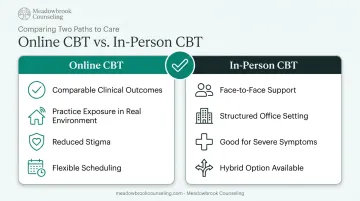
A randomized trial comparing therapist-supported online CBT to face-to-face CBT for panic disorder found both groups achieved significant, comparable improvements in panic severity, agoraphobia, and quality of life, with the online format requiring notably less therapist time. Other research pooling multiple panic-disorder studies backs this up, finding no statistically significant difference between guided internet-delivered CBT and face-to-face treatment at post-treatment.
These results make sense once you consider how exposure exercises work. They're most effective in your real environment: the car, the grocery store, your own living room. Online sessions let you practice with therapist guidance in the exact place your symptoms show up.
Additional advantages include:
- Reduced stigma around seeking mental health treatment
- No travel-related anxiety added on top of existing symptoms
- Easier scheduling consistency, fewer missed sessions
- Access to specialized therapists regardless of your location
That said, online-only treatment isn't automatically right for everyone. Severe symptoms, safety concerns, or significant co-occurring conditions may call for a hybrid approach that blends in-person and virtual sessions. Meadowbrook Counseling's intake team can help match you with a therapist and determine which format fits your situation best.
What to Expect From Your First Online CBT Session
Your first session functions as a clinical intake. The therapist will ask about your symptoms, triggers, history, and how panic has affected your daily routine. This conversation shapes a treatment plan specific to you, not a generic template.
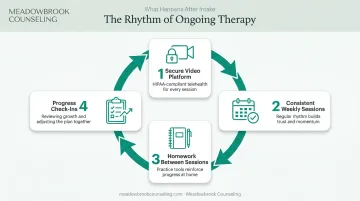
From there, sessions follow a predictable rhythm:
- Secure video platform: sessions happen through encrypted, therapist-approved software, the same standard used for in-office visits
- Consistent length and frequency: typically weekly, with each session building on the last
- Homework between sessions: thought records or panic diaries to track patterns in real time
- Progress check-ins: periodic symptom reviews to confirm the plan is working, or adjust it if it isn't
At Meadowbrook Counseling, this structure is built into the intake process itself, so you know what to expect before your first appointment. You'll generally know what you're working on and why.
Getting Started with Online CBT for Panic Disorder at Meadowbrook Counseling
Meadowbrook Counseling treats anxiety disorders, including panic-related symptoms, using evidence-based modalities like CBT, DBT, and EMDR across offices in Utah, Washington, Arizona, Wisconsin, Massachusetts, Texas, Idaho, Colorado, Florida, and beyond. Several therapists on staff, including those trained specifically in CBT and anxiety treatment, work with clients navigating panic symptoms and the avoidance behaviors that often come with them.
Here's how the process typically works:
- Intake and matching: The intake team connects you with a therapist suited to your presenting symptoms and treatment goals
- Insurance verification: Meadowbrook verifies your benefits before your first session, reducing surprises around cost
- Telehealth access: Online sessions are available across the practice's multi-state service areas, so location isn't a barrier to getting started
Once matched with a therapist, you can start addressing the patterns keeping panic in control. If panic attacks have been running your schedule — canceling plans, avoiding drives, skipping events — you don't have to keep managing it solo. Call 801-655-5450 or visit meadowbrookcounseling.com/contact to request a consultation and start building a plan tailored to your triggers.
Frequently Asked Questions
Can CBT cure panic disorder?
CBT doesn't erase your underlying biological vulnerability to anxiety, but it produces lasting remission for most people. You leave treatment with skills that prevent relapse, even if occasional anxious moments still show up.
Can I take cognitive behavioral therapy online?
Yes. Online, or internet-delivered, CBT is a validated and effective option that uses the same core techniques as in-person sessions, including cognitive restructuring and exposure exercises.
What is the best way to deal with panic disorder?
The most effective evidence-based approach combines professional CBT, relaxation and coping skills training, and gradual exposure to avoided situations. Trying to white-knuckle through avoidance alone tends to make things worse over time.
How many sessions of CBT are typically needed for panic disorder?
Most treatment courses run 8-12 sessions, though this varies based on symptom severity, how quickly you progress, and whether agoraphobia is also present.
Is online CBT as effective as in-person therapy for panic disorder?
Research comparing the two formats has consistently found comparable outcomes, with no statistically significant difference in symptom improvement between online and in-person CBT for panic disorder.
What techniques does CBT use to treat panic attacks?
CBT combines psychoeducation, cognitive restructuring, and relaxation training like diaphragmatic breathing. It also uses exposure therapy, both in-vivo and interoceptive, to break the panic cycle at its source.