
Standard EMDR therapy works well for a single traumatic event, like an accident or assault. But when the wound comes from years of inconsistent caregiving or emotional neglect in childhood, that approach can fall short. A 2023 longitudinal study of 892 adults found that childhood neglect predicted adult attachment anxiety and avoidance, while physical abuse predicted anxiety specifically.
This article covers attachment styles, what makes Attachment-Focused EMDR (AF-EMDR) different, and how sessions work. Meadowbrook Counseling's EMDR-trained therapists help adults address these deeper relational patterns.
Key Takeaways
- AF-EMDR, developed by Dr. Laurel Parnell, adapts EMDR for relational and developmental trauma, not just single incidents
- Identifying your attachment style (secure, anxious, avoidant, fearful-avoidant) helps clarify recurring relationship struggles
- Resource Tapping and bilateral stimulation, paired with a strong therapeutic bond, safely process attachment wounds
- Self-care around sessions helps your brain fully integrate what surfaces in treatment
Understanding Attachment Trauma in Adulthood
Attachment trauma is the lasting psychological impact of neglect, inconsistent caregiving, or abuse during infancy and childhood. It's different from a car accident or a single frightening event. There's no one moment to point to. Instead, it's built from thousands of small relational injuries: a parent who was emotionally unavailable, caregivers who were unpredictable, or a household where a child's needs came second.
That accumulation shapes how you see yourself and whether you believe relationships are safe.
Common Adult Signs of Attachment Trauma
These patterns often show up in relationships, work, and daily emotional life:
- Chronic conflict in romantic relationships
- Intense fear of abandonment, even when a partner shows commitment
- Difficulty trusting others, or trusting too quickly and getting hurt
- Emotional shutdown during conflict or vulnerability
- People-pleasing patterns that leave you exhausted and resentful
Research backs up the relational fallout. A 2019 meta-analysis of 132 studies and over 71,000 participants found that both attachment anxiety and avoidance were linked to lower relationship satisfaction. Your own insecurity predicted your satisfaction more strongly than your partner's insecurity did.
This is exactly why attachment wounds often need a different treatment lens. A single-incident trauma protocol wasn't built to untangle years of layered relational injury.
Recognizing Your Attachment Style
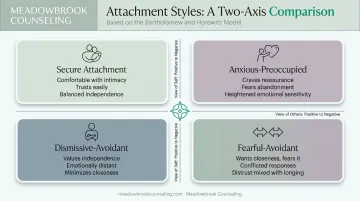
Attachment theory identifies four primary patterns that shape how you relate to others as an adult. Recognizing yours often explains why certain relationship struggles keep resurfacing, even with different people.
Secure Attachment
- Comfortable with both intimacy and independence
- Communicates needs directly and clearly
- Recovers from conflict without lingering resentment or panic
Anxious-Preoccupied Attachment
- Craves reassurance and closeness
- Fears abandonment, even in stable relationships
- Highly sensitive to small shifts in a partner's tone or availability
- Struggles with underlying self-worth
Dismissive-Avoidant Attachment
- Prioritizes independence over closeness
- Avoids emotional vulnerability
- Withdraws when a relationship starts to feel too intimate
Fearful-Avoidant Attachment
- Alternates between wanting closeness and fearing it
- Struggles with trust more than any other style
- Often tied to a history of unpredictable or traumatic caregiving
These four categories, first described by Bartholomew and Horowitz in 1991, summarize patterns based on how positively or negatively someone views themselves and others. Prevalence estimates shift depending on how researchers measure attachment. One nationally representative US study found 59% secure, 25% avoidant, and 11% anxious using a three-category model, though no single breakdown applies universally across all four styles.
What matters more than the exact numbers is recognizing your own pattern. Attachment-focused EMDR specifically targets the early experiences that shaped these patterns, helping you build the secure connections that may have felt out of reach.
What Is Attachment-Focused EMDR? How It Differs From Standard EMDR
Standard EMDR (Eye Movement Desensitization and Reprocessing), developed by Francine Shapiro in 1987, uses bilateral stimulation, such as guided eye movements or alternating taps, to help the brain reprocess distressing memories. It's an established treatment for PTSD, typically following an eight-phase protocol.
AF-EMDR, developed by Dr. Laurel Parnell and detailed in her book Attachment-Focused EMDR: Healing Relational Trauma, integrates attachment theory directly into that framework. It's built for wounds that formed slowly, over years of relational experience, rather than during one identifiable event.
| Aspect | Standard EMDR | AF-EMDR |
|---|---|---|
| Primary focus | Discrete traumatic events | Chronic relational wounds |
| Therapeutic relationship | Supports the protocol | Part of the treatment itself |
| Pacing | Follows standard eight phases | Slower, with added stabilization |
| Best suited for | Single-incident PTSD | Insecure attachment, CPTSD |
Why Standard EMDR Can Fall Short for Insecure Attachment
Standard EMDR depends on a trusting therapeutic relationship to work. That's a problem if your attachment wounds make trust itself the injury. Clients with insecure attachment styles may:
- Struggle to form the trusting bond the protocol requires
- Feel overwhelmed by intense emotion without enough internal support to manage it
- Disconnect or shut down mid-session when material feels too big
How AF-EMDR Modifies the Approach
AF-EMDR addresses these gaps directly. Parnell's model puts safety and emotional regulation first, before deep trauma processing starts. The therapeutic relationship itself becomes part of the treatment, offering a corrective, reparative experience alongside the reprocessing work.
AF-EMDR isn't a replacement for standard EMDR. It's an adaptation designed specifically for people with insecure attachment styles, complex trauma, or CPTSD rooted in chronic relational wounds. At Meadowbrook Counseling, our certified EMDR practitioners assess each client's attachment history to determine whether this adapted approach fits their needs.
How Attachment-Focused EMDR Works: Techniques and the Session Process
AF-EMDR unfolds in stages, and the pacing is deliberately slower than standard EMDR because the groundwork matters more.
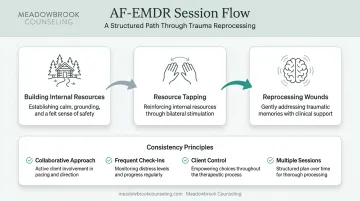
Building Internal Resources First
Before any trauma processing begins, therapists help clients identify:
- Real or imagined nurturing figures who represent safety
- A safe or peaceful place to mentally return to when things feel intense
- Internal support systems the client can draw on mid-session
Resource Tapping
This is Parnell's signature technique. It pairs a calming image, such as a nurturing figure or peaceful memory, with short sets of alternating tapping, often on the legs or shoulders. The goal is to help clients feel soothed and grounded, both as a stabilizing tool on its own and as preparation for harder work ahead. If tapping ever brings up negative material instead, therapists pause and adjust.
Reprocessing the Wounds
Once resourcing work has built enough internal safety, therapists move into direct processing. This stage introduces bilateral stimulation—eye movements, tapping, or auditory tones—to work through specific attachment memories. Talk therapy runs alongside this work throughout, helping clients make sense of what surfaces and integrate new insight.
A few things stay consistent throughout the process:
- Sessions are collaborative, not something done to the client
- Therapists check in frequently to gauge the nervous system's response
- Clients retain control and can pause or stop at any point
- Multiple sessions are standard, since developmental trauma involves reprocessing accumulated experience, not one memory
EMDRIA notes that even a single disturbing event in standard EMDR can take one to three sessions to process, and preparation alone may take one to four sessions for complex histories. Attachment trauma, being layered by nature, generally asks for more time and patience than either of those benchmarks suggest.
Benefits of AF-EMDR and Getting Started with the Right Therapist
Standard EMDR has strong research behind it. A 2014 meta-analysis of 26 randomized controlled trials found meaningful reductions in PTSD symptoms, depression, anxiety, and subjective distress among participants. AF-EMDR, as Parnell's clinical adaptation, draws on that same reprocessing mechanism while adding attachment-specific scaffolding, which shows up in the outcomes clients describe.
Clients working through AF-EMDR often report:
- Reduced anxiety and depressive symptoms
- Better emotional regulation during conflict or stress
- Growing capacity for secure, satisfying relationships
- A felt sense of safety within themselves, not just with others
- Increased self-awareness about long-standing patterns
Why Therapist Fit Matters Here
AF-EMDR leans heavily on the therapeutic relationship itself as part of the healing process. That means working with someone trained specifically in attachment-focused approaches isn't a nice-to-have. It's central to whether the work actually lands.
Meadowbrook Counseling has EMDR-certified therapists across its Utah, Washington, Arizona, Wisconsin, Massachusetts, and Texas locations, including Rosario Toral, ACMHC, EMDR, who works with clients navigating trauma and relational wounds. Other EMDR-certified clinicians on the team bring attachment-informed training to their practice as well, and the intake team can match you with the right fit based on your location.

The practice supports insurance verification before your first session and offers both in-person and telehealth appointments. If you're ready to explore whether AF-EMDR fits your history, book a consultation to get matched with a therapist suited to your goals.
Frequently Asked Questions
Do you talk during EMDR therapy?
Yes, talk therapy is woven throughout the process. You'll discuss the memory or feeling being targeted, but during the bilateral stimulation itself, you'll mostly focus inward rather than speaking at length.
How do I take care of myself during EMDR therapy?
Stay hydrated, rest well before and after sessions, and use any grounding techniques your therapist teaches. Be gentle with yourself if unexpected emotions surface between appointments.
What should I do after an EMDR session?
Rest, journal any insights or feelings that come up, and avoid major life decisions right away. Reach out to your therapist if distressing symptoms linger longer than expected.
How long does attachment-focused EMDR take to show results?
Timelines vary based on the depth of the attachment wounds involved. Many clients notice initial shifts within several sessions, though full integration takes longer given how layered developmental trauma tends to be.
Is attachment-focused EMDR covered by insurance?
Many insurance plans cover EMDR as a mental health service, though coverage depends on your specific plan and provider network. Meadowbrook Counseling verifies your benefits before your first session.
Can attachment-focused EMDR be done through online therapy?
Yes, in most cases. Telehealth sessions can use handheld tappers or guided eye movement videos for bilateral stimulation. That said, some clients prefer in-person sessions for certain phases, particularly early resourcing work.