

Not quite. In 2021, 21.0 million U.S. adults, or 8.3%, had at least one major depressive episode, and 14.5 million of them experienced severe impairment. Only 61% of those adults got treatment, according to NIMH data.
Choosing the right provider affects how fast you feel better, what you pay, and whether your treatment actually fits your symptoms. This guide breaks down the real differences between therapists and psychologists for depression, and shows how personalized matching (like the approach Meadowbrook Counseling uses) takes the guesswork out of the decision.
Key Takeaways
- Therapists hold master's degrees and specialize in talk therapy for depression, anxiety, and life challenges
- Psychologists hold doctoral degrees (PhD/PsyD) and add psychological testing and formal diagnosis
- Neither can typically prescribe medication — that requires a psychiatrist or prescribing nurse practitioner
- Your best choice depends on symptom severity, need for testing, cost, and comfort with the provider
- Many people start with a therapist and get referred onward only if symptoms don't improve
Therapist vs Psychologist for Depression: Quick Comparison
| Factor | Therapist | Psychologist |
|---|---|---|
| Cost | Generally lower session rates | Often higher rates tied to doctoral training |
| Education | Master's degree + supervised clinical hours | Doctoral degree (PhD/PsyD) + 1-2 years supervised practice |
| Treatment approach | Talk therapy: CBT, DBT, EMDR, and specialty modalities | Talk therapy plus psychological testing and evaluation |
| Complex diagnosis | Identifies and treats mild-to-moderate depression | Equipped for severe, treatment-resistant, or co-occurring cases |
| Prescribing | Cannot prescribe in nearly all states | Cannot prescribe in most states, with rare exceptions |
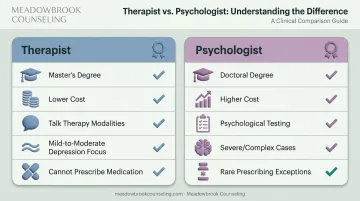
Cost isn't as clean-cut as "therapist cheaper, psychologist pricier." A 2024 study of over 175,000 U.S. psychotherapy listings found the average advertised cash-pay rate across all providers was $143.26 per session, with doctoral-level providers trending higher on average.
Your actual cost depends more on insurance network status and location than on the provider's degree. Checking whether a provider is in-network typically matters more than choosing between a therapist and a psychologist.
On prescribing: as of 2026, only nine states (Colorado, Hawaii, Idaho, Illinois, Iowa, Louisiana, New Mexico, Utah, and Vermont) allow specially trained psychologists to prescribe, and even then only after extensive additional certification. For nearly everyone, medication management still means seeing a psychiatrist or psychiatric nurse practitioner separately.
What Is a Therapist?
"Therapist" is an umbrella term covering licensed counselors (LPC, CMHC), clinical social workers (LCSW, LICSW), and marriage and family therapists (LMFT). Each holds a state license and clinical training in psychotherapy, and each can treat depression through talk therapy.
For depression specifically, therapists provide the consistent, ongoing sessions that help someone unpack negative thought patterns, build coping skills, and process emotions. This is often the most accessible entry point into care, with shorter wait times, broader provider availability, and typically lower costs than doctoral-level specialists.
Many therapists also specialize. Some focus on:
- Trauma-related depression using EMDR (Eye Movement Desensitization and Reprocessing)
- Grief and bereavement-related depressive episodes
- Depression tied to couples or family conflict
- Life-transition or burnout-driven depression
At Meadowbrook Counseling, for example, EMDR-certified clinicians combine trauma-focused training with depression-focused care, showing how a master's-level therapist can bring specialized tools to trauma-linked depression without a doctoral credential.
Use Cases of a Therapist for Depression
A therapist is usually the right first call if your depression is:
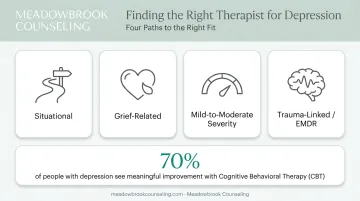
- Situational, tied to a job loss, breakup, move, or other life transition
- Grief-related, following the loss of a loved one
- Mild-to-moderate in severity, without complicating factors like psychosis or suicidality
- Trauma-linked, especially where EMDR-certified clinicians can target unresolved trauma driving the depressive symptoms
The evidence backs this up. A large 2023 meta-analysis covering 409 trials and 52,702 patients found cognitive behavioral therapy produced a moderate-to-large effect against control conditions (Hedges g = 0.79). CBT actually outperformed medication at the 6-to-12-month mark. For many depression presentations, talk therapy is the most durable option available.
What Is a Psychologist?
A psychologist holds a doctoral degree, either a PhD or PsyD. They typically complete a one-year clinical internship, plus 1-2 years of supervised post-degree experience, before earning independent licensure. That extra training centers on psychological assessment, research methodology, and complex diagnostic evaluation, in addition to psychotherapy.
For depression, this matters most when things aren't straightforward. Psychologists can administer standardized psychological tests to rule out co-occurring conditions, like bipolar disorder or a personality disorder that looks like treatment-resistant depression. That diagnostic clarity can prevent months of ineffective treatment aimed at the wrong problem.
One caveat: not every psychologist practices clinically. Some focus primarily on research or academic work. If you're looking for direct treatment, confirm the psychologist you're considering actually sees clients regularly.
Use Cases of a Psychologist for Depression
Consider a psychologist when depression is:
- Severe or chronic, with symptoms that haven't responded to standard talk therapy
- Treatment-resistant, having failed multiple prior interventions
- Suspected to involve a co-occurring condition requiring formal testing to confirm
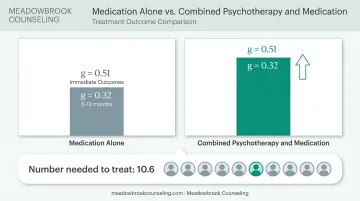
Psychologists also frequently coordinate with psychiatrists, combining psychotherapy with medication oversight for more complex cases. That combined approach has real evidence behind it: a 2023 meta-analysis found combined psychotherapy and medication outperformed medication alone, both immediately after treatment (g = 0.51) and at 6-12 months follow-up (g = 0.32), with a number needed to treat of just 10.6. In other words, for every roughly 10 patients receiving combined care instead of medication alone, one additional person responds to treatment.
Therapist vs Psychologist for Depression: Which Is Better?
There's no universal winner here. The right answer depends on severity, whether you need formal testing, your budget, and your insurance coverage.
Choose a therapist if:
- You're dealing with mild-to-moderate depression
- A specific life stressor triggered your symptoms
- You want to start care quickly and affordably
Choose a psychologist if:
- Your depression is severe, complex, or treatment-resistant
- You need psychological testing to clarify a diagnosis
- You suspect a co-occurring disorder
Many people do both, in sequence. They start with a therapist, then get referred to a psychologist or psychiatrist only if symptoms don't improve after a reasonable trial of talk therapy. That stepped approach avoids overpaying for doctoral-level care you might not need. Practices with multiple provider types on staff, like Meadowbrook Counseling, can help make that referral process seamless if your needs change.
Here's something the credentials chart doesn't capture: personal rapport often predicts outcomes better than the provider's degree. If you don't feel comfortable opening up to your provider, even the most qualified psychologist won't help much. Fit matters.
Finding the Right Fit: A Real-World Approach
Picture someone dealing with work burnout that's tipped into depression. They know they need help, but they're stuck. Do they search for "therapist near me" or "psychologist near me"? Do they need testing, or insurance coverage first? Weeks pass while symptoms worsen, and care gets delayed simply because that first decision felt too complicated.
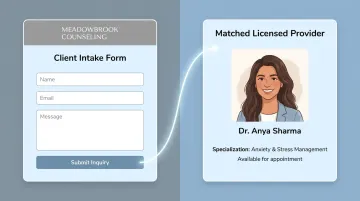
This is exactly the gap a dedicated intake process is built to close. At Meadowbrook Counseling, prospective clients start with a simple contact form gathering basic information and a message describing what's going on. From there, the team matches clients with a licensed provider suited to their specific situation.
Meadowbrook's staff spans multiple credential levels across its service areas, which matters for this exact scenario:
- Master's-level therapists (LCSW, CMHC, ACMHC) across states including Utah, Idaho, Washington, Arizona, Massachusetts, and Texas handle the majority of depression cases involving talk therapy, EMDR, CBT, and related modalities
- Doctoral-level psychologistsOnce a client is matched, Meadowbrook verifies insurance benefits before the first session, whether through their online contact form, direct email to the billing team, or a phone script for calling your carrier. That step removes cost uncertainty as a reason to delay treatment.
The takeaway: you don't have to solve the "therapist vs psychologist" question on your own. If you're in Utah, Washington, Arizona, Wisconsin, Massachusetts, Texas, or several other service areas, reach out to Meadowbrook Counseling at 801-655-5450 for a personalized match and insurance verification before your first appointment.
Conclusion
There's no single "winner" between therapist and psychologist for depression. The right choice comes down to how severe your symptoms are, whether you need formal diagnostic testing, and what feels manageable for your budget and comfort level.
What the research consistently shows is that starting treatment sooner leads to better long-term outcomes, regardless of which credential is on your provider's door. The bigger risk isn't picking the "wrong" type of provider. It's waiting too long to pick anyone at all. If you're ready to start, a good intake process can match you with the right type of provider for your specific needs.
Frequently Asked Questions
Is it better to see a psychologist or a therapist for depression?
It depends on severity. Therapists work well for mild-to-moderate depression and life-stress-related symptoms, while psychologists are better suited for severe, complex, or treatment-resistant cases needing formal testing.
Who is better for depression, a psychologist or a psychiatrist?
Psychologists focus on psychotherapy and testing; psychiatrists are medical doctors who can prescribe medication. Many people benefit from both working together for combined therapy and medication management.
Can a therapist diagnose depression?
Most licensed therapists can identify depression symptoms and provide a working diagnosis within their state's scope of practice. Formal psychological testing, however, is typically reserved for psychologists.
Is therapy or medication better for depression?
Research generally shows combined psychotherapy and medication outperforms medication alone, especially for moderate-to-severe depression. For milder cases, therapy alone often performs just as well.
How much does therapy for depression typically cost?
Rates vary widely by provider type, location, and training, with typical session rates commonly falling between $100 and $200. Many insurance plans now cover mental health treatment under federal parity laws, so check your benefits first.
How do I know if I need a therapist or a psychologist for my depression?
Consider your symptom severity and whether you need formal testing. Rather than self-diagnosing, Meadowbrook Counseling's intake team can match you with the right provider based on your specific situation.