
According to the National Institute of Mental Health, 19.1% of U.S. adults experienced an anxiety disorder in the past year, based on national survey data. Yet despite being one of the most treatable mental health conditions, many people either don't seek help or don't know what treatment actually looks like.
This guide covers the main types of anxiety therapy, how to match the right approach to your specific situation, and what to realistically expect when you begin — so the first step feels less like a leap in the dark.
Key Takeaways
- Anxiety disorders are highly treatable, and professional therapy delivers lasting results.
- CBT, Exposure Therapy, ACT, DBT, and EMDR are all evidence-based options, each suited to different anxiety types and needs.
- Choosing the right therapy depends on your anxiety type, personal history, and what approach feels like a fit.
- Therapy builds real skills — you leave with tools that work long after sessions end.
- Starting sooner leads to better outcomes; knowing what to expect makes that first step easier to take.
What Is Anxiety and When Does It Need Treatment?
Everyone feels anxious sometimes. Pre-interview nerves, first-date jitters, the knot in your stomach before a difficult conversation — these are normal, short-lived responses to stress. Clinical anxiety is different.
The American Psychiatric Association distinguishes ordinary anxiety from a disorder based on three factors: excessiveness, persistence, and interference with daily functioning. It's not just feeling anxious — it's anxiety that won't stop, doesn't fit the situation, and starts limiting how you live.
Common Anxiety Disorders
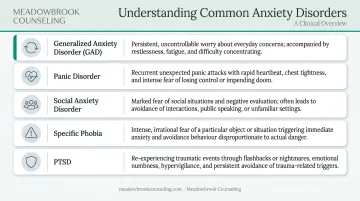
| Disorder | What It Looks Like |
|---|---|
| Generalized Anxiety Disorder (GAD) | Persistent, hard-to-control worry across work, health, and finances; often paired with restlessness, fatigue, or sleep problems |
| Panic Disorder | Recurrent unexpected panic attacks, plus ongoing fear of future attacks |
| Social Anxiety Disorder | Intense fear of judgment or embarrassment in social situations, often leading to avoidance |
| Specific Phobia | Excessive, persistent fear of a specific object or situation disproportionate to actual risk |
| PTSD | Following trauma: intrusive memories, avoidance, mood changes, and heightened arousal lasting more than one month |
Signs It's Time to Seek Support
Consider reaching out to a professional if you notice:
- Anxiety persisting for more than a few weeks without a clear cause
- Avoiding situations — social, professional, or everyday — that limit your quality of life
- Physical symptoms like a racing heart, muscle tension, or chronic sleep problems
- Anxiety that co-occurs with depression or substance use
- A sense that worry or fear is making decisions for you rather than you making them
The practical signal is functional impairment. Stress is part of life — the threshold for seeking help is when anxiety consistently disrupts your work, relationships, or daily choices. That's when professional support can make a real difference.
How Therapy Helps with Anxiety
Anxiety has three interlocking components: distorted thoughts, physical arousal, and avoidance behavior. Therapy targets all three.
Rather than just reducing symptoms temporarily, therapy teaches you to recognize triggers, challenge unhelpful thinking patterns, and face feared situations gradually rather than retreat from them. That's what makes the effects stick.
Why Therapy's Benefits Last
A 2020 systematic review of 69 randomized trials involving over 4,000 outpatients found that CBT benefits remained significant at 12 months or longer for GAD, social anxiety, and PTSD. The skills learned in therapy don't disappear when sessions end — they become part of how you respond to stress going forward.
Medication can be an important part of treatment, but its effects tend to taper once it's discontinued. Therapy equips you with tools that outlast the treatment itself.
The Role of Between-Session Practice
Those lasting benefits don't happen in the therapy room alone — they're built through practice. Therapy is collaborative and goal-oriented: patients work on skills between sessions through homework assignments like thought records, exposure exercises, or journaling.
That between-session practice matters. A 2018 meta-analysis in Cognitive Therapy and Research found homework completion was a reliable predictor of treatment outcomes across anxiety disorders. The real learning happens when you apply new skills to real situations — and each time you do, you're building confidence that carries forward long after therapy ends.
Types of Therapy for Anxiety
No single therapy works best for everyone. The right approach depends on the specific disorder, whether trauma is involved, and what resonates with how you think and process. Here's how the major evidence-based modalities differ.
Cognitive Behavioral Therapy (CBT)
CBT is the most extensively researched therapy for anxiety disorders across the board. It works by identifying negative, distorted thought patterns and changing the avoidant behaviors that reinforce them.
A 2018 meta-analysis of 41 placebo-controlled trials involving nearly 2,900 patients found a meaningful symptom effect (Hedges' g = 0.56) and a response odds ratio of 2.97 — meaning CBT patients were nearly three times more likely to respond than those on placebo. Effects varied by disorder, but the cross-diagnostic evidence is strong.
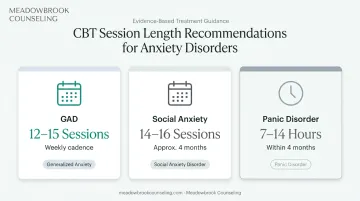
Treatment length is diagnosis-specific rather than one-size-fits-all:
- GAD: Typically 12–15 weekly sessions
- Social anxiety: 14–16 sessions over about four months
- Panic disorder: 7–14 hours of therapy, often completed within four months
Exposure Therapy
Exposure therapy — often used within a CBT framework — involves systematic, gradual confrontation of feared situations in a safe, controlled setting. The goal is to break the cycle where avoidance maintains fear.
Four main formats exist:
- In vivo: Direct contact with the feared object or situation in real life
- Imaginal: Vividly recalling or imagining the feared scenario
- Interoceptive: Deliberately inducing harmless physical sensations feared in panic disorder
- Virtual reality (VR): Simulated environments when real-world exposure isn't practical
Exposure is particularly effective for specific phobias, OCD (as Exposure and Response Prevention, or ERP), panic disorder, and PTSD. For OCD specifically, research shows roughly two-thirds of patients improve with ERP.
Acceptance and Commitment Therapy (ACT)
ACT takes a different angle. Instead of challenging anxious thoughts directly, it teaches you to accept them without judgment and act according to your values anyway. The goal is psychological flexibility — making room for difficult internal experiences while not letting them control your behavior.
ACT has solid evidence for mixed anxiety disorders and is particularly relevant for GAD. It's a strong fit for people who want an alternative to CBT's structured thought-challenging approach, or whose symptoms persisted after earlier treatment.
Dialectical Behavior Therapy (DBT)
Originally developed for borderline personality disorder, DBT has since been adapted for anxiety presentations where emotional dysregulation is prominent. Its four skill areas give clients concrete tools for managing intense emotional states:
- Mindfulness — building awareness of thoughts and feelings without reacting
- Distress tolerance — coping with crises without making them worse
- Emotion regulation — identifying and shifting overwhelming feelings
- Interpersonal effectiveness — navigating relationships without sacrificing needs
DBT is not a first-line treatment for most anxiety disorders, but it fits well when someone's anxiety is closely intertwined with emotional volatility or difficulty tolerating distress.
EMDR (Eye Movement Desensitization and Reprocessing)
EMDR uses bilateral stimulation — eye movements, tapping, or auditory tones — while a person recalls a distressing memory. The leading hypothesis is that this taxes working memory during recall, reducing the memory's emotional intensity over time.
The evidence base for EMDR is strongest for PTSD. The APA's 2025 clinical practice guideline conditionally recommends EMDR for adult PTSD; the International Society for Traumatic Stress Studies gives it a strong recommendation. For trauma-driven anxiety specifically, EMDR is a well-supported option.
Meadowbrook Counseling has EMDR-trained and certified practitioners across multiple locations — including Idaho and Utah — who work specifically with trauma-related anxiety and PTSD. Therapists like Rosario Toral (ACMHC) hold EMDR certification and bring experience across a range of trauma presentations.
Which Type of Anxiety Therapy Is Right for You?
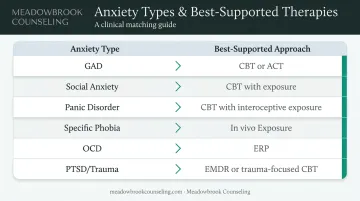
No single therapy works for everyone. The right approach depends on your specific diagnosis, symptoms, and how you respond to treatment. Here's a practical matching guide based on disorder and evidence:
| Anxiety Type | Best-Supported Approach |
|---|---|
| Generalized Anxiety Disorder | CBT or ACT |
| Social Anxiety Disorder | CBT with behavioral experiments and exposure |
| Panic Disorder | CBT with interoceptive and situational exposure |
| Specific Phobias | In vivo Exposure Therapy |
| OCD | ERP (Exposure and Response Prevention) |
| PTSD / Trauma-driven anxiety | EMDR, Prolonged Exposure, or trauma-focused CBT |
When Combination Approaches Make Sense
For moderate-to-severe anxiety, combining approaches — CBT plus medication, or therapy plus neurofeedback — can be more effective, especially when physical symptoms make it hard to engage with therapy alone. NICE guidelines for GAD, for example, note that combination treatment is typically considered for complex or treatment-resistant cases.
Finding the right fit can take some trial — and that's a normal part of the process. Treatment plans should be reviewed and adjusted regularly. If something isn't working, say so; a good therapist will expect that conversation and welcome it.
What to Expect from Anxiety Therapy
The First Few Sessions
Early sessions focus on assessment rather than immediate intervention. A therapist will gather information about your specific symptoms, history, relevant background, and goals. This is typically followed by psychoeducation — explaining how anxiety works and why the chosen treatment approach targets it the way it does.
A good therapist co-creates the treatment plan with you rather than handing one down. You should leave early sessions with a clearer picture of what's causing your anxiety, what you'll be working on, and why.
Ongoing Sessions
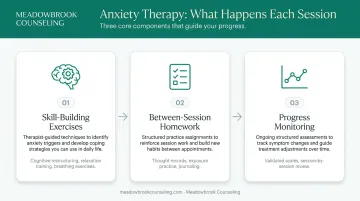
Once treatment begins in earnest, sessions typically involve:
- Skill-building exercises tied to your specific anxiety type
- Between-session homework : thought records, exposure practice, journaling, or behavioral experiments
- Progress monitoring using structured assessments like the Hamilton Anxiety Rating Scale (HAM-A), a 14-item clinician-rated tool that tracks symptom severity over time
Progress isn't always linear. Setbacks during treatment are common and don't signal failure — they're often built into the process, particularly with exposure-based work.
Realistic Timeline
Broad psychotherapy research suggests roughly 50% of patients see meaningful recovery within 15–20 sessions, though this varies by disorder, severity, and consistency of practice between sessions. Some people notice shifts within the first few sessions; others need more time, especially when comorbidities are present or trauma is involved.
The goal isn't to eliminate anxiety entirely. Some anxiety is healthy and adaptive. What changes through therapy is your relationship with it — you gain tools to respond rather than react, so anxiety no longer dictates your choices.
How to Find the Right Anxiety Therapist
What to Look For
When evaluating a therapist for anxiety, prioritize:
- Active licensure in your state (LCSW, LMFT, CMHC, ACMHC, or similar)
- Demonstrated experience with your specific anxiety disorder, not just general mental health
- Familiarity with evidence-based modalities — CBT, EMDR, ACT, ERP — relevant to your situation
- A collaborative style where you feel heard, not managed
Specialized credentials matter. For example, a Certified Clinical Anxiety Treatment Professional designation signals specific training beyond general licensure.
Practical Logistics
Before committing to a therapist:
- Verify insurance coverage before your first session to avoid unexpected costs. Coverage varies by plan, location, and individual therapist.
- Consider telehealth. A 2022 multisite randomized trial found videoconference CBT for GAD was as effective as in-person CBT on primary outcomes — meaning remote therapy is a fully valid choice.
- Request an initial consultation to assess fit before committing to ongoing sessions.
If you're looking for a place to start, Meadowbrook Counseling offers therapists credentialed across multiple license types — including LCSW, CMHC, ACMHC, and LICSW — who specialize in evidence-based anxiety treatment. Their intake team matches clients with the right therapist based on your specific concerns, and their billing team verifies insurance coverage before your first session, so there are no surprises on cost.
Meadowbrook operates across multiple states — including Utah, Idaho, Massachusetts, Florida, Texas, Colorado, and Wisconsin — with both in-person and telehealth options. You can reach their Orem office at 801-655-5450 or visit meadowbrookcounseling.com to get started.
Frequently Asked Questions
What is the best therapy for anxiety?
CBT is the most evidence-based, widely recommended first-line therapy for most anxiety disorders. That said, Exposure Therapy, ACT, and EMDR may be better suited to specific presentations — phobias, GAD, and trauma-related anxiety, respectively. The best approach is one tailored to your specific disorder and preferences.
What is the 3-3-3 rule for anxiety?
The 3-3-3 technique is a grounding exercise: name 3 things you can see, identify 3 sounds you can hear, and move 3 parts of your body. It's used to interrupt anxious spiraling and reconnect with the present moment. It's a practical self-help coping tool, but not a substitute for professional therapy.
How long does anxiety therapy take to work?
Some people notice early relief within the first few sessions; most see significant improvement within 12–20 weekly sessions. The timeline varies based on anxiety type, severity, consistency of between-session practice, and the specific modality used.
Can anxiety be treated without medication?
Yes. CBT and Exposure Therapy are effective standalone treatments for most anxiety disorders. Medication may be added for severe symptoms or to ease initial engagement with therapy, but it's not always necessary. Therapy's effects also tend to outlast medication's once treatment ends.
How do I know if I need therapy for anxiety?
If anxiety persists for weeks, limits daily activities, disrupts sleep or relationships, or drives avoidance of things that matter to you, professional support is warranted. A licensed therapist can assess what's happening and recommend the right treatment approach.
What happens in the first therapy session for anxiety?
The first session is an intake: your therapist gathers information about your symptoms, history, and goals, and explains how they approach treatment. You won't usually receive homework — it's mainly a conversation to clarify what you need and establish a path forward.