Those reactions often aren't about the dishes or the comment. They're about a script written years ago, sometimes decades ago, back when you were too young to know you were even learning a lesson.
Childhood lays the groundwork for how we regulate emotions, connect with others, and see ourselves. Both the warm, safe moments and the frightening or neglectful ones leave marks. This article walks through how childhood development unfolds, what qualifies as childhood trauma, how early experiences reshape the adult brain, and what real paths to healing look like.
Key Takeaways
- Early experiences shape brain development, attachment styles, and coping mechanisms well into adulthood
- Four recognized categories define childhood trauma: physical abuse, emotional abuse, sexual abuse, and neglect
- Unresolved childhood experiences often resurface as anxiety, relationship difficulties, or physical health problems
- Therapies like EMDR and trauma-focused CBT offer evidence-based paths for processing early-life experiences at any age
Foundations of Childhood Development
Childhood doesn't move in one smooth arc. It happens in distinct stages, each with its own developmental jobs to complete.
The American Psychological Association marks infancy as the first two years of life, a period of rapid growth in language, motor skills, and early attachment bonds. The CDC tracks developmental milestones from 2 months through age 5, covering social-emotional, language, cognitive, and physical growth. The World Health Organization defines adolescence as ages 10 to 19, a distinct bridge between childhood and adulthood marked by identity formation and social change (WHO).
How Attachment Forms
Much of what happens emotionally in childhood traces back to attachment, the bond between a child and their primary caregivers. Psychologist Mary Ainsworth's research identified how infants respond to separation and reunion with caregivers:
- Secure - uses the caregiver as a safe base, shows distress when separated, and is easily soothed on return
- Avoidant - shows little outward distress and tends to ignore the caregiver at reunion
- Anxious-resistant - shows heavy distress, mixing clinginess with anger, and is hard to soothe
- Disorganized/disoriented - lacks a consistent strategy; behavior can look frozen, contradictory, or confused
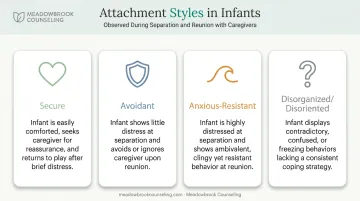
Researchers Main and Solomon added the disorganized category later, after noticing infant behaviors that didn't fit Ainsworth's original three patterns.
These aren't personality types stamped on for life. They describe observed infant behavior in a specific research setting, though the underlying relational patterns often echo into adult relationships. That echo matters because emotional impact isn't limited to attachment alone; it can also take root in homes that look stable from the outside.
When Loving Homes Still Leave a Mark
Trauma doesn't only come from abuse or neglect. A child raised in a stable, loving home can still carry emotional weight from:
- Parental divorce or separation
- A serious illness in the family
- Frequent moves or school changes
- Financial stress at home
None of these make a parent "bad." They're simply part of being human in an unpredictable world. Children absorb more of that unpredictability than adults often realize, which is why the next stage of development often shows the effects of what happened earlier.
Types of Childhood Trauma and Adverse Experiences
Not every hard day qualifies as trauma. SAMHSA defines child traumatic stress as occurring when a child feels intensely threatened by an event they experienced or witnessed, and their reaction to that threat overwhelms their normal coping abilities (SAMHSA).
Harvard's Center on the Developing Child draws a useful distinction here. Brief, positive stress (a tough exam, a scraped knee) is normal and even helpful for growth. Tolerable stress, buffered by a supportive adult, builds resilience. Toxic stress happens when a child faces excessive or prolonged adversity without that buffering relationship.
What Are the 4 Types of Childhood Trauma?
The CDC recognizes four primary categories of child maltreatment:
- Physical abuse - intentional force that causes or risks causing injury
- Emotional abuse - behavior that damages a child's self-worth or emotional development, including constant criticism or rejection
- Sexual abuse - any completed or attempted sexual act, contact, or exploitation involving a child
- Neglect - failure to meet a child's basic physical, emotional, or educational needs
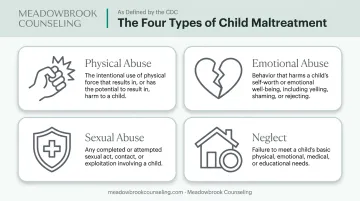
Warning signs vary by type but often include sudden behavioral changes, regression, unexplained injuries, withdrawal from peers, or fearfulness around specific people or places.
The ACE Study and Why It Matters
In the late 1990s, researchers Felitti, Anda, and colleagues at Kaiser Permanente and the CDC surveyed over 13,000 adult patients, with 9,508 responding, about adverse childhood experiences (ACEs) and their current health. The seven original categories covered abuse, witnessing violence against a mother, and household dysfunction like substance misuse or incarceration (Felitti et al., 1998).
The findings were striking. Compared to people with zero ACEs, those with four or more reported significantly higher risks of several long-term health issues, including:
- Alcoholism and problematic drinking
- Drug abuse and dependency
- Depression and other mood disorders
- Suicide attempts (4- to 12-fold higher risk overall)
More recent CDC data from 2011-2020 estimates 63.9% of U.S. adults experienced at least one ACE, and 17.3% experienced four or more (CDC). These are population associations based on retrospective self-report, not a prediction for any one individual.
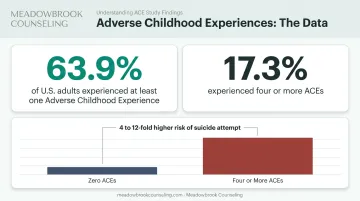
That caveat matters because adversity isn't limited to single, dramatic incidents. Chronic stressors like community violence, ongoing poverty, or persistent household dysfunction count too, and they often go unnoticed until a trained eye catches the pattern.
This is where early, specialized support makes a measurable difference. Recognizing these signs before they harden into long-term coping struggles can shift a child's developmental trajectory. Meadowbrook Counseling's therapists provide dedicated children's therapy for developmental, behavioral, and trauma-related concerns at office locations across Utah, Arizona, and several other states, with telehealth options for families who need flexibility.
How Childhood Experiences Shape the Adult Brain and Behavior
Trauma doesn't just fade with time. It can physically reshape how the brain processes threat and regulates emotion.
How Does Childhood Trauma Affect the Brain in Adulthood?
Three brain regions show up repeatedly in this research:
- The amygdala, the brain's threat detector, can become more reactive. One study of mother-child pairs found that violence exposure at home predicted increased sensitization to threat over repeated trials (PMC)
- The hippocampus, involved in memory, shows smaller volume more consistently in maltreated adults, especially those with PTSD, than in maltreated children (PMC)
- The prefrontal cortex, responsible for decision-making and emotional regulation, often shows altered connectivity with the amygdala after maltreatment
This isn't universal brain damage. It's context-dependent adaptation, sometimes an initially protective response to a genuinely dangerous environment that later becomes a liability.
The National Child Traumatic Stress Network describes fight, flight, and freeze as automatic survival responses triggered by threat or by reminders of past threat. For adults with childhood trauma histories, seemingly minor reminders (a raised voice, a slammed door) can trigger a full-body stress response that feels wildly disproportionate to the present moment.
Attachment Patterns Follow You Into Adult Relationships
These same threat-detection systems don't just react to loud noises or sudden movements. They shape how people connect with romantic partners, since early attachment experiences often become the blueprint for adult relationships. Someone who learned early on that caregivers were unpredictable may struggle to trust a partner, even a reliable one. Someone raised with emotional distance might avoid vulnerability altogether.
A 2018 study tracking participants across roughly 30 years found that childhood neglect predicted greater adult attachment avoidance, while both neglect and physical abuse predicted attachment anxiety later in life (PMC).
Mental Health and Physical Health Connections
A meta-analysis of 124 studies found meaningful associations between childhood maltreatment and adult mental health. Emotional abuse showed the strongest links, with adults roughly 3 times more likely to experience depression and anxiety disorders compared to non-abused peers.
The physical toll is documented too. One long-term study tracked over 17,000 ACE participants and found that, among those who died during the follow-up period, adults with six or more ACEs died at a mean age of 60.6, compared to 79.1 for those with no ACEs (PMC). That's an observed mortality pattern in one cohort, not a guaranteed outcome for every individual.
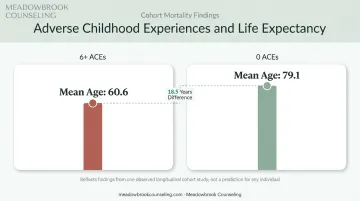
None of this means the brain's early adaptations are permanent sentences. Trauma-informed approaches like EMDR are specifically designed to help the nervous system recognize that old threats are no longer present, which is why licensed trauma specialists build treatment around this neuroscience rather than around willpower alone.
Signs Unresolved Childhood Experiences May Be Affecting You Today
Unresolved childhood trauma rarely announces itself directly. It shows up sideways, in patterns that feel like "just who you are" rather than echoes of something older.
Common patterns include:
- Chronic anxiety or hyperarousal: feeling on edge even when nothing is objectively wrong
- Emotional numbing or dissociation: feeling disconnected from your own feelings or body
- Difficulty trusting partners: expecting betrayal or abandonment even in stable relationships
- Over-functioning or people-pleasing tendencies: difficulty saying no or setting boundaries
- Social withdrawal: pulling away from connection even when you crave it
These patterns shape more than your inner world. They surface in concrete ways across major life areas:
- Careers - over-working to earn approval or prove your worth
- Parenting - repeating inherited patterns, or overcorrecting so hard you create new problems
- Romantic relationships - choosing partners who feel familiar, even when familiar isn't healthy
If you keep having the same emotional reaction across different relationships or situations, that repetition is data. It's worth asking where you first learned to feel this way.
Healing and Moving Forward: Professional Support Options
Here's the encouraging part. The brain retains neuroplasticity, its ability to reorganize and adapt, well into adulthood (NCBI). Healing from childhood trauma isn't limited to a specific age window.
Several evidence-based approaches show real promise:
- EMDR (Eye Movement Desensitization and Reprocessing) - a 2018 systematic review of six randomized trials found EMDR generally improved trauma, depression, and anxiety symptoms in people with complex childhood trauma histories
- Trauma-focused CBT - a manualized approach with 15 supporting trials, widely used with children, families, and increasingly recommended for adult PTSD
- Somatic and body-based therapies - preliminary research shows improvement in PTSD-related and physical symptoms, though the evidence base is still developing
Finding the right kind of support matters as much as the approach itself.
What Is a Child Trauma Specialist?
A child trauma specialist is a licensed mental health professional with specific training in identifying and treating trauma in children and adolescents. Unlike general therapists, they use age-appropriate, evidence-based interventions built around developmental stage, not just symptom checklists. Adults reflecting back on childhood trauma may also benefit from working with a specialist experienced in early developmental wounds, even decades later.
At Meadowbrook Counseling, therapists like Rosario Toral, ACMHC, bring EMDR certification directly into this work, drawing on both clinical training and lived experience to help clients process trauma and build resilience. Sessions are paced to what each client can tolerate, not a fixed timeline.
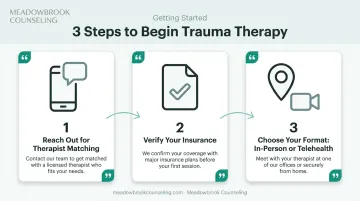
Getting started is usually simpler than people expect:
- Reach out for therapist matching - describe what you're working through, and the intake team helps connect you with a therapist trained in trauma-focused modalities
- Verify your insurance - Meadowbrook Counseling works with major plans including Aetna, BCBS, Cigna, UnitedHealthcare, and Medicaid, and can help confirm coverage before your first session
- Choose your format - in-person sessions are available across Utah, Massachusetts, Arizona, Washington, and several other states, with telehealth options extending access further
Frequently Asked Questions
What is a child trauma specialist?
A child trauma specialist is a licensed mental health professional trained specifically in identifying and treating trauma in children. They use age-appropriate, evidence-based interventions tailored to a child's developmental stage.
What are the 4 types of childhood trauma?
The four recognized categories are physical abuse, emotional abuse, sexual abuse, and neglect. Each can occur alone or alongside the others, and effects vary by severity and duration.
How does childhood trauma affect the brain in adulthood?
Chronic childhood stress can alter the amygdala, hippocampus, and prefrontal cortex, regions responsible for threat detection, memory, and emotional regulation. This often contributes to heightened anxiety and relationship difficulties in adulthood.
Can childhood trauma be healed in adulthood?
Yes. The brain retains neuroplasticity throughout life, and therapies like EMDR and trauma-focused CBT have research support for helping adults process and heal from early trauma at any age.
What are common signs of unresolved childhood trauma in adults?
Common signs include difficulty trusting others, chronic anxiety, people-pleasing tendencies, emotional numbness, and reactivity that feels disproportionate to the present situation.
Is therapy effective for addressing childhood trauma?
Yes. A licensed trauma-focused therapist typically starts by building safety and trust before addressing specific memories or triggers. Many clients notice reduced reactivity within the first several sessions.
If any of this feels familiar, reaching out to a therapist trained in trauma-focused care is a reasonable next step. Meadowbrook Counseling offers therapist matching and insurance verification support across multiple states to make that first step easier.