
Introduction
Living with OCD can mean spending hours trapped in a loop — an intrusive thought arrives, anxiety spikes, a ritual temporarily quiets it, and then the whole cycle restarts. For many people, this pattern consumes their mornings, derails their work, and strains their relationships before anyone around them realizes what's happening.
According to NIMH, OCD affects approximately 1.2% of U.S. adults in any given year, with serious functional impairment in over half of those cases. Despite this, a 2021 review found an average 17-year gap between symptom onset and receiving appropriate treatment — partly because OCD is frequently misdiagnosed or treated with approaches that weren't designed for it.
That gap exists despite OCD being one of the most treatable mental health conditions when matched with the right interventions.
This guide covers every major treatment option — from first-line ERP therapy and medication to adjunctive approaches and advanced interventions for the most persistent cases — so you can build a plan that actually works.
Key Takeaways
- ERP (Exposure and Response Prevention) is the gold-standard, first-line therapy for OCD, backed by 36 randomized controlled trials
- SSRIs are the first-line medications, prescribed at higher doses and longer durations than for depression
- Combining ERP with an SSRI typically produces better outcomes for moderate-to-severe OCD
- ACT and mindfulness can strengthen treatment response when used alongside ERP — not instead of it
- TMS and DBS are options when standard treatments fall short, but both require evaluation by a specialist
What Makes OCD Treatment Different From Other Anxiety Disorders
OCD shares surface features with anxiety disorders — worry, avoidance, distress — but treating it like generalized anxiety is a mistake that delays real recovery.
Why Generic Anxiety Approaches Fall Short
Techniques that work well for other anxiety conditions can backfire with OCD. Relaxation training, for example, can become a form of avoidance if it's used to escape exposure-related distress rather than tolerate it. Reassurance-seeking — whether from a therapist or family member — can function as a compulsion, temporarily reducing anxiety while reinforcing the obsession-compulsion cycle.
NICE guidelines specifically recommend CBT with ERP and/or an SSRI as the treatments of choice for OCD, finding insufficient evidence for non-specific supportive or psychodynamic therapy as primary treatments.
The Stepped-Care Model
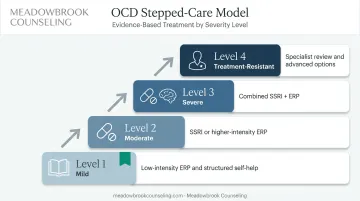
OCD treatment follows a stepped-care sequence, escalating only when lower-intensity options have been tried adequately:
| Impairment Level | Recommended Approach |
|---|---|
| Mild | Low-intensity ERP (up to 10 therapist hours), structured self-help |
| Moderate | SSRI or higher-intensity ERP (over 10 therapist hours) |
| Severe | Combined SSRI + ERP |
| Treatment-resistant | Specialist review, second-line or advanced options |
Accurate Diagnosis Comes First
Any solid treatment plan starts with a thorough evaluation. A proper OCD assessment uses the clinician-rated Y-BOCS (Yale-Brown Obsessive Compulsive Scale) as the standard severity measure and documents:
- Obsession content and compulsion type
- Time spent in the cycle daily
- Avoidance behaviors and functional impairment
- Family accommodation patterns
- Any co-occurring conditions
OCD commonly co-occurs with depression (~41% lifetime prevalence in clinical samples), anxiety disorders (~33%), and ADHD (~16%). Missing these comorbidities can undermine even a well-designed treatment plan.
First-Line OCD Treatments: ERP Therapy and Medication
Exposure and Response Prevention (ERP)
ERP is a specialized form of CBT built around one core idea: anxiety decreases on its own when you stop performing the compulsion.
The treatment works by deliberately exposing someone to their fear triggers while blocking the ritual response. The goal isn't to punish — it's to train the brain that the feared outcome doesn't actually require the compulsion to resolve.
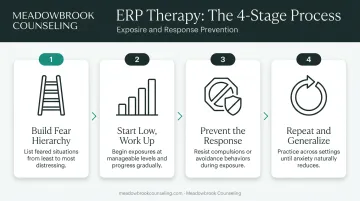
How it works in practice:
- Build a fear hierarchy — therapist and client map out situations from mildly anxiety-provoking to most feared
- Start low, work up — exposures begin where anxiety is manageable, not overwhelming
- Prevent the response — the client faces the trigger without performing the ritual, allowing natural anxiety reduction
- Repeat and generalize — each successful exposure weakens the obsession-compulsion link
For someone with contamination OCD, an early exposure might be touching a doorknob and waiting 30 minutes before washing hands. Eventually, exposures escalate to higher-anxiety situations — all with the same rule: no ritual.
A 2021 meta-analysis of 36 RCTs involving 2,020 participants found an overall ERP effect size of g=0.74, with stronger effects against psychological placebo comparisons. The IOCDF describes a typical course as 12–20 sessions, though severity, avoidance patterns, and homework completion all affect duration.
ERP is available across outpatient settings, intensive outpatient programs, and via telehealth. A 2022 retrospective study found meaningful symptom improvement with remote ERP delivery — a meaningful access improvement for people in areas with few OCD specialists.
ERP isn't about eliminating anxiety. It's about breaking the rule that anxiety must be resolved through a ritual. Clients who complete ERP don't stop feeling anxious — they stop needing to act on it.
Medication: SSRIs and Related Options
SSRIs are the first-line pharmacological treatment for OCD, but prescribing them for OCD looks different from prescribing them for depression.
FDA-approved SSRIs for adult OCD:
| Medication | Starting Dose | Target/Maximum |
|---|---|---|
| Fluoxetine | 20 mg/day | 20–60 mg/day (max 80 mg) |
| Fluvoxamine | 50 mg nightly | 100–300 mg/day |
| Sertraline | 50 mg/day | 50–200 mg/day |
| Paroxetine | 20 mg/day | Up to 60 mg/day |
Escitalopram has evidence for OCD but is off-label in the U.S. Clomipramine, a tricyclic antidepressant with strong serotonin reuptake inhibition, is FDA-approved and can be highly effective — particularly when SSRIs produce insufficient response — though its anticholinergic and cardiac risks generally keep it as a later option.
Key differences from depression prescribing:
- OCD typically requires higher doses than depression
- A full trial takes 8–12 weeks, with 4–6 weeks at the maximum tolerated dose before assessing response
- Trying multiple SSRIs before finding the right fit is common
- Never stop abruptly — always taper with physician guidance to avoid discontinuation symptoms
Adjunctive and Second-Line Therapies for OCD
These therapies are not replacements for ERP or medication. Used alongside first-line treatment, several have meaningful evidence. Used alone for OCD, most don't.
Adjunctive Options (Added to ERP or Medication)
- Acceptance and Commitment Therapy (ACT): Helps clients change their relationship with intrusive thoughts — defusing from them rather than fighting them. A 2010 RCT of 79 participants found post-treatment clinical response rates of 46–56% for ACT versus 13–18% for relaxation control.
- Cognitive Therapy (CT): Targets distorted beliefs driving OCD — inflated responsibility, overestimation of threat, thought-action fusion. Most CT protocols for OCD are combined with exposure work rather than used in isolation.
- Mindfulness-Based Cognitive Therapy (MBCT): A 2021 RCT of 123 participants found MBCT improved mild-to-moderate unmedicated OCD with gains maintained at six months.

Second-Line Options for Those Who Can't Access ERP
Some individuals can't tolerate, access, or initially engage with standard ERP. These approaches have emerging evidence:
- Inference-Based CBT (I-CBT): Targets the reasoning processes that generate obsessional doubt rather than the feared consequences directly; a 2022 multicenter RCT showed improvement similar to appraisal-based CBT.
- Metacognitive Therapy (MCT): A 2024 RCT of 74 participants found results noninferior to ERP at post-treatment, though that equivalence did not hold at six-month follow-up.
- SPACE (Supportive Parenting for Anxious Childhood Emotions): A parent-based intervention for pediatric OCD aimed at reducing family accommodation; evidence remains preliminary.
What Doesn't Work for OCD
The IOCDF is clear that EMDR, hypnotherapy, and psychoanalysis have not been found effective for OCD and are not recommended as primary OCD treatments. This speaks to OCD's specific mechanism, not the broader validity of those modalities.
EMDR, for example, has strong evidence for trauma and PTSD treatment. It simply does not address the obsession-compulsion cycle the way ERP does, which is why the research support for OCD specifically isn't there.
Advanced Treatments for Treatment-Resistant OCD
"Treatment-resistant" has a specific meaning: failed adequate trials of at least one SSRI (8–12 weeks including 4–6 weeks at maximum tolerated dose) plus an adequate course of ERP delivered by a trained clinician. This threshold matters before escalating to more intensive interventions.
Transcranial Magnetic Stimulation (TMS)
TMS uses focused magnetic fields to stimulate OCD-related brain circuits. It's non-invasive, doesn't require surgery, and was FDA-cleared for OCD in August 2018.
The pivotal trial randomized 99 patients to active or sham deep TMS after symptom provocation. Results:
- 38.1% active response vs. 11.1% sham at post-treatment (defined as ≥30% Y-BOCS reduction)
- 45.2% vs. 17.8% at one-month follow-up
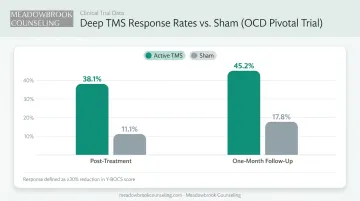
TMS is a meaningful option for those who haven't responded to standard treatments. It won't work for everyone, but roughly 40–45% of appropriate candidates see clinically meaningful improvement.
Deep Brain Stimulation (DBS)
For patients who don't respond to TMS or other approaches, DBS represents the most intensive option available. It involves surgically implanted electrodes that modulate OCD-related brain circuits. The FDA granted a Humanitarian Device Exemption for DBS in severe, treatment-resistant adult OCD in 2009 (not standard premarket approval), requiring institutional oversight and limiting it to narrowly defined cases.
This is a last-resort intervention. Key constraints include:
- Surgical risk: Implantation carries inherent procedural and anesthetic risks
- Narrow eligibility: Reserved for adults with severe, well-documented treatment-resistant OCD
- Limited access: Available at only a handful of specialized centers nationwide
- Oversight required: Institutional review is mandatory given the Humanitarian Device Exemption status
Clinicians reserve DBS only after exhausting and documenting all other adequate treatment options.
How to Build Your OCD Treatment Plan
A workable OCD treatment plan follows a clear sequence rather than grabbing from a menu of interchangeable options.
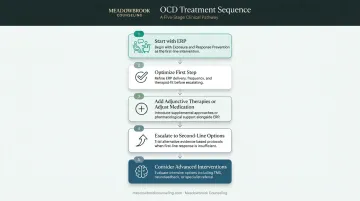
The Evidence-Based Sequence
- Start with ERP (with or without an SSRI, based on severity)
- Optimize the first step — ensure adequate dose, duration, and therapist training before declaring failure
- Add adjunctive therapies (ACT, CT, mindfulness) or adjust medication if response is partial
- Escalate to second-line options (I-CBT, MCT) for those who can't engage with standard ERP
- Consider advanced interventions (TMS, DBS) only after verified adequate failures at all prior steps
This should be a collaborative process between patient and clinician — not a unilateral decision at any stage.
Choosing the Right Therapist
General therapy experience is not a substitute for OCD specialization. Poorly delivered exposure work, or substituting ineffective modalities for ERP, can delay recovery by months or years.
The IOCDF recommends asking prospective therapists:
- "Are you specifically trained in ERP for OCD, and how many OCD clients are you currently treating?"
- "Do you assign between-session exposure practice, and how do you measure treatment progress?"
- "Can you coordinate with a prescriber if medication becomes part of the plan?"
The Role of Self-Help and Family Support
Formal treatment gets the core work done, but structured support between sessions strengthens outcomes:
- Evidence-based OCD workbooks and internet-based CBT have meaningful support as complements to therapy (a 2016 meta-analysis found a larger effect when therapist-guided versus standalone)
- Peer support groups through organizations like IOCDF connect people with shared experience and practical strategies
- Family psychoeducation helps family members recognize accommodation behaviors — reassurance-giving, ritual assistance — that inadvertently maintain OCD; a study of 18 patient-family dyads found that two family sessions added to ERP significantly reduced both accommodation and OCD symptoms versus ERP alone
Working with Meadowbrook Counseling
Meadowbrook Counseling has therapists specifically trained in ERP and evidence-based adjunctive modalities including ACT and MBCT. Diana Mansfield lists ERP and OCD treatment among her specializations; Kristie Jensen (LCSW) holds a Certified Clinical Anxiety Treatment Professional credential with OCD specialization.
Meadowbrook offers both in-person and telehealth appointments across Utah, Idaho, Massachusetts, Texas, Colorado, Florida, and other states. Key logistics at a glance:
- Accepts major insurance plans (Aetna, Cigna, UnitedHealthcare, Blue Shield Regence, Select Health, TriCare, and state Medicaid)
- Upfront insurance verification available before your first session
- Intake team reachable at 801-655-5450 or meadowbrookcounseling.com
Frequently Asked Questions
What is the best treatment for OCD?
ERP (Exposure and Response Prevention) is the gold-standard first-line treatment, with the strongest evidence base of any psychological intervention for OCD. SSRIs are the first-line medication option. For moderate-to-severe OCD, combining both typically produces better outcomes than either alone.
What is the hardest OCD to treat?
Cases involving poor insight, severe avoidance, significant comorbidities like depression, or primarily mental (covert) compulsions tend to be more resistant to standard treatment. These presentations often benefit from more intensive delivery formats, medication optimization, or second-line approaches.
What are the four types of OCD?
The commonly referenced subtypes are contamination/cleaning, doubt and checking, symmetry and ordering, and intrusive/forbidden thoughts. In practice, OCD exists on a spectrum and many people experience overlapping subtypes rather than fitting neatly into one category.
How long does OCD treatment take?
Mild OCD may respond within 8–20 ERP sessions, while moderate-to-severe cases typically require longer courses. Because OCD often follows a chronic, fluctuating pattern, relapse prevention planning and booster sessions are common — it's rarely a single fixed course of treatment.
Can OCD be treated without medication?
ERP alone is effective for many people, particularly those with mild-to-moderate symptoms. Medication is typically added for more severe presentations, when therapy hasn't produced sufficient improvement, or when co-occurring depression requires pharmacological treatment.
What should I look for in an OCD therapist?
Ask whether they are specifically trained in ERP, how many OCD clients they currently treat, and whether they use between-session exposures and track progress with standardized measures. General mental health experience isn't sufficient — OCD requires a clinician who knows the specific protocol.