

That's where EMDR (Eye Movement Desensitization and Reprocessing) enters the conversation. Originally built for trauma, EMDR is now being explored as a complementary tool for people with ADHD, particularly those carrying unresolved emotional baggage. It's not a replacement for medication or behavioral therapy. It's not a cure for ADHD, either.
This article breaks down what the emerging research actually shows, what an EMDR session for ADHD looks like in practice, who tends to benefit most, and how to find a therapist qualified to do this work safely.
Key Takeaways
- EMDR doesn't alter ADHD's underlying neurobiology, but it can ease trauma and negative self-beliefs that intensify symptoms
- Current evidence comes from case studies, not large clinical trials, so EMDR works best as a complement, not a replacement
- People with ADHD and a trauma history, chronic stress, or repeated criticism tend to see the most benefit
- Finding a certified, ADHD-informed EMDR therapist matters for both safety and results
What Is EMDR Therapy?
Psychologist Francine Shapiro developed EMDR in 1987 after noticing that eye movements seemed to lessen the intensity of disturbing thoughts. By 1991, her original technique had evolved into the full EMDR protocol used today.
EMDR runs on the Adaptive Information Processing (AIP) model. The theory: distressing memories that weren't fully processed at the time can stay "stuck," continuing to trigger present-day emotional reactions. Bilateral stimulation, meaning guided eye movements, taps, or tones, helps the brain reprocess these stuck memories so they lose their emotional charge.
That reprocessing mechanism is what's caught the attention of ADHD researchers, since many people with ADHD also carry unresolved trauma from years of struggling in school, work, or relationships. EMDR's track record centers on trauma, though:
- The American Psychological Association's 2025 guidelines recognize EMDR as a viable treatment for PTSD in adults
- The World Health Organization and the VA/DoD have issued similar recommendations for trauma-focused care
This trauma-specific track record is driving curiosity about whether EMDR could help people whose ADHD is compounded by difficult life experiences.
Important distinction: none of these organizations recognize EMDR as an evidence-based treatment for core ADHD symptoms. The interest is trauma-focused, not ADHD-focused.
The ADHD-Trauma Connection: Why EMDR Enters the Conversation
ADHD is neurodevelopmental, not caused by trauma. But people with ADHD tend to accumulate more adverse experiences over a lifetime than people without it — repeated rejection, academic failure, constant correction. Those experiences can function a lot like trauma, even if no single event would qualify as "capital-T Trauma."
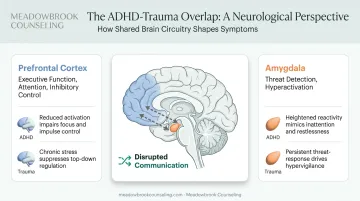
Overlapping Brain Regions
ADHD and trauma responses share some neurological real estate:
- Both involve difficulties in the prefrontal cortex, which governs executive function, attention, and inhibitory control
- Both can involve amygdala hyperactivation, the brain's alarm system for perceived threats
- Pediatric PTSD research has found disrupted communication between the prefrontal cortex and amygdala, similar to patterns seen in some ADHD-related executive dysfunction
The result is a feedback loop: emotional reactivity makes focus harder, and poor focus creates more opportunities for failure and criticism, which feeds the reactivity.
What the Case Research Actually Shows
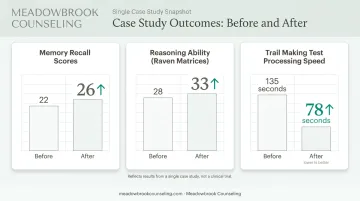
A frequently cited case report, published in the Journal of Personalized Medicine in January 2023, involved a child diagnosed with ADHD and mild PTSD at age 12, who received EMDR treatment at age 15. Researchers targeted a single traumatic memory (witnessing his mother's overdose at age 3) across two 65-minute EMDR sessions.
Nine months later, testing showed meaningful gains:
- Memory recall scores improved from 22 to 26
- Reasoning ability (Raven matrices) rose from 28 to 33
- Processing speed on the Trail Making Test dropped from 135 to 78 seconds
That's a real improvement. But it's one child, one case, no control group. The study's own authors called for randomized trials before drawing broader conclusions. A separate case report on a 9-year-old with ADHD, PTSD, and oppositional defiant disorder found something equally important: PTSD and behavioral symptoms improved dramatically after five EMDR sessions, but the child's core ADHD attention and hyperactivity scores stayed roughly the same as before the trauma occurred.
That's the headline finding across both cases: EMDR seems to help trauma-driven symptoms, not the ADHD itself.
Rejection Sensitive Dysphoria
If EMDR targets trauma-driven symptoms rather than core ADHD traits, one prime target is the emotional pain many people with ADHD carry around rejection. Clinicians sometimes call this Rejection Sensitive Dysphoria (RSD). A qualitative study of 43 young adults with ADHD documented patterns of rumination, self-blame, and physical distress tied to rejection experiences.
RSD isn't a formal clinical diagnosis. But the pattern is real for many people, and EMDR's memory-reprocessing approach may help by targeting the specific painful memories (a harsh teacher, a public correction, a rejected job application) that keep fueling that reactivity.
EMDR won't cure ADHD. What it may do is quiet the trauma-driven noise in the background, freeing up mental bandwidth that would otherwise go toward managing shame and fear. Therapists trained in EMDR, including those on Meadowbrook Counseling's team, often use this approach alongside ADHD-focused strategies rather than as a replacement for them.
What Does an EMDR Session for ADHD Look Like?
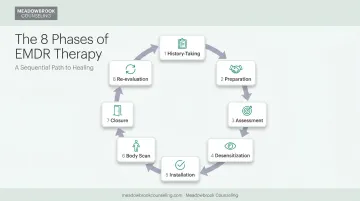
EMDR follows a structured eight-phase protocol:
- History-taking and treatment planning — identifying target memories and current struggles
- Preparation — building coping skills and trust before touching anything difficult
- Assessment — pinpointing the specific memory, image, and belief to target
- Desensitization — bilateral stimulation while focusing on the distressing memory
- Installation — replacing negative beliefs with positive ones
- Body scan — checking for lingering physical tension tied to the memory
- Closure — returning the client to emotional stability before ending
- Re-evaluation — checking progress at the start of the next session
This structure stays the same for every client, but the content shifts for ADHD. Therapists at practices like Meadowbrook Counseling often adapt the framework to target ADHD-specific negative beliefs, things like "I'm not good enough" or "I'm always failing," alongside more traditional trauma memories from abuse or accidents.
These beliefs shape how a session is planned, which brings up a practical question: what does the actual session structure look like day to day?
Practical logistics:
- Sessions typically run 60-90 minutes
- The American Psychological Association notes a typical course runs 6-12 sessions, often 1-2 times weekly
- Treatment length depends on how many memories need processing and the client's pace
For clients with ADHD, therapists sometimes vary the bilateral stimulation method more frequently. Switching between eye movements, tapping, or auditory tones helps accommodate attention or concentration difficulties during sessions.
Benefits, Candidates & Limitations: Is EMDR Right for You?
Who Tends to Benefit Most
EMDR isn't for every person with ADHD. It tends to help most when someone also has:
- A documented trauma history or adverse childhood experiences
- Co-occurring anxiety, depression, or PTSD
- A persistent feeling of being "stuck" despite consistent medication and behavioral strategies
- Chronic exposure to "small t" traumas, like repeated academic struggles or years of critical feedback
This overlap is common: research on adults with ADHD found that 47.1% had an anxiety disorder and 38.3% had a mood disorder in the prior 12 months. Other studies point to similarly high rates of co-occurring PTSD. This overlap is exactly why a combined, trauma-informed approach matters for so many.
Potential Benefits Beyond Symptom Reduction
- Increased self-esteem and reduced self-criticism
- Less avoidance and procrastination tied to fear of failure
- Better emotional regulation in relationships
- Lower overall anxiety and stress load
EMDR Works Best as a Complement
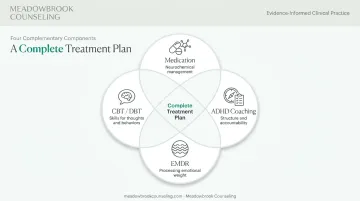
Think of EMDR as clearing emotional roadblocks, not replacing the rest of your treatment plan:
- Medication manages the neurochemical side of ADHD
- CBT or DBT builds skills for managing thoughts and behaviors
- ADHD coaching provides structure and accountability
- EMDR processes the emotional weight that can undermine all three
Key Limitations
- EMDR does not change ADHD's underlying neurobiology
- It requires a specialized, EMDRIA-certified therapist with additional training beyond basic EMDR
- Clients need a baseline of emotional stability before diving into trauma memory processing (this is Phase 2's whole purpose)
- Session count and results vary significantly by individual; there's no universal timeline
Setting realistic expectations with your provider before starting is one of the most important steps in the process.
Making EMDR Part of a Complete ADHD Treatment Plan
The strongest outcomes typically come from a personalized plan, not a single therapy in isolation. That might mean medication plus ADHD coaching plus EMDR, adjusted over time as needs shift.
At Meadowbrook Counseling, certified EMDR practitioners like Rosario Toral, ACMHC, bring both clinical training and trauma-informed care to clients navigating ADHD alongside emotional overwhelm. The goal isn't to replace what's already working. It's to address the trauma and negative self-beliefs that keep undermining it.
Once you've decided EMDR is worth exploring, finding the right support matters just as much as the decision itself. A few practical advantages worth knowing:
- Insurance verification before your first session: Meadowbrook's billing team confirms your benefits so there are no surprises
- Personalized therapist matching: the intake team connects you with a provider suited to your specific concerns
- Office locations across Utah, Washington, Arizona, Wisconsin, Massachusetts, Texas, Idaho, Florida, and Colorado, with both in-person and telehealth options
If standard ADHD treatment hasn't fully addressed the emotional side of things—shame, reactivity, that sense of being perpetually behind—it's worth raising EMDR with a licensed provider. You don't have to figure out if it's right for you alone.
Frequently Asked Questions
Does EMDR work if you have ADHD?
EMDR doesn't cure ADHD itself, but it can reduce trauma-related emotional dysregulation and negative beliefs that intensify ADHD symptoms. It works best when trauma or chronic stress is also part of the picture.
How many sessions of EMDR are needed?
Session count varies widely, often 6-12 or more, depending on how many memories need processing, trauma complexity, and your coping resources. Some people see shifts sooner; others need a longer course.
What not to do after EMDR?
Avoid making major decisions, skipping self-care or grounding practices, or suppressing emotions that surface after a session. Rest, and lean on the coping tools your therapist taught you during Phase 2.
Is EMDR considered an evidence-based treatment for ADHD?
EMDR is well-established for PTSD, but it's still in an emerging evidence phase specifically for ADHD. Current support comes mainly from case studies and clinical theory, not large randomized trials.
Can children with ADHD do EMDR therapy?
Yes, EMDR can be adapted for children using play, art, or storytelling techniques. It should only be done with a therapist trained in both EMDR and childhood ADHD to ensure safety and effectiveness.
Does insurance cover EMDR therapy for ADHD?
Many insurance plans cover EMDR as a form of psychotherapy, but coverage varies by plan and provider. Verify your specific benefits with your provider, such as Meadowbrook Counseling, before starting treatment.