
Afterward comes the shame spiral: Why did I react like that? What's wrong with me?
Here's what many people don't realize: problematic anger rarely stems from poor self-control. It's often rooted in unresolved trauma or distressing past experiences that never got fully processed.
EMDR therapy offers a research-backed way to address what's actually driving the anger, not just manage the outbursts after they happen. At Meadowbrook Counseling, EMDR-trained therapists work with clients across multiple states to help identify and reprocess the experiences fueling chronic anger and rage.
Key Takeaways
- EMDR targets the memories fueling anger, not just the behavior itself
- Anger often masks hurt, fear, or shame hiding underneath (the "iceberg" effect)
- Both major trauma and repeated "small t" wounds (neglect, bullying) can wire the brain for chronic anger
- Treatment follows a structured 8-phase process using bilateral stimulation
- 7.8% of U.S. adults report a lifetime history of poorly controlled anger (Okuda et al., 2015)
Understanding Anger: Why a Protective Emotion Can Become Overwhelming
Anger isn't the enemy. It's a signal.
At its healthiest, anger tells you a boundary got crossed. It's part of your fight-or-flight response, and it can motivate real change: leaving a bad job, ending a harmful relationship, standing up for yourself.
The problem isn't anger itself. It's what happens when anger stops being proportionate to what's actually happening.
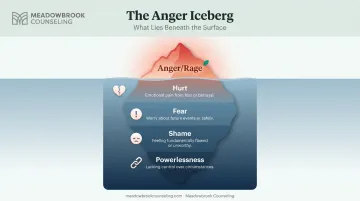
The Anger Iceberg
Visible rage is often just the tip of something bigger. Beneath the surface, you'll usually find:
- Hurt that feels too vulnerable to express directly
- Fear of losing control, being abandoned, or getting hurt again
- Shame about past experiences or current reactions
- Powerlessness from situations where you had no say
Anger becomes the "acceptable" emotion that covers for the ones that feel too raw to show.
When Anger Becomes Dysregulated
Dysregulated anger shows up as:
- Reactions wildly out of proportion to the trigger
- Chronic hostility or a short fuse that never seems to reset
- Passive-aggression instead of direct expression
- Harsh self-criticism or anger turned inward
Chronic anger takes a physical toll, too. Stress hormones like adrenaline and cortisol spike blood pressure and heart rate. Long-term activation raises the risk of high blood pressure, heart disease, and stroke, according to the Mayo Clinic.
Research consistently links unmanaged anger and hostility to a higher risk of coronary events, even in people with otherwise healthy hearts.
The goal of therapy isn't to eliminate anger. It's to restore it as a proportionate, useful signal instead of a constant state, which is where targeted approaches like EMDR come in.
The Trauma-Anger Connection: What's Really Driving Your Rage
EMDR is built on something called the Adaptive Information Processing (AIP) model. The basic idea: your brain normally files away distressing experiences so they stop feeling urgent.
Sometimes, though, a memory gets "stuck." It stays stored with all its original emotion, physical sensation, and belief intact instead of settling into the past where it belongs.
Why Old Wounds Hijack Present Reactions
When something in the present resembles that stuck memory, even loosely, your brain can react as though the original event is happening right now. That's why a raised voice from your boss can trigger the same fury you felt at eight years old, facing a parent's anger.
This helps explain both types of trauma that fuel adult anger:
- "Big T" traumas: Abuse, major accidents, assault, events involving real or threatened harm
- "Small t" traumas: Chronic criticism, emotional neglect, bullying, feeling consistently dismissed or unseen
A Familiar Pattern
Picture someone who grew up with a highly critical parent. As an adult, they receive gentle, constructive feedback from a manager, nothing harsh. Yet they feel a rush of defensiveness, maybe even rage, completely out of proportion to the comment itself.
That's not an overreaction. That's an old wound getting touched.
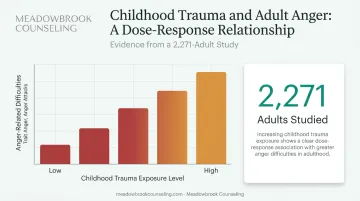
Research backs this up. A 2023 study of 2,271 adults found a dose-response relationship between childhood trauma and every measured anger construct: more trauma exposure correlated with more anger-related difficulties, including trait anger and anger attacks.
Separately, a study following 3,294 adults over roughly nine years found that anger expression patterns helped explain the link between childhood trauma and later depression, panic disorder, and alcohol use.
Here's the limitation with talk therapy alone: it can help you understand why you react the way you do. It's much less effective at resolving the emotional and physical charge still living in your nervous system. You can know exactly why you're angry and still feel the same rush every single time. That gap is where EMDR does different work.
How EMDR Therapy Treats Anger and Rage
EMDR uses bilateral stimulation, meaning eye movements, tapping, or alternating auditory tones, while a client focuses briefly on a distressing memory. This dual-attention process is thought to help the brain reprocess memories that got stuck, though researchers note the exact mechanism is still being studied rather than settled science.
As reprocessing happens, the goal is to loosen the grip of negative beliefs tied to the memory, things like:
- "I'm powerless."
- "I'm not safe."
- "I have to protect myself at all costs."
And replace them with more adaptive ones:
- "I have choices now."
- "I can handle this calmly."
- "That was then. This is now."
The Phased Process, Applied to Anger
That belief shift doesn't happen randomly. It unfolds through a standardized, multi-phase structure, per EMDRIA, which outlines eight phases total. Here's how the core stages typically play out when the target is anger:
History-taking – Your therapist maps out your anger triggers and starts identifying the root experiences connected to them, whether that's a specific event or a pattern of smaller ones.
Preparation – Before touching any difficult material, you build grounding and emotional regulation skills. This matters especially for anger work, since intense emotion can already feel hard to manage.
Desensitization & reprocessing – You briefly bring the target memory to mind while engaging in bilateral stimulation, gradually reducing its emotional charge.
Installation & body scan – Positive beliefs get reinforced, and any remaining physical tension (clenched jaw, tight chest, that familiar heat in your face) gets addressed directly.
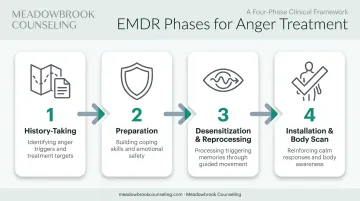
These remaining phases (closure and reevaluation) round out the full protocol, checking in on progress and preparing you for the next session. At Meadowbrook Counseling, EMDR-trained clinicians such as Rosario Toral, ACMHC, guide clients through this process at a pace suited to their specific triggers and history. No two anger patterns look identical, so the targets and pacing shift based on what's actually underneath each client's reactions.
Signs It May Be Time to Seek Professional Support
Not sure if your anger warrants professional help? Consider these patterns:
- Your reactions feel disproportionate to what actually triggered them
- Outbursts leave you feeling regretful or ashamed afterward
- Anger is straining your relationships, friendships, or work performance
- People close to you have expressed fear or concern about your reactions
- You notice the same specific triggers repeatedly: feeling dismissed, criticized, ignored, or disrespected
That last one is worth paying attention to. Consistent, specific triggers usually point to unresolved wounds underneath, not a character flaw.
If your anger consistently spikes around certain themes, that's not randomness. That's information about where the old injury lives.
None of this means something is fundamentally wrong with you. It means your nervous system learned, at some point, that anger was the safest or only available response. That pattern is highly treatable, and a therapist trained in EMDR can help you trace it back to its source.
Benefits of EMDR for Anger and Getting Started at Meadowbrook Counseling
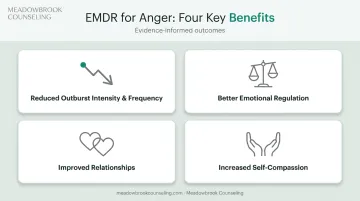
Clients working through EMDR for anger-related concerns often notice:
- Reduced intensity and frequency of outbursts over time
- Better emotional regulation, meaning more space between trigger and reaction
- Improved relationships as reactive patterns soften
- Increased self-compassion, replacing the shame cycle that often follows anger episodes
Results vary by person and depend on how longstanding or complex the underlying patterns are. Some people notice shifts within the first several reprocessing sessions rather than needing months of weekly talk therapy to see movement. Others, especially those with more complex trauma histories, need a longer course of treatment. Both are normal.
How to Start
Whatever your timeline looks like, taking the first step is the same for everyone. Meadowbrook Counseling offers personalized therapist-matching to connect you with an EMDR-trained clinician suited to your specific concerns, across offices in Utah, Washington, Arizona, Wisconsin, Massachusetts, Texas, and beyond. The team also assists with insurance verification before your first session, so you know what to expect financially going in.
To get started:
- Call (801) 655-5450 or visit meadowbrookcounseling.com/contact
- Complete an intake to share what you're experiencing
- Get matched with an EMDR-trained therapist suited to your needs
- Confirm your coverage and any out-of-pocket costs before your first appointment
Frequently Asked Questions
Does EMDR help with anger issues?
EMDR can help with anger rooted in trauma by targeting the underlying memories rather than just managing outbursts as they happen. It's used for anger tied to distressing experiences even without a formal PTSD diagnosis.
Do you talk during EMDR therapy?
Yes, there's discussion during history-taking and while identifying target memories, but EMDR doesn't require the detailed, repeated retelling of trauma common in traditional talk therapy. Much of the processing happens through bilateral stimulation, not conversation.
How long does EMDR last?
A single, well-defined target memory may take just a few sessions to process. Longstanding or complex anger patterns tied to multiple experiences typically require more time, and this varies significantly by individual.
Why do I feel weird after EMDR?
Unusual sensations, vivid dreams, or shifting emotions between sessions are common as your brain continues processing after you leave the room. This is a normal, temporary part of reprocessing, not a cause for concern.
What causes anger issues in adults?
Common roots include unresolved trauma, childhood emotional neglect, chronic stress, and unprocessed "small t" experiences like repeated criticism or feeling consistently dismissed. Often it's a combination rather than one single cause.
Is EMDR only used for PTSD?
EMDR is best known and most strongly recognized for PTSD treatment. It's also used for anxiety, depression, grief, and anger-related struggles connected to distressing life experiences, though research on these applications is still developing.
Disproportionate anger usually points to a nervous system still reacting to something old, not a character flaw. If your reactions have been costing you relationships, peace, or self-respect, Meadowbrook Counseling's EMDR-trained therapists can help you identify and address what's driving it.