PTSD doesn't just affect the person who lives with it. It reshapes the relationship around it, too. The good news: your support matters, and there are concrete, research-backed ways to offer it.
This guide covers everyday support strategies, how to respond during an episode, protecting your own wellbeing, and when it's time to bring in a professional.
Key Takeaways
- Identify your partner's specific triggers rather than guessing, and offer support without pressure
- During an episode, stay calm and check in gently instead of assuming what they need
- Watch for signs of secondary trauma in yourself, and maintain your own support system
- Most people improve with evidence-based treatment like EMDR or CPT, though timelines vary widely
- Couples therapy can strengthen communication but doesn't replace individual trauma treatment
Understanding PTSD and Its Impact on Your Relationship
PTSD develops after exposure to actual or threatened death, serious injury, or sexual violence. It typically involves four symptom clusters: intrusive memories, avoidance, negative shifts in mood or thinking, and heightened arousal or reactivity. Common causes include assault, combat, serious accidents, natural disasters, and childbirth complications.
Not everyone who experiences trauma develops PTSD. In a 24-country study of nearly 69,000 adults, 70.4% reported at least one traumatic event in their lifetime, but the average conditional risk of developing PTSD after a given trauma was just 4.0%. That risk climbs much higher for certain traumas, like rape (19.0%) or physical abuse by a partner (11.7%), and these symptoms don't stay contained to the person who experienced the trauma. They ripple outward into the relationship itself.
How PTSD Shows Up in Relationships
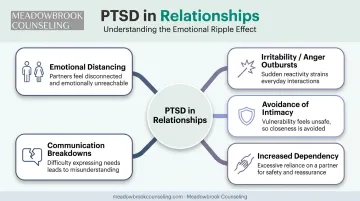
Research consistently links PTSD to specific relationship strains:
- Emotional distancing and reduced self-disclosure
- Irritability or anger outbursts, sometimes seemingly out of nowhere
- Avoidance of intimacy, both emotional and physical
- Increased dependency on one partner for reassurance
- Communication breakdowns, often described as "walking on eggshells"
A 2018 review of PTSD and relationship functioning found that emotional numbing has the strongest, most consistent negative link to relationship satisfaction, more so than any other symptom cluster. Trauma-focused approaches like EMDR, one of the evidence-based modalities used at Meadowbrook Counseling, are specifically designed to address this kind of numbing and reconnect partners over time.
A Note on Safety
Most people with PTSD are not violent. That said, an observational study of 287 veteran couples found PTSD was associated with more hostility and psychological abuse during conflict discussions, compared to couples without PTSD. The effect was modest and the study couldn't prove causation, but it deserves honest acknowledgment.
If you ever feel physically unsafe, that's not a moment for "just be patient." Call the National Domestic Violence Hotline at 1-800-799-SAFE (7233) or text START to 88788. Your safety isn't negotiable, regardless of what's driving the behavior.
Everyday Ways to Support Your Partner with PTSD
Day-to-day support is where most of the relationship work actually happens. Small, consistent choices matter more than grand gestures.
Learn Their Triggers, Together
Ask your partner, when they're calm and open to it, what tends to set off a reaction. Sounds, smells, specific dates, crowded places. Every person's trigger map is different. Approach this as a shared project, not an interrogation.
Build Predictable Routines
Once you understand the triggers, routines become your next tool. Consistent meals, regular sleep schedules, and small shared rituals create a felt sense of safety. This isn't about rigidity. It's about giving your partner's nervous system fewer surprises to brace against.
Communicate Without Pressure
How you talk matters as much as what you say:
- Avoid phrases like "just get over it" or "it's been long enough"
- Skip unsolicited advice unless they ask for it
- Let them set the pace on when and how much to share about their trauma
- Use "I feel" statements instead of accusatory "you" statements
Validate Before You Problem-Solve
When your partner opens up, resist the urge to fix things immediately. Try: "That sounds really hard, I'm here" instead of jumping to solutions or toxic positivity like "everything happens for a reason." Validation comes first. Problem-solving, if wanted, comes later.
A few other habits worth building:
- Learn about PTSD together through books, reputable sites, or a support group, so you're working from shared understanding
- Never threaten to leave or end the relationship during conflict, since fear of abandonment can intensify PTSD symptoms and those words can do lasting damage even said in anger
- Consider working with a couples or trauma-informed therapist if patterns feel too tangled to untangle alone; a trained third party can help you both build these skills with support

What to Do When Your Partner Has a PTSD Episode
Episodes can escalate fast. Knowing the signs and having a plan takes the panic out of the moment for both of you.
Recognize the Signs Early
Watch for zoning out, rapid or shallow breathing, sudden fear, or disorientation. These often show up before a full flashback takes hold.
Ground Them Gently
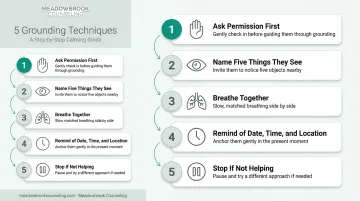
According to SAMHSA's trauma-informed care guidance, grounding helps someone overwhelmed by memories or dissociation reconnect with the present moment. Try:
- Ask permission first - "Can I help you ground for a second?" respects their autonomy even mid-crisis
- Name five things they can see in the room to anchor attention in the present
- Breathe together, slowly and audibly, so they have something to match
- Remind them of the date, time, and location in a calm, matter-of-fact tone
- Stop if it's not helping. Not every technique works for every person, or every episode
Mind Your Own Body Language
Your nonverbal cues matter as much as the grounding techniques themselves. Lower your voice and move slowly. Don't touch them unless they've told you, in advance, that touch helps during an episode—sudden physical contact can make things worse, not better.
Check In, Don't Assume
Say things like "You're safe, I'm here" and then ask what they need, rather than guessing. Needs can shift moment to moment, even within the same episode.
After the Episode
- Give space if they want it. Don't demand an explanation right away
- Revisit the moment later, once things are calm, to talk about what helped and what didn't
- If there's any talk of self-harm or suicide, take it seriously immediately. Call or text 988 (the Suicide & Crisis Lifeline) and remove access to weapons or other means if you're able to safely do so
A trauma-informed therapist can help you and your partner turn these steps into a personalized plan built around what actually works for your relationship.
Taking Care of Yourself While Supporting Your Partner
Supporting someone through PTSD takes a toll. Caregivers of trauma survivors often experience real burden, secondary stress, and relationship strain, especially as symptom severity increases.
That toll is not a sign you're doing it wrong. It's a sign you need support too.
Ways to protect your own wellbeing:
- Maintain friendships and family relationships outside the relationship
- Consider your own therapist or couples counseling, so your partner isn't your only outlet for processing hard emotions
- Set boundaries, including stepping away from an overwhelming moment when you need to
- Keep up basic self-care: exercise, sleep, hobbies, journaling
None of this is selfish. A partner running on empty has less capacity to show up consistently, which is exactly what someone with PTSD needs most.
When to Seek Professional Help Together
Partner support matters, but PTSD is a clinical condition that responds best to evidence-based treatments like EMDR, cognitive processing therapy (CPT), and trauma-focused CBT. Your support matters most alongside these treatments, not as a replacement for them.
What the Evidence Says About Treatment
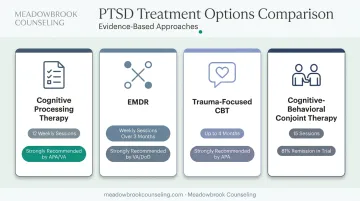
| Treatment | Typical Course | Evidence Base |
|---|---|---|
| Cognitive Processing Therapy (CPT) | 12 weekly sessions | Strongly recommended by APA and VA/DoD |
| EMDR | Weekly sessions over ~3 months | Strongly recommended by VA/DoD |
| Trauma-Focused CBT | Up to ~4 months | Strongly recommended by APA |
| Cognitive-Behavioral Conjoint Therapy | 15 sessions | In a 40-couple trial, 81% no longer met PTSD criteria post-treatment |
Standard couples counseling won't cure PTSD on its own. What it can do is rebuild communication patterns and address the relationship strain that symptoms have caused, especially when paired with individual trauma treatment.
Finding the Right Fit
Coordinated care, where individual trauma treatment and couples work happen in tandem rather than separately, tends to produce better outcomes. At Meadowbrook Counseling, couples navigating PTSD have access to therapists trained in both trauma treatment and relationship-focused modalities, so partners aren't left piecing together two disconnected treatment plans.
Meadowbrook offers:
- Personalized therapist matching based on your specific situation
- EMDR-trained clinicians across multiple office locations
- Insurance verification support, so you know your coverage before your first session
- Both in-person and telehealth options, depending on location
Reaching out for an initial consultation, if your partner is open to it, is a proactive step. It can prevent months of unnecessary strain on both of you.
Frequently Asked Questions
How do I support my partner who has PTSD?
Learn their specific triggers, validate their feelings instead of jumping to solutions, and avoid pressuring them to talk before they're ready. Encourage professional treatment gently, without making it an ultimatum.
What should I do when my partner has a PTSD episode?
Stay calm, lower your voice, and use grounding techniques like naming things they can see or breathing together. Check in verbally about what they need instead of assuming, since it can change moment to moment.
Can PTSD in a partner get better with support and treatment?
Yes, most people improve with proper treatment and consistent support, though timelines vary significantly. Research shows remission rates vary widely, from under 10% to nearly 90%, depending on treatment type and follow-up length.
Is it normal to feel exhausted or resentful when supporting a partner with PTSD?
Yes, caregiver fatigue is well documented among partners of people with PTSD. It's a sign you need your own support system and self-care, not a character flaw.
Should we try couples therapy if one partner has PTSD?
Couples therapy can complement individual trauma treatment by improving communication and rebuilding connection. It isn't a substitute for individual, trauma-focused treatment like EMDR or CPT, though many practices, including Meadowbrook Counseling, offer both under one roof.
What are signs that PTSD is affecting our relationship negatively?
Watch for constant conflict, emotional withdrawal, loss of intimacy, or feeling unsafe. Any of these are good reasons to seek professional guidance sooner rather than later.