

Choosing between them (or knowing when to combine them) affects how quickly you feel relief, how much you'll need to verbally revisit painful memories, and how long treatment takes. The WHO's 2013 guideline recognizes both trauma-focused CBT and EMDR for PTSD, so neither is a fringe option.
This guide breaks down how each approach works, who benefits most, and how to figure out which one—or both—fits your situation.
Key Takeaways
- EMDR reprocesses traumatic memories using bilateral stimulation, without requiring detailed verbal storytelling
- Talk therapy is an umbrella term covering CBT, psychodynamic, and humanistic approaches focused on insight and coping skills
- EMDR often works faster for specific trauma; talk therapy suits ongoing emotional patterns and life stress
- Many therapists, including those at Meadowbrook Counseling, blend both approaches based on client needs
EMDR vs. Talk Therapy: Quick Comparison
| Category | EMDR | Talk Therapy |
|---|---|---|
| Primary focus | How trauma memories are stored in the nervous system | Conscious thought patterns, beliefs, behaviors |
| Approach to trauma | Bilateral stimulation (eye movements, tapping, tones) | Verbal dialogue and reflection |
| Typical length | Often 6-12 sessions total for PTSD; single-incident trauma reprocessing sometimes done in 3 sessions | Open-ended; can span months or years |
| Verbal disclosure | Minimal detailed storytelling required | Requires more verbal exploration |
| Best suited for | PTSD, specific traumatic events, phobias, distressing memories | Anxiety, depression, life transitions, relationship patterns |
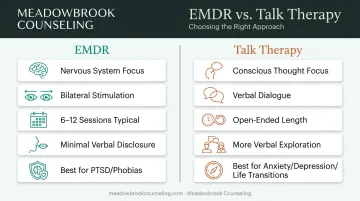
That "typical length" row deserves a closer look: EMDR's "3 sessions" figure applies specifically to reprocessing a single trauma, not the entire treatment course. The American Psychological Association describes typical EMDR treatment as 6-12 sessions, factoring in history-taking, preparation, and follow-up phases.
What Is EMDR?
EMDR (Eye Movement Desensitization and Reprocessing) was developed by psychologist Francine Shapiro, who first observed its effects in 1987 and published her initial study in 1989. It's since become one of the most researched trauma treatments available.
The core idea: traumatic memories sometimes get "stuck" in the nervous system, triggering distress long after the danger has passed. EMDR uses bilateral stimulation—guided eye movements, tapping, or alternating tones—while you briefly recall the memory. This process appears to reduce the memory's emotional intensity, though researchers are still refining exactly why it works.
A 2018 systematic review points to working-memory competition as a leading explanation: recalling a distressing image while performing another task may reduce how vivid and emotional that memory feels. It's a solid theory, not a settled fact.
What makes EMDR distinct:
- You don't need to describe the traumatic event in detail
- The therapist guides you through recalling the memory internally while facilitating the bilateral stimulation
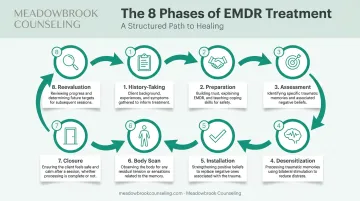
- Treatment follows eight structured phases: history-taking, preparation, assessment, desensitization, installation, body scan, closure, and reevaluation
This structure matters because EMDR involves real conversation throughout, not just eye movements. History-taking, treatment planning, and closure all require genuine dialogue with your therapist; the difference is that EMDR doesn't require you to narrate the trauma in detail the way talk therapy often does.
Who EMDR Helps Most
EMDR shows the strongest evidence for:
- PTSD, particularly tied to a specific traumatic event
- Single-incident trauma (accidents, assaults, one-time medical emergencies)
- Phobias, though evidence here is narrower than for PTSD
- Birth trauma: a 2025 randomized clinical trial of 151 women found early postpartum EMDR reduced PTSD symptoms compared to usual care
At Meadowbrook Counseling, EMDR-certified clinicians like Rosario Toral, ACMHC, integrate this protocol for clients who want to build resilience without reliving trauma in exhaustive detail. Depending on what each client needs, therapists often combine EMDR with other evidence-based frameworks.
What Is Traditional Talk Therapy?
Talk therapy isn't one method—it's an umbrella term covering several distinct approaches, each with its own philosophy and structure.
The three major branches:
- Cognitive Behavioral Therapy (CBT): Structured, goal-focused, connects thoughts, feelings, and behaviors. Often includes homework between sessions.
- Psychodynamic therapy: Explores unconscious patterns, past experiences, and relationship dynamics. Can be brief or open-ended.
- Humanistic therapy: Centers on personal agency, growth, and self-direction within an empathetic therapeutic relationship.
These three branches share the same conversational foundation, but session structure still depends heavily on which modality your therapist uses—unlike EMDR's fixed eight-phase structure. CBT tends to be more directive—your therapist might assign specific exercises or track thought patterns weekly. Psychodynamic and humanistic approaches are generally more open-ended, letting the client guide session content.
Who Talk Therapy Helps Most
Talk therapy tends to work best for:
- Anxiety and depression not tied to one specific traumatic event
- Life transitions—divorce, career changes, grief
- Relationship patterns that repeat across different situations
- General self-exploration and building long-term emotional resilience
Treatment length varies widely by modality. General CBT courses often run 5-15 sessions, while psychodynamic therapy reviewed in a 2010 APA evidence summary averaged 21 sessions over 34 weeks in short-term study samples. Humanistic therapy has no fixed timeline at all—it moves at the client's pace.
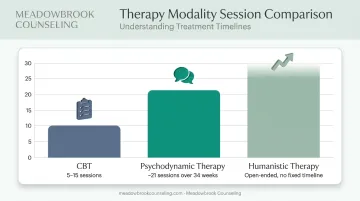
Humanistic therapy has no fixed timeline at all—it moves at the client's pace. At Meadowbrook Counseling, therapists are trained across several of these modalities, so your treatment plan can shift toward whichever approach—or combination—fits your goals.
EMDR vs. Talk Therapy: Which Approach Is Right for You?
Start by asking yourself three questions:
- Is my distress tied to a specific event, or is it more general and ongoing? A car accident that still causes panic when driving points toward EMDR. Chronic low-grade anxiety about work performance points toward talk therapy.
- Do I have a physical reaction that doesn't match my logical understanding? If you know you're safe but your body still reacts as though you're not, that's a signal EMDR might help.
- Am I looking for faster symptom relief, or ongoing insight and growth? EMDR often targets a specific symptom cluster. Talk therapy builds skills and self-understanding over time.
The Top-Down vs. Bottom-Up Framework
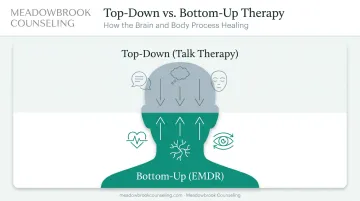
This is a useful mental model, though it's a simplification rather than settled neuroscience. Talk therapy tends to work "top-down"—engaging your conscious, logical brain to reframe thoughts and beliefs. EMDR is often described as "bottom-up," working with how the nervous system stores and responds to trauma memories.
Reality check: neither is purely one or the other. CBT changes emotional and physiological responses too, and EMDR requires plenty of conscious recall, appraisal, and dialogue. Still, this framework explains why someone might logically "get" why they're triggered (thanks to years of talk therapy) but still feel physically reactive—the deeper processing EMDR targets hasn't happened yet.
Bottom line for choosing:
- Choose EMDR if a clear traumatic event still causes physical or emotional triggers
- Choose talk therapy for broader life stress, relationship patterns, or general personal growth
- Both may be worth considering if you're dealing with specific trauma and broader patterns that need ongoing attention
Can EMDR and Talk Therapy Be Combined?
Yes, and it's common practice. Many therapists use an integrative approach: building trust and coping skills through talk therapy first, then incorporating EMDR once a client feels ready to process specific traumatic memories.
The APA's own 2002 publication on EMDR as an Integrative Psychotherapy Approach examines EMDR through cognitive-behavioral, humanistic, and psychodynamic lenses, supporting the idea that these methods are clinically compatible. No strong research shows combining them always outperforms either treatment alone, but it's a well-established clinical practice rather than a guaranteed shortcut.
At Meadowbrook Counseling, several therapists work this way. Jonathan Neves, a CMHC trained in EMDR, integrates it alongside CBT, DBT, and motivational interviewing "when appropriate to treatment goals and client readiness." Jonathan Malley combines Trauma-Focused CBT with EMDR and Gottman Method principles for couples work.
Meadowbrook's therapist-matching process and insurance verification support help remove the guesswork—clients get paired with a clinician suited to their specific needs, whether that's an EMDR specialist, a talk-therapy-focused provider, or someone trained in both.
Conclusion
There's no universally "better" therapy—only the better fit for what you're dealing with.
Consider your situation:
- EMDR tends to work faster when a specific traumatic event still triggers physical or emotional reactions
- Talk therapy typically serves you better when you're untangling broader patterns, relationship dynamics, or ongoing life stress
Many people benefit from both, sequenced thoughtfully by a clinician. A qualified therapist can help clarify which path—or combination—makes sense during an initial consultation.
Meadowbrook Counseling's intake team can match you with a therapist trained in EMDR, talk therapy, or both, based on what you're working through.
Frequently Asked Questions
What is the difference between EMDR and talk therapy?
EMDR uses bilateral stimulation to reprocess trauma at a physiological level without requiring detailed verbal disclosure. Talk therapy relies on conversation to build insight and coping skills over time.
Can EMDR and talk therapy be used together?
Yes. Many therapists blend both approaches, using talk therapy for ongoing support and skill-building, then incorporating EMDR for targeted trauma processing when the client is ready.
Is EMDR more effective than talk therapy for PTSD?
Both are evidence-based for PTSD, per the APA's 2025 clinical guideline and WHO recommendations. EMDR sometimes produces faster relief for specific traumatic events, but research doesn't support a blanket claim that it's always superior.
How long does EMDR take compared to talk therapy?
EMDR for PTSD often runs 6-12 sessions total, with single-incident trauma reprocessing sometimes completed in about 3 sessions. Talk therapy tends to be more open-ended, sometimes spanning months or years.
Do I have to talk about my trauma in detail during EMDR?
No. EMDR doesn't require detailed verbal storytelling. You can process memories internally while your therapist guides the bilateral stimulation component of treatment.
Is EMDR covered by insurance?
EMDR is typically billed under standard psychotherapy codes and covered by most major insurance plans, though coverage varies by plan. Meadowbrook Counseling verifies your benefits before your first session so you know your exact costs upfront.