According to CDC data updated in 2025, 11% of U.S. children ages 3–17 currently have a diagnosed anxiety disorder. That's not worry that passes after a rough week — it's persistent, impairing fear that disrupts school, friendships, and family life.
The encouraging part? Childhood anxiety responds well to treatment. The challenge is knowing what to look for, what actually works, and when to get professional support.
This guide covers all of it: how to recognize anxiety, what causes it, evidence-based treatment options, practical home strategies, and clear signals that it's time to reach out for help.
Key Takeaways
- Childhood anxiety affects 1 in 9 children in the U.S. — but it's highly treatable, especially with early intervention
- CBT (Cognitive Behavioral Therapy) is the gold-standard first-line treatment, particularly for mild-to-moderate cases
- Avoidance provides short-term relief but worsens anxiety over time; gradual exposure is what produces lasting change
- Parents shape the anxiety cycle — accommodation and anxious modeling reinforce fear, while calm encouragement reduces it
- Untreated childhood anxiety raises long-term risk for depression, substance use, and academic difficulties
Recognizing Anxiety in Children: Signs, Symptoms, and Types
Childhood anxiety doesn't always look like worry. Many parents miss it because their child isn't saying "I'm scared" — they're acting out, getting sick, or refusing to go to places they once loved.
What Anxiety Looks Like at Different Ages
In younger children (under 6):
- Intense clinginess or difficulty separating from caregivers
- Frequent stomachaches or headaches without a clear medical cause
- Nightmares and sleep resistance
- Regression in previously mastered skills (bedwetting, thumb-sucking)
- Meltdowns that seem disproportionate to the situation
In school-age children and teens:
- Avoiding school, social events, or activities they used to enjoy
- Excessive "what if" thinking and difficulty tolerating uncertainty
- Perfectionism and intense fear of making mistakes
- Irritability, anger outbursts (anxiety often surfaces as frustration)
- Difficulty concentrating, frequent reassurance-seeking
The irritability piece catches many parents off guard. A child who snaps constantly or refuses activities isn't necessarily being difficult — they may simply be overwhelmed by anxiety they can't name.
Types of Childhood Anxiety Disorders
| Disorder | How It Looks in Children | Duration Threshold |
|---|---|---|
| Separation Anxiety Disorder | Excessive distress when separated from caregivers; school refusal; physical complaints before separations | 4 weeks in children |
| Generalized Anxiety Disorder (GAD) | Persistent, hard-to-control worry about multiple things; restlessness; fatigue; only 1 associated symptom needed in children | 6 months |
| Social Anxiety Disorder | Fear of negative evaluation by peers; may appear as crying, freezing, or refusing to speak in group settings | 6 months |
| Specific Phobia | Intense, disproportionate fear of a particular object or situation; immediate avoidance response | 6 months |
| Panic Disorder | Recurrent unexpected panic attacks followed by persistent concern about more attacks | 1 month of post-attack concern |
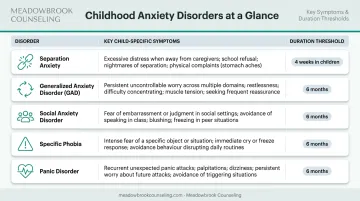
A key distinction: anxiety becomes a disorder when it's persistent, disproportionate, and meaningfully disrupts daily life — not simply because a child feels nervous sometimes. Note that duration thresholds differ by disorder; the "six months" rule doesn't apply universally.
What Causes Childhood Anxiety?
No single factor causes anxiety in children. The research consistently points to a mix of biological predisposition and environmental experience.
Biological and Genetic Factors
A 2024 peer-reviewed review found that children of anxious parents face a 2- to 4-fold higher risk of developing an anxiety disorder themselves. This transmission happens through a combination of genetics, modeled behavior, and shared stress environments.
Children with naturally sensitive temperaments — those who startle easily, withdraw from novelty, or take longer to warm up — are at higher baseline risk. This isn't a parenting failure; it's neurobiological variation.
Environmental Triggers
Biological risk alone rarely determines outcomes — the environment shapes whether that risk becomes a disorder. Common environmental contributors include:
- Adverse childhood experiences (ACEs): Trauma, abuse, neglect, and family instability are associated with anxiety across the lifespan
- Bullying: A meta-analysis of 165 studies found bullying victimization associated with anxiety (OR 1.77), making it a clinically relevant and potentially modifiable risk factor
- Academic pressure, frequent moves, parental conflict, and major life disruptions all contribute
The Role of Parental Anxiety
Anxious parents can unintentionally model anxious responses or repeatedly remove triggers to protect their child. Research with school-aged children found that anxious parental modeling increased children's reported anxiety, anxious thoughts, and avoidance tendencies. This isn't about blame — it means effective treatment often needs to involve the whole family, not just the child.
Evidence-Based Treatment Options for Childhood Anxiety
Anxiety disorders rarely resolve on their own without some form of intervention. The good news: treatment works. In the landmark CAMS trial, only 23.7% of children on placebo showed meaningful improvement — compared to substantially higher rates with active treatment. That gap matters.
Cognitive Behavioral Therapy (CBT)
CBT is the most well-supported psychotherapy for childhood anxiety. The American Academy of Child and Adolescent Psychiatry (AACAP) recommends it as a first-line treatment for ages 6–18 across separation anxiety, GAD, social anxiety, specific phobias, and panic disorder.
How CBT works:
- Psychoeducation — children and parents learn what anxiety is and how it functions
- Cognitive restructuring — identifying and challenging distorted "what if" thinking
- Graduated exposure — systematically facing feared situations in manageable steps
- Coping skill development — tools for managing physical symptoms and distress
- Relapse prevention — building confidence that the child can handle future challenges
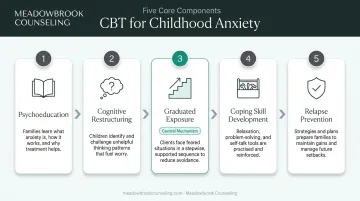
The exposure component is central. Avoidance keeps anxiety alive; facing feared situations — gradually and with support — is what produces lasting change. This is sometimes called the habituation curve: anxiety spikes initially, then naturally decreases as the child stays in the situation and learns they can tolerate it.
Session counts vary by protocol. CAMS used 14 sessions, Coping Cat uses 16, and NICE recommends 10 individual sessions for social anxiety. "Around 12 weekly sessions" is a reasonable general estimate, not a fixed rule.
Parents are often involved — sometimes attending portions of sessions, sometimes receiving coaching directly.
Therapists at Meadowbrook Counseling are trained in CBT and evidence-based anxiety treatment. Kristie Jensen (LCSW) holds the Certified Clinical Anxiety Treatment Professional designation, and therapists across locations including Orem, Utah use CBT as a core approach for child and adolescent anxiety.
Complementary Approaches: ACT and DBT
When CBT alone is insufficient, two additional therapies may be incorporated:
- Acceptance and Commitment Therapy (ACT): Uses mindfulness and acceptance strategies to build psychological flexibility. A 2024 umbrella review found promising effects for children, though evidence remains emerging relative to CBT. Meadowbrook therapists including Dominick Allen are trained in ACT.
- DBT (Dialectical Behavior Therapy) skills: Focuses on emotional regulation and distress tolerance, sometimes used alongside CBT. DBT does not have established, guideline-level evidence as a standalone treatment for primary pediatric anxiety.
Medication
For moderate-to-severe cases, medication is sometimes indicated — almost always alongside therapy, not instead of it.
The CAMS trial, which enrolled 488 youths ages 7–17, found response rates of:
- 80.7% for combined CBT + sertraline
- 59.7% for CBT alone
- 54.9% for sertraline alone
- 23.7% for placebo
SSRIs are the first-line medication option. Escitalopram (Lexapro) received FDA approval in 2023 for pediatric GAD in children ages 7 and older; other SSRIs are frequently used off-label for childhood anxiety. Medication decisions should involve a thorough conversation with a prescribing physician about the specific drug, dose, and risk-benefit profile.
The FDA requires a black box warning on all antidepressants stating they "increased the risk of suicidal thoughts and behaviors in pediatric and young adult patients in short-term studies." Families should monitor closely — especially in the first weeks and after dose changes — for clinical worsening, unusual behavioral changes, or any emergence of suicidal thoughts, and communicate changes promptly to the prescriber.
This warning should not be minimized, but it also shouldn't automatically rule out medication when it's clinically indicated. Discuss it openly with the prescribing physician.
How Parents Can Support an Anxious Child at Home
The goal of parenting an anxious child is to help them learn they can tolerate discomfort and keep moving — not to remove every trigger that causes it. That shift in perspective changes most of what follows.
Avoid Accommodation
When parents repeatedly remove anxiety triggers — letting a child skip the birthday party, answering every reassurance question, or speaking for the child — it feels kind in the moment. Over time, it signals to the child's brain that the feared situation genuinely was dangerous, reinforcing the anxiety cycle.
Research on the SPACE program (Supportive Parenting for Anxious Childhood Emotions) found that 12 weeks of parent-only training was as effective as child CBT in reducing anxiety symptoms — specifically because it targeted family accommodation directly.
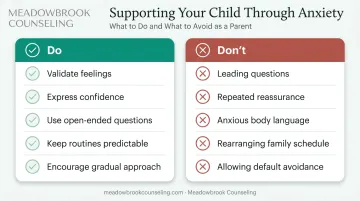
Practical Do's and Don'ts
| Do | Don't |
|---|---|
| Validate feelings ("I know this feels scary") | Ask leading questions ("Are you nervous about the test?") |
| Express confidence ("I think you can handle this") | Offer repeated reassurance to neutralize the fear |
| Use open-ended questions ("How did that go?") | Display anxious body language or a worried tone |
| Keep daily routines predictable | Rearrange the family schedule around the child's fears |
| Encourage approach behavior gradually | Allow avoidance to become the default response |
Practical Coping Tools
Several skills can be practiced at home to help children manage anxiety symptoms:
- Diaphragmatic breathing: Slow, belly-focused breathing reduces the body's stress response and is a core technique in evidence-based CBT protocols for children
- Progressive muscle relaxation: Tensing and releasing muscle groups to reduce physical tension
- Structured exposure practice: With therapist guidance, practicing facing a slightly feared situation in small steps between sessions
Tools like "worry time" and grounding exercises can support daily coping but work best alongside formal treatment — they don't carry the same evidence base as exposure-based CBT on their own.
Model Calm Yourself
Children watch how caregivers handle stress. Studies have shown that when a parent visibly models anxious behavior — even briefly — children's own worry and avoidance increases. You don't need to be perfectly calm, but making visible choices ("I was nervous about that meeting, so I took some deep breaths and just did it") teaches more than any technique.

When to Seek Professional Help
Some anxiety is developmentally normal. A toddler who cries when you leave or a child who gets nervous before a big test isn't necessarily struggling with a disorder. The question is whether the fear is persistent, disproportionate, and getting in the way of daily life.
Seek a professional evaluation when you notice:
- Worry or fear that persists for several weeks without improving
- Avoidance of school, social activities, or previously enjoyed pursuits
- Repeated physical complaints (stomachaches, headaches) with no identified medical cause
- Regression in developmental milestones
- Escalating reassurance-seeking that doesn't provide lasting relief
- Any mention of not wanting to be alive, hopelessness, or self-harm
Why Early Treatment Matters
A prospective longitudinal study by Woodward and Fergusson found that adolescent anxiety disorders were associated with later anxiety, depression, substance dependence, educational underachievement, and adverse social outcomes into young adulthood. Earlier intervention improves the trajectory.
The CAMELS follow-up study found that 46.5% of children who received treatment were in remission six years later. Those who responded to acute treatment had significantly better odds of long-term remission (OR 1.83) — evidence that getting effective help early meaningfully improves long-term mental health outcomes.
Finding a therapist trained in evidence-based approaches for childhood anxiety is the practical next step that research supports. Meadowbrook Counseling serves families across Utah, Idaho, Massachusetts, Washington, Florida, Texas, Colorado, Arizona, and Wisconsin, with both in-person and telehealth options. Their team offers insurance verification support before the first session, and intake staff can help connect your child with a therapist whose training aligns with their specific anxiety type. You can reach them at 801-655-5450, Monday through Friday.
Frequently Asked Questions
What is the best treatment for childhood anxiety?
CBT is the most well-supported first-line treatment for children ages 6–18. For moderate-to-severe cases, combining CBT with an SSRI produces the strongest results — the CAMS trial showed an 80.7% response rate for combination treatment. Early intervention consistently improves long-term outcomes.
How does childhood anxiety affect adulthood?
Untreated childhood anxiety raises the risk of adult anxiety disorders, depression, and substance use. Research also links adolescent anxiety to educational underachievement and social difficulties. Getting effective treatment in childhood meaningfully improves the long-term trajectory.
What is the difference between normal childhood worry and an anxiety disorder?
Normal worry is temporary, age-appropriate, and doesn't meaningfully disrupt daily life. An anxiety disorder involves persistent, disproportionate fear that interferes with school, friendships, or family routines — and lasts long enough to meet diagnostic criteria, which varies by condition.
Can children outgrow anxiety without treatment?
Some mild developmental anxieties do resolve naturally. Clinical anxiety disorders, however, rarely disappear on their own — separation anxiety in early childhood, for example, can shift into social anxiety or GAD by adolescence. If symptoms persist or start interfering with daily life, a professional evaluation is worth pursuing.
How long does CBT for childhood anxiety typically take?
Most structured CBT protocols run approximately 12–16 weekly sessions. Many children show measurable improvement within the first few sessions, and the coping skills they build tend to stay useful well beyond the end of treatment.