
Both situations send people searching for therapy. But they point toward very different starting places.
Choosing between individual and couples therapy isn't about picking the "better" option. It's about figuring out where the struggle actually lives: in you, in the relationship, or in both. This guide breaks down what each type involves, who benefits most from each, and whether you can do both at once.
Key Takeaways
- Individual therapy focuses on you: your history, emotions, and personal growth.
- Couples therapy treats the relationship itself as the client, targeting communication and trust.
- Choose individual therapy if your struggles predate the relationship, such as anxiety, trauma, or self-worth issues.
- Start couples therapy if the pain shows up mainly in how you and your partner interact.
- A hybrid approach works well for many people, and Meadowbrook Counseling can match you with therapists who coordinate individual and couples care.
What Is Individual Therapy?
Individual therapy is one-on-one work between you and a licensed therapist. The focus stays on your thoughts, behaviors, and emotional history—not on managing a relationship dynamic.
It's often the starting point for anxiety, depression, trauma, and self-worth struggles that existed long before your current relationship did.
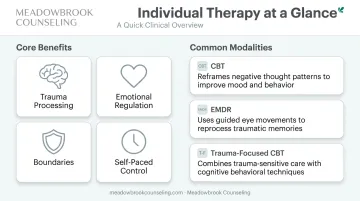
Core benefits include:
- Deeper trauma processing without needing to manage a partner's reactions in the room
- Stronger emotional regulation skills you build at your own pace
- Healthier personal boundaries, both at home and elsewhere
- Complete control over session pacing and goals
Individual sessions are also 100% confidential. Nothing gets shared with a partner unless you sign a release. That privacy matters if you're processing something you're not ready to discuss as a couple yet, or ever.
Common Modalities and Session Structure
Therapists often draw from Cognitive Behavioral Therapy (CBT), EMDR, and trauma-focused approaches. The American Psychological Association describes CBT as treatment based on the idea that unhelpful thinking patterns and learned behaviors drive psychological problems—and that changing them, through coping and problem-solving skills practiced between sessions, changes outcomes.
EMDR, meanwhile, is designed specifically to help the brain reprocess unresolved traumatic memories through structured phases. At Meadowbrook Counseling, several therapists are trained specifically in EMDR and trauma-focused CBT, so clients working through trauma can be matched with a clinician who specializes in that approach.
Most individual therapy runs on a weekly cadence, with sessions typically reassessed every couple of months to check progress and adjust frequency.
Use Cases of Individual Therapy
Individual therapy fits best when the issue is fundamentally yours to work through, even if it affects your relationships.
Common scenarios:
- You're unsure whether you want to stay in your relationship and need clarity before making a decision
- Childhood trauma is fueling triggers that show up in your current relationship
- You're single and working through self-esteem, grief, or a major life transition
- You're managing ADHD, anxiety, or depression that predates your current partner
Common presenting issues include anxiety, depression, grief, unresolved trauma, and difficulty setting boundaries, and the research backing individual treatment for these issues is substantial. A 2018 meta-analysis of 100 studies found a 51% mean remission rate for CBT in adults with anxiety disorders. That's a solid benchmark for what structured, individual-style talk therapy can achieve, though remission rates vary by diagnosis and how remission is defined.
At Meadowbrook Counseling, therapists trained in evidence-based modalities like EMDR and trauma-informed care work with clients on exactly these presenting issues, whether the goal is processing trauma or building healthier boundaries before addressing relationship dynamics.
What Is Couples Therapy?
Couples therapy treats the relationship itself as the client. Neither partner is "the patient." The interaction pattern between you is what gets examined and changed.
This systemic lens matters because recurring conflict rarely comes from one person acting badly in isolation. It comes from a cycle both partners feed into.
Core benefits include:
- Improved communication that reduces repetitive arguments
- Rebuilt trust after a breach, such as infidelity
- Deeper intimacy through the process itself, not just the outcome
- Both partners witnessing each other's growth in real time
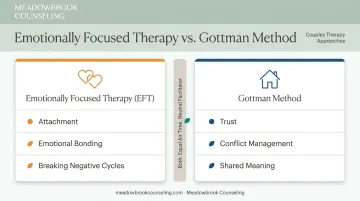
Approaches: EFT and the Gottman Method
Two evidence-informed models dominate couples work:
- Emotionally Focused Therapy (EFT) targets attachment and emotional bonding, helping partners break negative interaction cycles and build a more secure connection.
- The Gottman Method uses structured assessment and research-based tools built around what Gottman calls the Sound Relationship House, covering trust, conflict management, and shared meaning.
Meadowbrook Counseling therapists train in these evidence-based models and often combine them with other modalities, such as EMDR, depending on what a couple needs.
Knowing the model matters less than knowing what happens in the room. Both partners get roughly equal air time, and the therapist acts as a neutral facilitator rather than a referee picking sides. Sessions typically run 50-90 minutes, often weekly at the start.
Use Cases of Couples Therapy
Couples therapy fits when the distress centers on the relationship dynamic itself, not just one partner's internal struggles.
Common scenarios:
- Recurring arguments about the same topics with no resolution
- Emotional withdrawal, feeling like roommates instead of partners
- Trust broken by infidelity
- Proactively strengthening the relationship before a major transition, like a move or new baby
Common presenting issues:
- Financial disagreements and money management conflicts
- Parenting differences and co-parenting stress
- Intimacy concerns, including emotional or physical disconnect
- Blended family dynamics and stepfamily adjustment
Meadowbrook Counseling's marriage and couples counselors work with partners across each of these scenarios, tailoring sessions to the specific dynamic causing strain.
The research backing couples therapy is strong. A 2020 meta-analysis of 58 studies and 2,092 couples found a large improvement in relationship satisfaction (Hedges g = 1.12) from pre- to post-treatment. Couples on a waitlist, by contrast, saw almost no change (g = 0.12). A separate RCT-only analysis found EFT specifically produced some of the strongest effects among couples-based approaches.
Individual vs Couples Therapy: Which One Is Right for You?
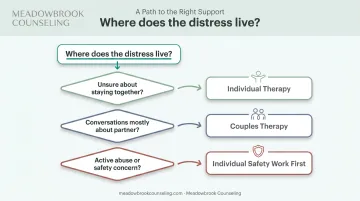
Here's the core question to ask yourself: does the distress live mostly inside you, or mostly between you and your partner?
Run through this quick self-check:
- Are you unsure if you want to stay together? Start individual therapy first.
- Are most of your therapy conversations going to be about your partner? Start couples therapy.
- Is there active abuse or a safety concern? Individual safety work always comes first, before any joint sessions.
Choose individual therapy if:
- You're processing personal trauma, anxiety, or a past relationship
- You're not currently in a relationship
Choose couples therapy if:
- The majority of your stress centers on your partner
- Both of you are willing to attend and engage in the process
One important nuance: even if the root issue seems to belong to one partner—say, anger reactions tied to unprocessed trauma—couples therapy can still run in parallel. Relationship patterns almost always involve both people, even when one person's history is doing more of the driving.
That safety check from step 3 deserves more detail. Research on situational couple violence shows some couples may benefit from carefully screened conjoint treatment, but this does not apply to coercive control or severe abuse. In those cases, individual safety planning takes priority over joint sessions.
Still not sure? Meadowbrook Counseling's intake coordinators can walk through your situation with you and help clarify the right starting point before you commit to either path.
Can You Do Individual and Couples Therapy at the Same Time?
Yes. Many clients benefit from a hybrid model: one or both partners see an individual therapist while also attending couples sessions.
How it works in practice:
- Individual work reduces personal defensiveness and emotional reactivity
- Couples sessions give both partners a shared language and structured space to rebuild connection
- Progress in one setting often accelerates progress in the other
Clinical literature supports this kind of coexistence. However, named protocols like partner-assisted interventions have stronger research backing than two separate therapists working independently.
Coordination between therapists helps avoid conflicting guidance, whether through direct communication or simply staying aware of each other's involvement. Practices offering both individual and couples services under one roof, like Meadowbrook Counseling's locations across multiple states, can simplify scheduling for clients pursuing both formats.
Conclusion
Neither individual nor couples therapy is inherently better. The right choice depends on whether your pain originates from personal history or relationship dynamics, and it's completely normal to move between the two as your needs evolve.
If you're still weighing your options, start with a brief consultation. Meadowbrook Counseling's intake team verifies your insurance coverage and matches you with a therapist experienced in the approach that fits your situation.
Frequently Asked Questions
Can you do couples and individual therapy at the same time?
Yes, this hybrid approach is common and often effective, especially when one partner's personal history is affecting the relationship. Coordination between providers helps keep guidance consistent.
What is the 5-5-5 rule for couples therapy?
It's an informal exercise: five minutes for one partner to speak uninterrupted, five minutes for the other to listen, and five minutes discussing solutions together. It's not a clinically standardized technique, but many couples find it useful for structuring hard conversations.
What is the 2-2-2 rule for couples?
It's a relationship maintenance habit: a date night every two weeks, a weekend away every two months, and a longer trip every two years. It's meant to protect connection, not fix acute conflict.
How do I know if I need individual or couples therapy?
Ask whether the distress lives mostly within you or mostly in how you and your partner interact. Personal history and mental health symptoms point to individual work; recurring relationship patterns point to couples work.
Is couples or individual therapy covered by insurance?
Many plans cover both, though coverage varies widely by plan and provider. Meadowbrook Counseling verifies benefits before your first session to help you avoid surprise costs.
What if my partner refuses to go to therapy?
Start with individual therapy to gain clarity and build your own tools. This often reduces relationship tension on its own and can open the door to couples work later.