That disconnect between perception and reality is exactly what makes panic attacks so difficult to manage alone. And it's precisely what Cognitive Behavioral Therapy (CBT) is designed to fix.
CBT works by targeting the thought patterns and behaviors that keep panic alive — not just calming symptoms in the moment. It's the most extensively researched, guideline-recommended psychotherapy for panic disorder, consistently supported by clinical trials and endorsed by bodies like NICE.
This guide covers how panic attacks work, why CBT is effective, the specific techniques used, and what to expect from treatment — so you finish with a clear picture of what recovery actually looks like.
Key Takeaways
- CBT is the first-line, guideline-recommended psychotherapy for panic attacks, targeting both distorted thoughts and avoidance behaviors
- Panic attacks are driven by a self-reinforcing "fear of fear" cycle — CBT interrupts this at its root
- Core CBT techniques target thought patterns, physical sensations, and avoided situations to break the panic cycle
- Most CBT programs run 9–12 sessions, with many people experiencing meaningful improvement by the end of treatment
- Telehealth CBT produces outcomes comparable to in-person therapy, making treatment far more accessible
Understanding Panic Attacks and How CBT Addresses Them
What Is a Panic Attack?
According to DSM-5 criteria, a panic attack is an abrupt surge of intense fear that peaks within minutes and includes at least 4 of 13 symptoms:
- Heart palpitations or racing heart
- Shortness of breath or a smothering sensation
- Chest discomfort or pain
- Dizziness, faintness, or lightheadedness
- Sweating, trembling, or chills
- Fear of dying, losing control, or "going crazy"
- Derealization (feeling detached from surroundings)
A single panic attack doesn't equal panic disorder. Panic disorder is diagnosed when recurrent, unexpected attacks are followed by at least one month of persistent worry about future attacks — or significant behavioral changes like avoidance.
The Panic Spiral
The mechanism driving panic is a self-reinforcing feedback loop:
- A physical sensation occurs (e.g., a racing heart)
- The brain interprets it as catastrophic ("I'm having a heart attack")
- Fear intensifies, amplifying the physical symptoms
- Heightened sensations "confirm" the threat — and the cycle escalates
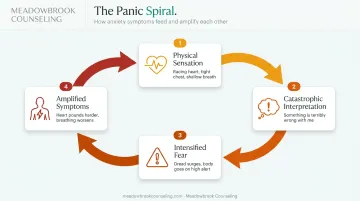
Clark's 1986 cognitive model identified catastrophic misinterpretations of bodily sensations as the engine of panic. Later research confirmed the sequence: changes in those catastrophic interpretations predicted subsequent reductions in panic severity.
Avoidance behaviors compound the problem. Skipping crowded places, exercise, or driving offers short-term relief, but teaches the brain that those situations are genuinely dangerous — strengthening the cycle with each episode avoided.
CBT targets this loop at both points. It changes how a person interprets bodily sensations and systematically dismantles avoidance, breaking the reinforcement rather than working around it.
How CBT Breaks the Panic Cycle
Starting with Psychoeducation
CBT for panic typically begins with psychoeducation — understanding why your brain and body respond the way they do. Learning about the sympathetic nervous system and the fight-or-flight response doesn't just provide context. For many people, it immediately reduces the fear of sensations, because the sensations finally make sense.
Knowing "this is a panic attack, not a heart attack" directly changes the brain's response to the experience.
The Inhibitory Learning Model
Older approaches to exposure therapy focused on habituation — tolerating feared sensations until anxiety naturally decreased. Modern CBT uses a different framework: inhibitory learning.
The goal isn't to white-knuckle through discomfort until it fades. It's to actively build a new association — "this sensation is uncomfortable, not dangerous." The shift in internal language matters: from I have to survive this to I can handle this.
Craske et al.'s inhibitory learning framework recommends maximizing expectancy violation — in other words, creating situations where the feared outcome clearly doesn't happen — rather than simply waiting for fear to subside.
Dismantling Avoidance
Those new associations are only possible when avoidance stops reinforcing the original fear. Avoidance is the primary mechanism that keeps panic disorder going — every avoided situation sends the same message: that place/feeling/activity is a real threat.
CBT systematically reverses this. Through graduated exposure, patients re-engage with avoided situations and sensations — and discover that their feared outcomes don't materialize. Research supports this: stopping safety behaviors during exposure produced larger reductions in anxiety and catastrophic beliefs compared to keeping those behaviors in place.
The two-phase CBT process works like this:
- Recognize and replace catastrophic thought patterns through cognitive work
- Build new behavioral responses through skill practice and graduated exposure
These phases work together. Cognitive work creates the mental flexibility to tolerate exposure; exposure provides direct evidence that challenges the catastrophic beliefs.
Core CBT Techniques for Panic Attacks
Cognitive Restructuring
Cognitive restructuring targets distorted thoughts like "I'm going to have a heart attack" or "I'm losing my mind." A therapist guides the patient to:
- Identify the automatic catastrophic thought
- Examine the evidence for and against it
- Develop a more realistic, balanced interpretation
Common tools used between sessions include thought records, panic diaries, and structured journaling — all designed to make the skill habitual, not just theoretical. A 1994 RCT found cognitive therapy outperformed both applied relaxation and imipramine on most measures at three months, supporting the value of this approach.
Interoceptive Exposure
Interoceptive exposure means deliberately inducing the physical sensations of panic in a safe, controlled setting. Common exercises include:
- Spinning in a chair to produce dizziness
- Breathing through a narrow straw to simulate breathlessness
- Running in place to elevate heart rate
The purpose is to break the association between these sensations and the belief that they're dangerous. Through direct, repeated experience, the brain learns: the feeling is not the threat. A 2018 component network meta-analysis identified interoceptive exposure as having the strongest positive signal among CBT components for panic disorder.

In Vivo Exposure
In vivo exposure means gradually confronting real-world situations avoided due to panic fear — supermarkets, driving, public transportation, crowded spaces.
Therapist and patient collaborate to build a fear hierarchy: a ranked list of avoided situations from least to most distressing. Working through the hierarchy in order accomplishes two things: it disconfirms feared outcomes and builds genuine confidence that avoidance never provides.
Behavioral Experiments
Where in vivo exposure focuses on confronting avoided places, behavioral experiments test specific anxious predictions against real-life outcomes. A patient who fears an elevated heart rate will trigger a heart attack might engage in brisk exercise — then observe what actually happens.
Key characteristics of behavioral experiments:
- Designed around the patient's specific feared prediction
- Outcomes are recorded and reviewed with the therapist
- Evidence gathered firsthand, not inferred or assumed
This experiential approach is more persuasive than cognitive argument alone, because the patient collects their own evidence rather than being told what to believe.
Relaxation and Breathing Techniques
Diaphragmatic breathing and progressive muscle relaxation (PMR) can help manage the physical symptoms of panic. In CBT, though, these are supporting tools — not the primary intervention.
The distinction matters. When breathing techniques become safety behaviors — used to escape feared sensations rather than face them — they can undermine exposure work. The goal is for relaxation skills to support engagement with fear, not replace it.
What to Expect During CBT Treatment for Panic Attacks
Structure and Timeline
NICE recommends 7–14 total hours of CBT, typically delivered in weekly 1–2 hour sessions completed within four months. Most standard programs run 9–12 sessions.
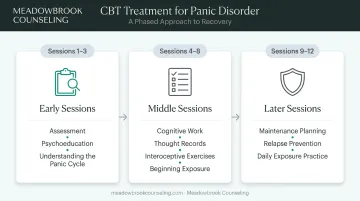
A typical course progresses through three phases:
- Early sessions: Assessment, psychoeducation, and understanding the panic cycle
- Middle sessions: Active cognitive work (thought records, interoceptive exercises), beginning exposure
- Later sessions: Maintenance planning, relapse prevention, building an ongoing exposure practice for daily life
Intensive formats are also effective. A 2025 open trial of the Bergen 4-Day Treatment found that 90% of participants were classified as in remission at 18 months — a strong preliminary signal, though the study lacked a control group.
The Role of Homework
CBT is not a passive process. Progress depends heavily on what happens between sessions — completing thought records, practicing relaxation, and engaging with avoided situations. This between-session work is where durable change gets built. Clients who treat sessions as the whole treatment tend to see slower results.
CBT and Medication Together
Both CBT and medication (SSRIs/SNRIs) are first-line treatments for panic disorder. A 2007 Cochrane review found that combined antidepressant plus CBT improved acute response more than either treatment alone.
The longer-term picture is more nuanced. After treatment ends, CBT-only patients maintained gains more consistently than medication-only patients.
There's also an important attribution dynamic to consider: research suggests that patients who attribute their improvement primarily to medication, rather than their own developing coping skills, are more likely to relapse when medication is discontinued. This doesn't mean medication is wrong — it means the self-efficacy built through CBT has independent protective value.
When and How to Start CBT for Panic Attacks
Signs It's Time to Seek Help
Self-help resources have a role, but professional CBT becomes important when:
- Panic attacks are occurring frequently or unpredictably
- Anticipatory anxiety is growing between attacks
- You've begun avoiding situations, places, or activities
- Panic is interfering with work, relationships, or daily functioning
Panic disorder is highly treatable. Seeking help isn't a sign that things are dire — it's the most practical next step available.
Finding the Right Therapist
When looking for a CBT therapist for panic disorder, prioritize:
- Relevant credentials: Licensed therapists (LCSW, LMFT, CMHC, or equivalent) with anxiety disorder experience
- Specific familiarity with interoceptive and in vivo exposure techniques
- A collaborative approach — CBT is a working partnership, not something done to you
Meadowbrook Counseling provides therapist matching across multiple states — including Utah, Massachusetts, Texas, Idaho, and Colorado — with clinicians trained in CBT and anxiety treatment. Their intake team verifies insurance benefits before your first session, so you know your coverage before you walk in the door. Call 801-655-5450 to get started.

In-Person vs. Online CBT
Research confirms that internet-delivered and telehealth CBT produce outcomes comparable to in-person therapy for panic disorder. A randomized trial found no significant difference between guided internet CBT and group CBT on panic symptom measures. If scheduling or location has kept you from starting, telehealth removes that obstacle — effective CBT is accessible wherever you are.
Frequently Asked Questions
How do you break a panic cycle?
Breaking the panic cycle means interrupting the feedback loop between frightening thoughts and physical sensations. The main tools are cognitive restructuring (challenging beliefs like "this is dangerous") and exposure-based techniques that teach the brain to associate those physical sensations with safety rather than threat.
Should I let a panic attack happen?
Yes — and that surprises most people. Allowing a panic attack to occur without fighting or fleeing from it is a core principle of modern CBT. Resisting or escaping reinforces the belief that sensations are dangerous; observing them teaches the brain they're uncomfortable but not catastrophic.
What type of therapy is best for panic attacks?
CBT has the strongest research base of any psychotherapy for panic disorder and is recommended in clinical guidelines across the board. It works by targeting the distorted thoughts and avoidance patterns that keep panic going, not just the symptoms themselves.
How many CBT sessions does it take to see improvement?
Most standard CBT programs for panic disorder run 9–12 weekly sessions, with many people experiencing meaningful symptom reduction within that timeframe. Intensive formats can produce comparable results faster, though individual response varies.
Can CBT for panic attacks be done online?
Yes. Research shows internet-delivered and telehealth CBT are as effective as in-person therapy for panic disorder, making treatment accessible for people with scheduling, geographic, or mobility barriers.
What is the difference between a panic attack and panic disorder?
A panic attack is a single episode of intense fear with physical and cognitive symptoms. Panic disorder is diagnosed when a person experiences recurrent panic attacks and develops persistent worry about future attacks or makes significant behavioral changes — like avoidance — as a result.