

Interpersonal Psychotherapy (IPT) and Cognitive Behavioral Therapy (CBT) are two of the most researched talk therapies for depression, anxiety, grief, and major life changes. Both are short-term and structured. Both work. But they get you there through completely different doors.
The stakes of picking wrong aren't trivial. An estimated 21 million U.S. adults, or 8.3%, experienced a major depressive episode in 2021, according to NIMH data, and millions more live with anxiety disorders. Choosing a mismatched therapy approach can stall progress for months. This guide breaks down how IPT and CBT actually differ, so you walk into your first session already knowing what to expect.
Key Takeaways
- IPT targets relationship problems and grief; CBT targets distorted thinking and avoidance behaviors.
- Both approaches are backed by decades of research and typically run 12-20 sessions.
- IPT suits grief, divorce, or new parenthood; CBT suits anxiety loops, phobias, and OCD.
- Many therapists blend techniques from both when a client's struggles overlap.
IPT vs CBT: Quick Comparison
The table below breaks down how these two approaches differ across focus, technique, and evidence base.
| Factor | IPT | CBT |
|---|---|---|
| Primary Focus | Relationships, social roles, life transitions | Thought patterns and behaviors |
| Typical Techniques | Communication analysis, role-playing, decisional analysis | Cognitive restructuring, behavioral experiments, exposure |
| Session Length | 12-16 structured sessions | Typically 10-20 sessions, varies by concern |
| Best Suited For | Grief, role disputes, role transitions, interpersonal deficits | Anxiety disorders, phobias, OCD, negative thinking |
| Evidence Base | Strong for depression (effect size d=0.63 vs. control) | Extensively researched (effect size g=0.71 vs. control for depression) |
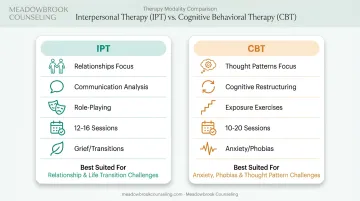
Neither number above proves one therapy beats the other — they're each measured against no-treatment control groups, not against each other. Keep that in mind as you read on. A licensed therapist can help you determine which approach, or combination, best fits your situation.
What Is Interpersonal Psychotherapy (IPT)?
IPT is a short-term, structured therapy built on a simple premise: your mental health struggles are tied to the state of your relationships. Depression rarely happens in a vacuum. It's often connected to a loss, a conflict, or a life change you haven't fully adjusted to.
IPT organizes treatment around four problem areas that map directly onto these triggers:
- Grief — depression linked to the death of someone close
- Role disputes — ongoing conflict from mismatched expectations, such as a marriage where one partner feels unheard
- Role transitions — difficulty adjusting to a changed life circumstance, like becoming a parent or retiring
- Interpersonal deficits — a long pattern of isolated or strained relationships with no single triggering event
Core Techniques and What a Session Looks Like
IPT sessions rely on communication analysis (reviewing exactly what was said in a difficult conversation and where it broke down), role-playing (practicing a hard conversation before having it for real), and structured problem-solving focused entirely on relationships.
Here's a concrete example. A client going through a difficult divorce comes in overwhelmed and withdrawn. The therapist identifies this as a role transition — the client is losing the identity of "spouse" and needs help building a new one. Sessions focus on processing the loss, rebuilding a support network, and practicing new ways of communicating with an ex-partner or children.
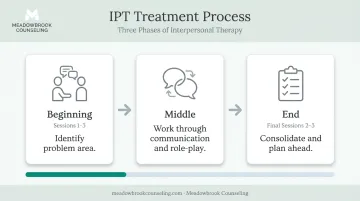
The Three Phases of IPT Treatment
- Beginning (sessions 1-3): The therapist connects your symptoms to your relationships and helps you pick one primary problem area to focus on.
- Middle: You work through that problem using communication analysis, role-play, and direct problem-solving.
- End (final 2-3 sessions): You consolidate what you've learned and plan for future stress.
Who benefits most: People whose depression or anxiety is closely tied to a relationship conflict, a loss, or a major life change — new parents, people navigating divorce, or anyone feeling cut off from their support system. A 2011 meta-analysis found IPT produced a moderate-to-large effect (d=0.63) compared to control conditions across 16 studies. This overlap with grief and life-transition support is why therapists offering grief counseling often draw on IPT techniques when a client's symptoms trace back to a specific relational event.
What Is Cognitive Behavioral Therapy (CBT)?
CBT works from a different starting point: thoughts, feelings, and behaviors are interconnected, and changing how you think can change how you feel and act. If IPT looks outward at your relationships, CBT looks inward at your thought patterns.
CBT leans on three core techniques:
- Cognitive restructuring — identifying distorted thoughts ("I always fail") and testing them against real evidence
- Behavioral experiments — testing a fear directly, like giving a small presentation to see if the "everyone will judge me" prediction actually holds up
- Exposure exercises — gradually facing feared situations to reduce avoidance, commonly used for phobias and panic disorder
These techniques are backed by strong research. A 2013 meta-analysis found CBT produced an effect size of g=0.71 against control conditions across 94 comparisons for adult depression, one of the more robust findings in psychotherapy research. That effect dropped to g=0.53 when limited to the highest-quality studies, but it still held up.
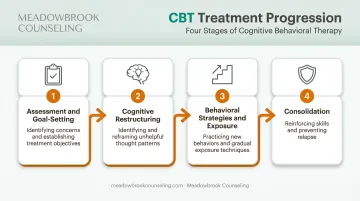
How CBT Treatment Progresses
- Assessment and goal-setting — mapping out your specific thought patterns and behaviors
- Cognitive restructuring — actively challenging distorted thinking
- Behavioral strategies and exposure — confronting avoided situations
- Consolidation — relapse-prevention planning for the future
Delivery Formats Vary More Than People Expect
CBT isn't limited to sitting in an office once a week. It's delivered through:
- Individual, one-on-one sessions
- Therapist-led group formats
- Guided online/app-based programs, which research shows outperform unguided self-help versions, especially for moderate-to-severe symptoms
Who benefits most: People dealing with anxiety disorders, phobias, OCD, panic attacks, or a persistent loop of negative self-talk that keeps triggering avoidance.
CBT is one of several structured, evidence-based modalities offered by Meadowbrook Counseling therapists, often paired with trauma-focused approaches like EMDR for clients working through anxiety and PTSD alongside other concerns.
IPT vs CBT: Which Approach Is Right for You?
The honest answer: it depends on where your distress is coming from.
Lean toward IPT if:
- You're grieving a loss and can't seem to move forward
- You're navigating a breakup, divorce, or major relationship conflict
- You just became a parent, retired, or hit a major life transition
- You feel isolated and struggle to form or maintain close relationships
Lean toward CBT if:
- Your mind gets stuck in anxious thought loops you can't break
- You avoid specific situations, objects, or places out of fear
- You want concrete coping skills you can practice between sessions
- You're dealing with panic attacks, OCD, or a specific phobia
"What Therapy Is Better Than CBT?"
No therapy is universally "better." A 2017 meta-analysis comparing IPT and CBT head-to-head in depression found a small CBT edge on one self-rated scale but no significant difference on clinician-rated measures.
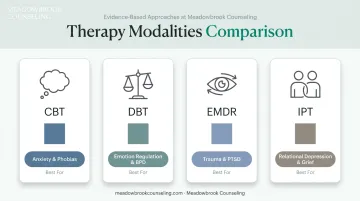
The same pattern holds elsewhere: DBT outperforms general CBT specifically for emotion regulation and borderline personality disorder, while EMDR performs comparably to trauma-focused CBT for PTSD. Effectiveness depends on what you're treating, not a universal ranking.
When Blending Makes Sense
Real cases rarely fit one category perfectly. Consider a new mother with postpartum depression who feels isolated from friends (relational) while also caught in relentless self-critical thinking ("I'm a terrible mother") that keeps her from reaching out (cognitive). A rigid either/or choice shortchanges her. Many therapists draw techniques from both approaches for exactly this kind of overlap.
Cases like hers are exactly why working with a practice offering multiple modalities matters. Meadowbrook Counseling's intake team matches clients with therapists trained in CBT, EMDR, DBT, and other evidence-based approaches based on individual needs, so you're not stuck guessing which therapy to request on your own.
Conclusion
IPT and CBT aren't rivals fighting for the same title. They're different tools built for different problems. If your struggles trace back to a relationship, a loss, or a life transition, IPT's structure will likely feel more relevant. If you're fighting distorted thinking or avoidance behavior, CBT gives you a more direct path forward.
A qualified therapist can help you sort this out during an initial assessment rather than leaving you to diagnose yourself. Whether you're rebuilding your life after a loss or trying to break a cycle of anxious thinking, Meadowbrook Counseling's intake team matches you with a therapist trained in the approach that fits your situation. That match happens before your first session, not after months of trial and error.
Frequently Asked Questions
What is an example of IPT therapy?
A client becoming an empty-nester struggles with a sudden loss of identity and purpose. The therapist helps them process this role transition through communication analysis and role-playing, rebuilding neglected relationships.
What therapy is better than CBT?
No single therapy is universally better. IPT, DBT, and EMDR each outperform CBT in specific contexts, such as relationship-driven depression, emotion regulation, or trauma.
Can IPT and CBT be used together?
Yes. Therapists often blend techniques from both when a client faces overlapping relational and cognitive struggles, such as grief combined with anxious rumination. Integrative treatment plans are common in clinical practice.
How long does IPT or CBT treatment typically take?
Both are short-term therapies. IPT typically runs 12-16 sessions, while CBT ranges from about 10 to 20 sessions depending on the severity and complexity of the concern.
Are IPT and CBT effective for anxiety as well as depression?
Both have solid evidence for anxiety. CBT is especially well-studied for phobias and panic disorders, while IPT is more established for depression tied to relationship stress and life transitions.
How do I know which therapy is right for me?
A licensed therapist can assess your specific symptoms and history during an initial consultation to recommend the best fit. Contact Meadowbrook Counseling at 801-655-5450 for personalized therapist matching.