

Talk therapy has long been the go-to treatment for trauma. But it typically asks survivors to describe what happened, sometimes repeatedly, which can feel retraumatizing rather than healing. That's part of why more clinicians and survivors are turning to EMDR (Eye Movement Desensitization and Reprocessing) — an approach that doesn't require verbalizing every detail of the abuse.
This guide breaks down what EMDR actually is, how it works step-by-step, and how it specifically helps adults process sexual trauma.
Key Takeaways
- EMDR helps the brain reprocess "stuck" traumatic memories without detailed verbal disclosure
- Sexual trauma often creates negative beliefs like "it was my fault" — EMDR directly targets and shifts these
- Bilateral stimulation (eye movements, taps, or tones) drives the structured, phased protocol
- EMDR works for childhood or adult trauma, even with fragmented or partially forgotten memories
- Healing isn't linear — an EMDR-certified, trauma-informed therapist should guide the pace
What Is EMDR Therapy?
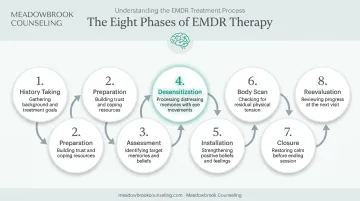
EMDR is a structured psychotherapy developed by psychologist Dr. Francine Shapiro after she noticed, in 1987, that certain eye movements seemed to reduce the intensity of disturbing thoughts. She published her first controlled study two years later, and clinicians have refined the protocol into what's now an eight-phase treatment framework. At Meadowbrook Counseling, EMDR-certified therapists like Rosario Toral, ACMHC, use this exact framework when working with trauma survivors.
The core idea: traumatic memories sometimes get "stuck" in the nervous system instead of being processed like ordinary memories. Researchers studying this describe traumatic memories as more sensory and emotionally charged, with weaker links to context. This means they surface as raw fragments — images, body sensations, panic — rather than a coherent story with a beginning, middle, and end.
Why EMDR Doesn't Require Reliving Every Detail
Traditional talk therapy often asks survivors to repeatedly narrate what happened. EMDR works differently. It engages the brain's reprocessing system directly through bilateral stimulation, which means survivors don't need to describe graphic details aloud for the therapy to work.
EMDR is not:
- Hypnosis
- A form of suggestion
- A way to implant or "recover" memories
- Dependent on verbalizing every traumatic detail
Does EMDR Actually Work for Sexual Trauma?
The evidence is mixed. A small 1997 trial of adult rape survivors found that 90% of participants who received EMDR no longer met PTSD criteria after treatment, compared to just 12% of those on a waitlist. That's a striking result, though the study's small sample size limits how much weight it can carry.
Other research tells a more complicated story. A 2021 trial testing EMDR shortly after recent rape found no significant advantage over watchful waiting at 8 or 12 weeks, though both groups improved over time.
What's clearer is institutional recognition. The World Health Organization's 2023 evidence update gives EMDR a conditional recommendation for adult PTSD based on moderate-certainty evidence, and the American Psychological Association's 2025 guideline does the same. Neither is a sexual-trauma-specific endorsement — they cover PTSD broadly — but sexual trauma is one of the most common causes of PTSD, so the treatment's general effectiveness matters here.
EMDR can be adapted for survivors who remember everything and for those whose memories are fragmented or partially inaccessible, since the therapy targets the body's stored trauma response rather than requiring full conscious recall.
How EMDR Therapy Works for Sexual Trauma
EMDR follows eight defined phases, but for sexual trauma survivors, treatment generally unfolds in three broader stages: preparation, active reprocessing, and integration. At Meadowbrook Counseling, EMDR-certified therapists like Rosario Toral, ACMHC, guide clients through each stage at a pace that respects their history.
Preparation and Safety Building
Before any trauma processing begins, the therapist spends time on history-taking and building trust. This groundwork forms the foundation everything else depends on.
During this phase, therapists typically:
- Teach grounding and self-soothing techniques for use between sessions
- Identify a "resource" figure or felt sense of safety the client can mentally return to
- Assess readiness without rushing toward the traumatic material
For sexual trauma survivors specifically, this stage often takes longer than average. Trust was violated during the trauma itself, so establishing it with a new person takes deliberate, unhurried work.
Active Reprocessing Through Bilateral Stimulation
Once safety and trust are established, active reprocessing can begin. Bilateral stimulation means alternating left-right sensory input: side-to-side eye movements, alternating hand taps, or tones through headphones. While this happens, the therapist guides the client to briefly hold a target memory in mind.
Here's the part many survivors find relieving: you don't have to narrate the abuse in detail. Many EMDR therapists use a "private event" or "blind-to-therapist" approach, where the survivor processes the memory internally and simply reports process-level feedback (distress levels, general shifts) without disclosing specifics aloud. This protocol was developed specifically for clients unwilling or unable to describe traumatic content.
As reprocessing continues, distressing images, body sensations, and self-blaming beliefs naturally surface. Repeated sets of bilateral stimulation help these lose their emotional charge over time.
Regulation and Monitoring Distress
Throughout reprocessing, therapists check in constantly using a 0-10 distress scale (Subjective Units of Disturbance, or SUD) to track whether the memory's intensity is dropping across sessions.
This pacing matters enormously for sexual trauma. It:
- Prevents emotional overwhelm during sessions
- Keeps the survivor in control of the process at every step
- Avoids the retraumatization risk that comes from constant verbal recounting
Integration and New Beliefs
The goal is for the traumatic memory to become stored like an ordinary past memory — something you can recall without it hijacking your nervous system in the present.
Practically, survivors often notice:
- Fewer flashbacks and intrusive images
- Reduced hypervigilance in daily life
- Greater ability to feel safe in their body during intimacy or physical closeness
How EMDR Reframes the Negative Beliefs Sexual Trauma Creates
Beyond the flashbacks and body memories, sexual trauma frequently plants negative self-beliefs that operate below conscious awareness — "it was my fault," "I'm broken," "I can't trust anyone." These beliefs don't feel like thoughts you can just argue yourself out of. They feel like facts.
EMDR identifies these negative cognitions early in the process (during the assessment phase) and pairs them with a preferred, adaptive belief the survivor wants to feel true instead.
Common shifts survivors experience through EMDR:
| Negative Belief | Adaptive Belief |
|---|---|
| "It was my fault" | "I am not to blame" |
| "I'm powerless" | "I am in control now" |
| "I'm broken" | "I am whole and healing" |
| "I can't trust anyone" | "I can learn who is safe" |
| "I should have stopped it" | "I did what I could to survive" |
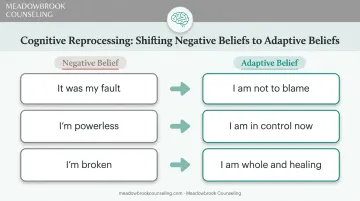
This isn't positive thinking or a mental trick. According to Shapiro's Adaptive Information Processing model, the belief shift happens because the brain is reprocessing the underlying memory network itself. It links the traumatic memory to more adaptive associations already stored in the brain. The therapist isn't talking the client out of the old belief; the belief loosens its grip as the memory network changes.
Survivors frequently describe this shift as happening organically during sessions. They're not told what to believe — they arrive at the new belief themselves, often mid-session, almost by surprise. At Meadowbrook Counseling, EMDR-certified therapists guide clients through this process at a pace that respects each survivor's readiness.
Who Can Benefit From EMDR After Sexual Trauma
EMDR is used with both adults who experienced sexual abuse in childhood and those who experienced sexual assault later in life. The approach adapts to either timeline.
What If You Don't Fully Remember?
This is one of the most common concerns survivors raise, and it's a valid one. Memory gaps around abuse are well documented, particularly when the perpetrator was a trusted figure.
A prospective study following women whose childhood sexual abuse had been previously documented found that 38% did not report or recall the abuse during a follow-up interview 17 years later. Researchers caution this figure reflects non-reporting broadly, not a confirmed rate of memory repression specifically.
The reassuring news: EMDR doesn't require a complete narrative memory to work. It can target:
- Present-day triggers (certain touch, smells, situations)
- Body sensations that arise without a clear "story" attached
- Emotional reactions that feel disproportionate to current events
EMDR Rarely Works Alone
Healing from sexual trauma is rarely a straight line, which is why EMDR is often combined with complementary approaches rather than used as a standalone fix.
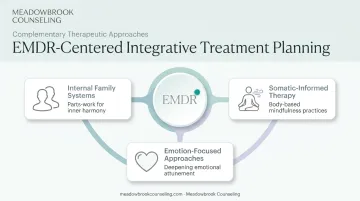
At Meadowbrook Counseling, several clinicians integrate EMDR directly with other modalities within the same treatment plan. Rather than referring clients elsewhere for that support, they combine EMDR with:
- Internal Family Systems (parts work)
- Somatic-informed therapy
- Emotion-focused approaches
Finding the Right EMDR Therapist for Sexual Trauma Recovery
Not every EMDR-trained therapist has deep experience with sexual trauma specifically. When you're looking for a provider, look beyond general EMDR familiarity.
What to look for:
- Formal EMDR certification (not just a weekend training)
- Specific trauma-informed experience with sexual abuse or assault survivors
- A first-session approach focused on safety and pacing, not diving straight into details
- A clear willingness to let you set the pace, since a good therapist never pressures disclosure before you're ready
Meadowbrook Counseling connects clients with EMDR-certified clinicians experienced in trauma recovery, including Rosario Toral, ACMHC, who uses EMDR alongside other evidence-based approaches to help clients process trauma. The practice also offers insurance verification support through its contact page, so you can confirm coverage details before your first appointment rather than after.
If you'd rather talk it through than fill out a form, the billing team at 801-655-5450 can walk you through what your specific plan covers for EMDR sessions.
Frequently Asked Questions
Is EMDR therapy effective for sexual trauma?
Research is mixed but generally supportive . One early trial found that 90% of rape survivors no longer met PTSD criteria after treatment, while later studies have found smaller but still meaningful improvements. Major health bodies like WHO and the APA recognize EMDR as an evidence-based PTSD treatment.
What type of therapy is best for treating sexual trauma?
There's no single "best" option. EMDR, trauma-focused CBT, and somatic therapies are all evidence-based, and the right fit depends on your comfort level and specific needs. A trauma-informed therapist can help you decide.
Do I have to talk about the details of my abuse during EMDR?
No. EMDR can be done through a "private event" approach, where you process the memory internally and only share process-level feedback, not specific details, with your therapist.
How many EMDR sessions are typically needed for sexual trauma recovery?
This varies widely based on whether the trauma was a single incident or repeated abuse over time. Sessions generally run 60-90 minutes, and your therapist can offer a personalized estimate after an initial assessment.
Can EMDR help if I don't clearly remember my abuse?
Yes. EMDR can target present-day triggers, body sensations, and emotional patterns connected to the trauma, even without a complete conscious memory of the event itself.
Is EMDR the same as hypnosis?
No. You remain fully awake, aware, and in control throughout EMDR sessions, and you can stop the process at any point, unlike hypnosis, which involves an altered state of consciousness.