

That unease isn't random. Many people carry it after years of navigating microaggressions, discrimination, or the quiet exhaustion of hiding parts of themselves. This is often identity-based trauma: not one event, but the accumulated weight of being treated as "other" because of race, gender, sexuality, disability, religion, or another core part of who you are.
This article breaks down what identity-based trauma actually is, why it's uniquely hard to heal from, and what evidence-based recovery can look like — including how trauma-informed therapists at Meadowbrook Counseling approach this work.
Key Takeaways
- Identity-based trauma stems from repeated harm tied to race, gender, sexuality, disability, or religion, not one isolated incident
- Common signs include chronic anxiety, hypervigilance, internalized oppression, and trouble trusting others
- This trauma is harder to name and heal than single-event trauma because it's diffuse and often socially invalidated
- EMDR, community support, and trauma-informed therapy offer a proven path forward
What Is Identity-Based Trauma?
Identity-based trauma refers to psychological and emotional harm caused by discrimination, invalidation, or threats tied to a person's social identity group. Researchers describe it as hate or bias-motivated experiences that "target and demean facets of a minoritized individual or group's identity" (Allwood et al., 2021).
This isn't a formal DSM-5 or ICD-11 diagnosis. It's a framework for understanding how certain experiences produce trauma-like symptoms, even when they don't fit the traditional definition of a single catastrophic event.
Even awareness of belonging to a targeted group can carry risk. A 2024 study of 1,122 US adults found that the Charlottesville rally increased hate-crime-related stress among Black respondents nationwide. Most had no direct connection to the event. Perceived personal vulnerability alone explained the effect (Hellyer and Gereke, 2024).
Racial Battle Fatigue: A Case Study in Chronic Stress
One of the clearest research examples is Racial Battle Fatigue, a term coined by University of Utah scholar William A. Smith in 2003. It describes the psychophysiological toll of repetitive, systemic racism and microaggressions.
Documented responses include:
- Anxiety and frustration
- Anger and depression
- Headaches and insomnia
- Elevated blood pressure
This isn't abstract. It's a body responding to a threat that never fully goes away.
Examples Across Different Identities
This same chronic-stress pattern appears across other identity groups too, though it takes different forms depending on which parts of a person's identity are targeted:
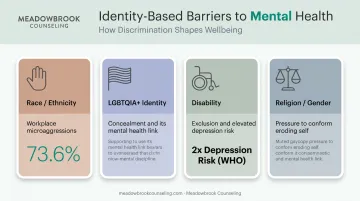
- Race/ethnicity: A Black employee endures repeated racial microaggressions in meetings — being interrupted, having ideas credited to others, being asked to "represent" their race. A 2024 meta-analysis of 2,998 participants estimated workplace microaggression prevalence at 73.6% (Salari et al., 2024).
- LGBTQIA+ identity: A gay man conceals his relationship at work, fearing rejection or violence. Research shows concealment is linked to higher depression and anxiety, though it can also function as protection in unsafe environments.
- Disability: A wheelchair user is repeatedly excluded from inaccessible venues, leading to social isolation. The World Health Organization reports people with disabilities face roughly twice the risk of depression, driven largely by stigma and exclusion.
- Religion or gender: A woman in a conservative religious community faces constant pressure to conform to rigid gender roles, slowly eroding her sense of self.
Childhood exposure compounds the damage. The CDC's 2019 Vital Signs report found that 61% of adults experienced at least one Adverse Childhood Experience (ACE), and preventing ACEs could avert up to 44% of adult depression cases. Identity-based harm experienced early in life doesn't just hurt in the moment — it can shape long-term mental and physical health.
Understanding Trauma Types: Where Identity-Based Trauma Fits
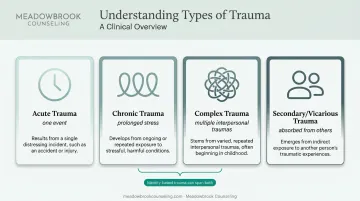
Clinicians generally recognize four trauma categories:
- Acute trauma — a single, time-limited event
- Chronic trauma — repeated or prolonged stressors that don't resolve
- Complex trauma — multiple, recurring interpersonal traumas with long-term effects
- Secondary/vicarious trauma — trauma symptoms absorbed through close contact with others' trauma (common among helping professionals)
Identity-based trauma fits most closely into the chronic or complex categories, since it rarely comes from one incident with a clear before-and-after. Instead, it builds from thousands of smaller moments — a comment here, a slight there, a door closed somewhere else — that accumulate over months or years.
Compare that to single-event trauma, like a car accident. There's a start, an end, and often a clear recovery arc. Identity-based trauma is more like a constant, low-level hum — background noise that never fully switches off.
That ambiguity is exactly what makes it so hard to pinpoint, since there's no single moment to point to and say, "That's when it happened." Because it's harder to name, it's also easier for others — even well-meaning people — to dismiss or minimize it. Trauma-informed clinicians are trained to recognize this pattern, which is why identifying it accurately is often the first step toward effective treatment.
Recognizing the Signs of Identity-Based Trauma
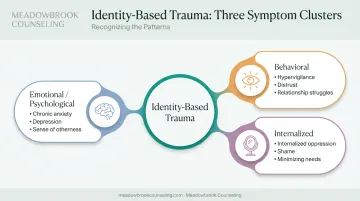
The symptoms of identity-based trauma often overlap with other trauma responses, but they show up in three distinct clusters.
Emotional and Psychological Signs
- Chronic anxiety or a persistent sense of dread
- Depression or low mood that doesn't have an obvious trigger
- A nagging feeling of "otherness," even in familiar spaces
Behavioral Signs
- Hypervigilance — scanning rooms, conversations, or environments for signs of threat
- Difficulty trusting others, even those who mean well
- Struggling to form or sustain close relationships
Internalized Signs
Internalized oppression is one of the most insidious effects, often showing up as:
- Believing negative stereotypes aimed at your own identity group
- Feelings of shame or self-hatred with no clear source
- Minimizing your own experiences or needs compared to others'
This pattern isn't a character flaw. It's a learned response, shaped by years of external messaging absorbed over time.
Recognizing these signs in yourself or a loved one is often the first step toward seeking trauma-informed care that addresses identity-based wounds directly.
Why Identity-Based Trauma Can Be Especially Hard to Heal
Standard trauma treatment often assumes a clear starting point and a path toward resolution. Identity-based trauma disrupts that model in a few key ways:
- No clean endpoint: Unlike a single traumatic event you can process and move past, discrimination, inaccessible environments, and identity-based threats often remain active in daily life. You can't simply avoid the trigger when it's woven into your workplace, neighborhood, or family.
- Frequent societal invalidation: Microaggressions are, by definition, subtle and easy to explain away. When someone says "that's not what they meant" or "you're overreacting," it compounds the original injury. Researchers call this pattern microinvalidation, and it's one of the most commonly reported forms of identity-based harm.
- Treatment timelines that need to adapt: Because the trauma is spread across many moments rather than tied to one event, healing tends to be layered and ongoing rather than a single processing session.
This isn't a sign that something's wrong with the treatment — it's a reflection of the trauma's actual shape. Trauma-informed clinicians, including those trained in approaches like EMDR, build their pacing around this reality rather than forcing identity-based trauma into a standard short-term model.
Evidence-Based Paths to Healing
Healing from identity-based trauma isn't a single fix. It's a combination of approaches that work together over time.
Start With Self-Education
Understanding the mechanism behind your experience, knowing terms like Racial Battle Fatigue, minority stress, or internalized oppression, can be genuinely empowering. It reframes what you're feeling from "something's wrong with me" to "this is a documented response to real harm."
Find Community
Connecting with others who share your identity and experiences provides validation that's hard to get elsewhere. Minority Stress Theory identifies community connectedness as a real resilience resource. That said, community isn't automatically protective. Some LGBTQIA+ people of color report additional marginalization even within community spaces, so finding the right community matters as much as finding a community.
Work With a Trauma-Informed Therapist
This is where professional support makes a measurable difference. EMDR (Eye Movement Desensitization and Reprocessing) is one of the most well-supported therapies for trauma. The American Psychological Association's 2017 guideline formally recommends it for PTSD, and a typical course runs about three months of weekly 50- to 90-minute sessions.

At Meadowbrook Counseling, Rosario Toral, ACMHC, is a certified EMDR practitioner with a trauma-informed lens for clients navigating difficult, identity-related experiences. She combines EMDR with CBT and solution-focused approaches, creating space for clients to process what they've been carrying without having to over-explain or justify their pain.
Other practical tools worth building into your healing process:
- Cognitive reframing to challenge internalized negative beliefs
- Self-compassion practices — research links greater self-compassion to lower minority stress and better mental health outcomes
- Validation-focused therapy that names the harm instead of minimizing it
Getting Started Without the Added Stress
Finding the right therapist shouldn't feel like another burden. Meadowbrook Counseling matches clients with a therapist suited to their needs. The practice also supports insurance verification before that first session, so you're not left guessing about coverage or cost. With offices across multiple states, plus telehealth options, support is more accessible than it might seem.
Frequently Asked Questions
What is identity-based trauma and what are some examples?
Identity-based trauma is psychological harm from repeated discrimination or invalidation tied to a core identity, such as race, gender, or sexuality. Examples include workplace racial microaggressions or an LGBTQIA+ person concealing their identity out of fear of rejection.
Which trauma is hardest to heal from?
Chronic, complex, and identity-based traumas are often considered the hardest to heal because they stem from repeated, ongoing exposure rather than one defined incident. Without a clear endpoint, healing tends to be gradual and layered rather than a single resolution.
What are the four types of trauma?
The four commonly recognized types are acute (a single event), chronic (repeated or prolonged stress), complex (multiple recurring interpersonal traumas), and secondary/vicarious (absorbed through contact with others' trauma).
How is identity-based trauma treated in therapy?
Common evidence-based approaches include EMDR, talk therapy such as CBT, and community-based support, all offered by Meadowbrook Counseling's trauma-informed therapists. Many therapists also incorporate cognitive reframing to address internalized negative beliefs.
Can identity-based trauma be healed without professional help?
Self-education, community connection, and self-compassion practices can meaningfully support healing on their own. That said, professional therapy, especially EMDR, often accelerates and deepens the process. A therapist matching you to the right specialist can make that step easier.
Is identity-based trauma the same as complex PTSD?
No. Identity-based trauma describes the source of harm, while complex PTSD is a specific ICD-11 diagnosis with defined symptom criteria. Repeated identity-based harm can contribute to complex PTSD symptoms, but it doesn't automatically produce that diagnosis.