?](https://file-host.link/website/meadowbrookcounseling-3lwkjw/assets/blog-images/b3aa1629-7eab-4d42-9768-1d8273ccfe32/1784909535371084_d11d407190ad45f783954d9742917725/360.webp)
It's a fair question, and the answer isn't simple. Insurance rules around relationship counseling are genuinely confusing, and they shift depending on your plan, your diagnosis, and even which state you live in. Many couples give up on therapy altogether just trying to figure out the paperwork.
This article breaks down when coverage actually applies, how to check your specific plan before booking, and what to do if your insurer says no.
Key Takeaways
- Insurance rarely covers couples therapy alone, since "relationship issues" aren't a diagnosable condition
- Coverage becomes possible when joint sessions support a partner's diagnosed mental health treatment plan
- Sessions are typically billed under CPT code 90847 tied to an individual diagnosis, not "couples therapy"
- EAPs, sliding-scale fees, and HSA/FSA funds (with documentation) can help offset costs when insurance won't
Does Insurance Cover Couples Therapy? The Short Answer
Here's the reality: most insurance plans won't pay for couples therapy when the focus is purely relationship dynamics, communication problems, or everyday conflict. Insurers cover treatment tied to "medical necessity," meaning a diagnosable condition listed in the DSM. Wanting to communicate better with your partner doesn't meet that bar on its own.
This surprises a lot of people, especially because two major federal laws sound like they should help.
Why Parity Laws Don't Guarantee Coverage
The Affordable Care Act (ACA) requires many plans to include mental health services as an essential benefit. The Mental Health Parity and Addiction Equity Act (MHPAEA) requires that when a plan does cover mental health treatment, it can't impose stricter limits than it does for medical or surgical care.
Neither law forces a plan to cover relationship counseling without a diagnosis. Parity only kicks in once a covered benefit exists — it doesn't create new benefits out of thin air.
When a Diagnosis Changes the Picture
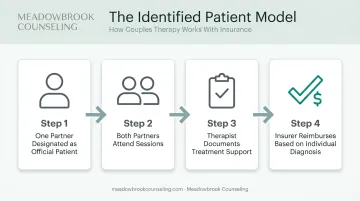
If one partner has a diagnosed condition, such as anxiety, depression, an adjustment disorder, or PTSD, and couples sessions are documented as part of that treatment plan, coverage becomes possible. This is where the "identified patient" model comes in.
Here's how it works in plain terms:
- One partner is listed as the official patient on the insurance claim
- Both partners attend and participate in sessions
- The therapist documents how the joint sessions support that one partner's treatment
- The insurer reimburses based on that individual's diagnosis, not the relationship itself
You'll also see the diagnosis code Z63.0 ("relationship problems with spouse or partner") mentioned online. It's real, but it's not your golden ticket. Z-codes describe circumstances, not psychiatric illness, so CMS guidance on psychiatric billing doesn't list Z63.0 among diagnoses that support medical necessity. Most insurers want a clinical diagnosis attached, not just a relationship code.
Sorting out whether your specific plan covers couples sessions under the identified patient model can get confusing fast. Meadowbrook Counseling verifies insurance benefits before your first session, so you know what's covered before you commit to a therapist.
When Insurance Might Cover Couples Therapy
Factors That Influence Coverage
Three things largely determine whether your claim gets paid:
- Network status — In-network therapists mean lower copays and simpler billing; out-of-network providers get reimbursed at lower rates with more paperwork on your end.
- The diagnosis code used — A clinical diagnosis tied to one partner's treatment carries far more weight than Z63.0 alone.
- Medical necessity documentation — Insurers require proof that treatment addresses a real condition, not general relationship enrichment.
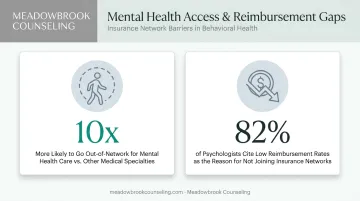
Network gaps are a bigger problem than most couples realize. The American Psychological Association found that patients are more than 10 times as likely to go out-of-network for mental health care compared to other medical specialties. Among psychologists who don't participate in insurance networks, 82% cited low reimbursement rates as the reason, according to APA's 2024 survey data.
That gap matters because it means many qualified couples therapists simply aren't paneled with major insurers, regardless of diagnosis. Meadowbrook Counseling addresses this directly by accepting a wide range of carriers across its locations, including Aetna, Blue Cross Blue Shield, Cigna, UnitedHealthcare, TriCare, and various Medicaid and Medicare Advantage plans. Acceptance still varies by state, office, and individual therapist, so confirm your specific provider's network status before your first session.
Medicare and Couples Therapy
The diagnosis requirement carries over to Medicare, too. Medicare Part B covers family counseling only when the main purpose is helping treat the beneficiary's diagnosed condition, according to Medicare's official coverage guidance. Relationship improvement as a standalone goal isn't covered.
There's also a provider limitation worth knowing:
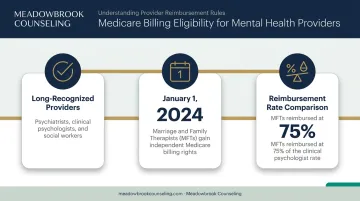
- Psychiatrists, clinical psychologists, and clinical social workers have long been Medicare-recognized providers
- Marriage and family therapists (MFTs) only gained independent Medicare billing rights starting January 1, 2024, following the Consolidated Appropriations Act, 2023
- MFTs are reimbursed at 75% of the clinical psychologist rate under the Physician Fee Schedule
This means a standalone MFT practice that hasn't enrolled with Medicare may not be billable, even if the therapist is excellent. Always confirm your specific provider's Medicare enrollment status before assuming coverage.
How to Check Your Coverage Before Booking
Don't just search "does insurance cover couples therapy" and hope for a clear answer. Call your insurer directly and ask specific questions:
- "Do you cover CPT code 90847 for a client with a mental health diagnosis?"
- "What's my in-network cost per session, and what's my deductible status?"
- "Is prior authorization required for family or conjoint psychotherapy?"
- "What's my out-of-network reimbursement rate if my therapist isn't paneled?"
When reviewing your plan documents, search for terms like "behavioral health," "family therapy," or "outpatient mental health." You likely won't find "couples therapy" listed as its own category since it doesn't exist as a distinct billing classification.
Meadowbrook Counseling's team can help verify insurance benefits before your first session. The process depends on your plan type:
- Marketplace or ACA plans: Email your member ID for a benefits check
- EAP coverage: Provide your authorization code or member ID to the billing team
- Medicaid variants or TriWest plans: Call 801-655-5450 directly for the clearest answer
What If Insurance Doesn't Cover It? Alternatives and Costs
If your plan won't cover couples therapy, you still have real options. Private-pay rates vary by location and therapist credentials, but Meadowbrook Counseling's general self-pay range runs:
| Session Type | Typical Cost |
|---|---|
| Intake session | $180–$200 |
| Regular session | $135–$160 |
Employee Assistance Programs (EAPs)
Many employees never realize their workplace offers this benefit. EAPs are typically free to employees, with no copay or deductible, and they often extend to a partner or household member. According to SHRM's research on EAP structures, EAP counseling commonly covers three to six sessions before referring out to longer-term care.
That's a real window to work with a couples therapist at no cost, and it doesn't require a diagnosis.
HSA and FSA Funds
HSA and FSA funds come with a specific catch. IRS guidance is clear: therapy treating a diagnosed mental illness counts as a medical expense, but ordinary marital counseling does not. A Letter of Medical Necessity tied to a documented diagnosis may open the door, but general relationship counseling won't qualify on its own.
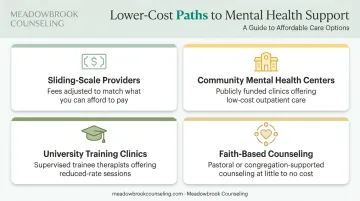
Other Lower-Cost Paths
- Sliding-scale providers — many practices adjust fees based on income
- Community mental health centers — often government-subsidized
- University training clinics — supervised graduate students at reduced rates
- Faith-based counseling — frequently free or low-cost through religious organizations
Is Free Couples Therapy Possible?
Sometimes, yes. Free EAP sessions, community mental health programs, university clinics, and some nonprofit or faith-based initiatives can provide no-cost sessions. Availability depends heavily on your location, so treat this as a possibility worth researching, not a guarantee.
Why Paying Out-of-Pocket Can Still Be Worth It
Evidence-based approaches carry real weight. A 2019 meta-analysis of nine randomized controlled trials found Emotionally Focused Therapy produced a large effect size (Hedges' g = 2.09) for improving marital satisfaction, according to research published on PubMed. Meadowbrook's therapists use EFT and the Gottman Method, both research-backed frameworks, which makes private pay a reasonable investment even without reimbursement.
Premarital Counseling and Insurance
Don't expect your insurer to help here. Premarital counseling is preventive, not diagnosis-driven, so it falls outside what insurance typically reimburses. There's no medical condition being treated, which is the entire basis insurers use to approve claims.
Instead, premarital counseling usually covers:
- Communication styles and conflict patterns
- Financial expectations and money management
- Family planning and parenting philosophies
- Intimacy expectations and physical connection
- Compatibility around values and life goals
Since insurance isn't a realistic funding source, look at sliding-scale providers, structured workshops, or bundled session packages instead. Many therapists at Meadowbrook Counseling specialize in premarital work using approaches like the Gottman Method, which is built around these relationship-building topics rather than clinical diagnosis.
Frequently Asked Questions
Can you get couples therapy for free?
Free options exist but aren't guaranteed everywhere. EAPs, community mental health centers, university training clinics, and nonprofit or faith-based programs are your best bets, depending on local availability.
What gets covered in premarital counseling?
Premarital counseling typically addresses communication patterns, financial and family planning goals, and conflict resolution styles rather than a medical diagnosis. That's exactly why insurance rarely applies to it.
What diagnosis code is used for couples therapy?
The ICD-10 code Z63.0 covers "relationship problems with spouse or partner," but most insurers require a more clinical diagnosis, like anxiety or depression, for actual reimbursement.
Can couples therapy be billed as individual therapy?
Sometimes. Sessions may be billed under one partner's individual diagnosis using CPT code 90847, but this requires proper clinical documentation and is determined by the therapist, not the client.
Does Medicare cover couples therapy?
Medicare Part B may cover family or couples sessions when they're medically necessary for one partner's diagnosed condition. Standard relationship-focused counseling without a diagnosis generally isn't covered.
How much does couples therapy cost without insurance?
Rates commonly fall between $135 and $200 per session depending on the therapist's credentials and session type. Sliding-scale options and upfront benefits verification, which Meadowbrook Counseling offers before your first session, can help make costs more manageable.