
Introduction: What Is CBT for OCD?
Imagine checking the stove for the fifteenth time before leaving the house — not because you want to, but because the alternative feels unbearable. For people living with OCD, this isn't a quirk. It's an exhausting, time-consuming loop that can consume hours each day and quietly shrink life down to the size of their fears.
According to NIMH, OCD affects 2.3% of U.S. adults over their lifetime — and many go years without effective treatment. One 2023 systematic review found that people wait an average of 87.5 to 94.5 months between symptom onset and receiving adequate care.
That wait doesn't have to continue. Cognitive-Behavioral Therapy (CBT) — specifically a technique called Exposure and Response Prevention (ERP) — is the first-line, evidence-based treatment for OCD. This guide covers what CBT actually involves, how ERP works, what cognitive therapy adds, and what to expect when you start.
Key Takeaways
- OCD is maintained by an obsession-compulsion cycle, not by personality or preference
- CBT with ERP is the gold-standard psychological treatment, recommended by leading mental health organizations
- 50–60% of people who complete ERP show meaningful, lasting symptom reduction
- Treatment typically spans 12–20 sessions; homework between sessions is essential
- Telehealth CBT for OCD is well-supported by research and widely available
Understanding OCD: More Than Just "Being Neat"
OCD involves two linked components the DSM-5 defines precisely: obsessions (unwanted, recurring thoughts, images, or urges that cause distress) and compulsions (repetitive behaviors or mental acts performed to reduce that distress). The relief compulsions provide is real — but temporary. Because the anxiety returns, the cycle repeats and gradually tightens.
This is what makes OCD different from a preference for tidiness or a careful personality. Someone who likes a clean kitchen can leave dishes in the sink and move on. Someone with OCD may spend 90 minutes washing to neutralize a contamination fear they know, logically, isn't rational — but can't stop acting on.
OCD Looks Different for Different People
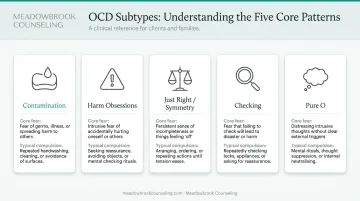
The contamination-and-washing image is the most recognized version, but OCD takes many forms:
- Contamination — fear of germs, illness, or chemicals; compulsions include washing, cleaning, and avoidance
- Harm obsessions — intrusive thoughts about accidentally or intentionally hurting others; often accompanied by checking or reassurance-seeking
- "Just right" or symmetry — an internal sense of incompleteness that drives ordering, counting, or repeating until it "feels right"
- Checking — repeatedly verifying locks, appliances, emails, or memories
- "Pure O" — a commonly misunderstood label: visible rituals are absent, but covert compulsions (mental review, neutralizing, silent counting) keep the cycle running just the same
OCD is a diagnosable mental health condition — not a personality type, a preference, or something someone can simply "stop doing" through willpower.
Why OCD Persists
Regardless of which form OCD takes, the same underlying mechanism keeps it going. Cognitive models point to four core distorted beliefs: overestimated threat, inflated responsibility, intolerance of uncertainty, and perfectionism. Compulsions and avoidance reinforce these beliefs by blocking the one experience that would challenge them — learning that the feared outcome either won't happen or is survivable. This is the maintenance cycle CBT is specifically designed to interrupt.
What Is CBT for OCD and Why Does It Work?
CBT is a structured, present-focused therapy built on a direct premise: thoughts, feelings, and behaviors influence each other — shift one, and the others follow.
For OCD, the key insight is that intrusive thoughts are universal. Most people have occasional unwanted thoughts about harm, contamination, or making mistakes. What distinguishes OCD is the meaning assigned to those thoughts.
People with OCD interpret intrusive thoughts as signals of danger, moral failure, or personal responsibility to act. That interpretation drives compulsions. CBT targets the meaning-making, not the thoughts themselves.
What the Research Shows
NICE guideline CG31 recommends CBT including ERP as the first-line treatment for OCD across all severity levels, with treatment intensity scaling based on impairment. The International OCD Foundation (IOCDF) identifies ERP as the most important form of CBT for OCD.
In terms of outcomes, a 2019 clinical review found that approximately 50–60% of people who complete ERP show clinically significant improvement. This is a treatment-completer rate, not a guarantee — but it's meaningful, particularly for a condition as disabling as untreated OCD.
How CBT Differs from General Counseling
CBT for OCD isn't open-ended talk therapy. It's structured and skills-based, involving:
- A formal assessment and case formulation
- A collaboratively built fear hierarchy
- Active practice of exposures, often in-session
- Response prevention during and after exposures
- Between-session homework
- Relapse planning
Generic supportive counseling without ERP has no comparable evidence base in OCD trials — which is why the distinction matters when choosing a provider.
When Medication Fits In
For severe OCD or when depression co-occurs, CBT may be combined with SSRIs (serotonin reuptake inhibitors). NICE supports combination treatment for significant functional impairment, and the two approaches complement each other — medication can lower baseline distress enough to make ERP engagement possible, while ERP addresses the behavioral patterns medication alone doesn't change.
Exposure and Response Prevention (ERP): The Heart of CBT for OCD
ERP works by doing the opposite of what OCD demands. Instead of avoiding a feared trigger or performing a compulsion to reduce distress, the person confronts the trigger — and waits.
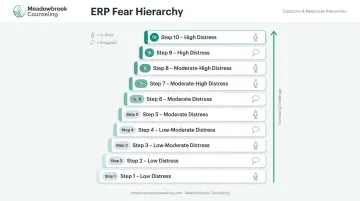
The process starts with building a fear hierarchy: a collaboratively developed, ranked list of feared situations from least to most anxiety-provoking. Client and therapist work through items progressively, moving up the hierarchy as lower-level exposures become manageable.
In Vivo vs. Imaginal Exposure
In vivo exposure means direct, real-life contact with the feared situation. A person with contamination OCD might touch a doorknob without washing their hands. Someone with checking compulsions might leave the house without verifying the lock.
The mechanism traditionally described is habituation — anxiety naturally decreases when a person stays in the feared situation without ritualizing, because the brain updates its threat prediction. More recent research frames this as inhibitory learning: the person learns a new, competing association (this situation is safe) rather than simply waiting for distress to fall.
Imaginal exposure works with feared scenarios that can't be recreated directly — for instance, a harm obsession involving a feared consequence. The therapist helps the person mentally engage with the feared outcome through a detailed narrative or recording. It's also used as a bridge before real-world exposure for highly distressed clients.
Both exposure types only work when paired with one critical step: not performing the compulsion afterward.
Why Ritual Prevention Is Essential
Response prevention means choosing not to perform the compulsion once triggered. This is the harder half of ERP — and the critical half.
Compulsions work in the short term. They reduce distress quickly, which reinforces the belief that the compulsion was necessary. Over time, the obsession grows stronger, not weaker.
Blocking the compulsion during exposure gives the brain a chance to learn something new: the feared outcome didn't happen, the distress was tolerable, and the ritual wasn't needed.
ERP follows several non-negotiable principles in practice:
- Done at the client's pace: the therapist guides, but the client drives every decision to engage
- Exposures are never forced
- Active emotional engagement is required: mentally checking out during an exposure undermines corrective learning — the client needs to genuinely contact the feared situation
- Covert rituals (mental reviewing, silent reassurance) count as compulsions and need to be addressed
The Cognitive Side of CBT: Challenging Distorted Thinking
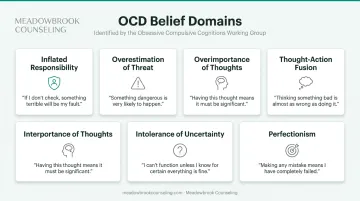
Cognitive therapy (CT) works alongside ERP by identifying and challenging the specific distorted beliefs maintaining OCD. The Obsessive Compulsive Cognitions Working Group identified six key belief domains:
| Belief Domain | How It Appears in OCD |
|---|---|
| Inflated responsibility | "If I don't check, something terrible will happen and it'll be my fault" |
| Overestimation of threat | Exaggerating how likely or severe a feared outcome is |
| Overimportance of thoughts | Treating an intrusive thought as meaningful or dangerous |
| Thought-action fusion | Believing thinking something is as bad as doing it |
| Intolerance of uncertainty | Needing certainty before stopping a checking or reviewing ritual |
| Perfectionism | Treating any mistake or incompleteness as unacceptable |
How CT Is Applied
The practical work involves:
- Questioning the evidence — "What actually supports this belief? What contradicts it?"
- Generating alternative interpretations — what else could explain this situation?
- Behavioral experiments — testing new ways of thinking in real life (which overlaps directly with ERP)
Research supports this combined approach. A 2005 randomized trial by Whittal and colleagues compared individual CBT with ERP alone and found both produced substantial improvement, with no significant difference between the two. CT doesn't replace ERP — it works best as a complement, giving therapists another route in, particularly when a client has poor insight, strong magical thinking, or significant depression alongside OCD.
What to Expect During CBT for OCD
The Treatment Arc
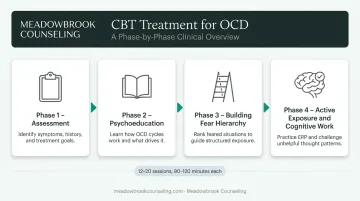
A typical course of CBT for OCD moves through recognizable phases:
- Assessment — identifying obsessions, compulsions, triggers, and how much time OCD consumes daily
- Psychoeducation — understanding the obsession-compulsion cycle and why compulsions make things worse
- Building the fear hierarchy — collaboratively ranking feared situations
- Active exposure and cognitive work — the core of treatment, done both in-session and at home
Most clients attend weekly sessions. A 2021 clinical review found 12–20 sessions — typically 90–120 minutes each — to be the most effective format for most clients. NICE frames intensity by therapist hours rather than a fixed session count, scaling up for more severe presentations. Some intensive outpatient formats — including concentrated daily ERP programs — exist for people who need faster or more supported treatment.
The Role of Homework
Between-session practice isn't optional in ERP. Research on homework adherence has found it predictive of treatment response — meaning the work done outside of therapy sessions directly affects outcomes. The therapist coaches and structures; the client does the exposures.
CBT for OCD requires active engagement. People who approach it as something done to them, rather than by them, tend to see weaker results.
Finding the Right Support
Meadowbrook Counseling has therapists trained in CBT and ERP for OCD, available across multiple locations and via telehealth. Getting started is straightforward:
- The intake team matches you with a clinician suited to your specific OCD presentation
- The billing team verifies your insurance benefits before your first session
- Both in-person and telehealth appointments are available with flexible scheduling
Getting Started with CBT for OCD
What to Look for in a Therapist
Not every therapist who lists "OCD" on their website is trained in ERP. The IOCDF recommends asking:
- What techniques do you use for OCD specifically?
- Do you use ERP, and how were you trained in it?
- Do you practice exposures in-session, or only discuss them?
- What proportion of your caseload involves OCD?
The answer to whether exposures happen in-session matters. A therapist who only talks about facing fears — but never practices them with you in the room — isn't delivering the treatment as designed. Therapist-supervised in-session exposure is a core component of ERP, not an optional add-on.
Practical Barriers — and How to Navigate Them
Cost and access are real obstacles. A geospatial study in Texas found that nearly 97% of specialty OCD treatment locations were concentrated in the four largest metro areas — a stark indicator of how unevenly care is distributed.
Telehealth changes this picture. Remote ERP sessions show meaningful symptom improvement, and several providers — including Meadowbrook Counseling — offer virtual appointments that make CBT-trained care accessible regardless of geography. Meadowbrook also verifies insurance benefits before the first session, which removes some of the financial uncertainty that stops people from reaching out.
What Recovery Actually Looks Like
If access has been the barrier holding you back, that barrier is now smaller than it used to be. Recovery from OCD through CBT is possible — not easy, but possible. The people who do best aren't those with the mildest symptoms. They're the ones who engage fully, do the homework, and stay in treatment long enough to see results compound.
Meadowbrook Counseling works with individuals across multiple states — in person and via telehealth — and verifies insurance benefits before your first appointment. Call 801-655-5450 or visit meadowbrookcounseling.com/contact to get matched with a therapist.
Frequently Asked Questions
Can cognitive behavioral therapy help with OCD?
Yes — CBT is the first-line evidence-based treatment for OCD, endorsed by NICE and the IOCDF. ERP, the behavioral core of CBT, produces clinically significant improvement in roughly 50–60% of people who complete treatment. Outcomes are strongest when exposures are practiced actively, both in-session and at home.
What are the subtle signs of OCD?
OCD doesn't always involve visible rituals. Subtle signs include mental compulsions like silently reviewing events, seeking reassurance repeatedly, or trying to "neutralize" unwanted thoughts. Spending significant time on intrusive thoughts — even without outward behavior — and avoiding triggers that provoke anxiety are also common indicators.
What are the 3 C's of OCD?
"Catch, Check, Change" appears in some general cognitive reframing resources as a way to identify a distorted thought, evaluate it, and respond differently. This framework comes from generic CBT material, not a named OCD-specific protocol — it isn't an ERP technique or an IOCDF-endorsed approach.
How long does CBT for OCD typically take?
Most people complete CBT for OCD in 12–20 sessions, though session length, frequency, and total duration vary by severity and individual engagement. More severe presentations may benefit from intensive formats with daily sessions over a concentrated period.
What is the difference between ERP and CBT for OCD?
ERP (Exposure and Response Prevention) is the primary behavioral technique used within the broader CBT framework for OCD. CBT also includes cognitive restructuring — challenging distorted beliefs — alongside ERP. In practice, ERP is the most essential component of CBT for OCD.
Can CBT for OCD be done online or remotely?
Telehealth ERP has shown meaningful symptom improvement in multiple studies, though research has not yet conclusively established it as equivalent to in-person care in all cases. For many people, particularly those in areas with limited specialist access, virtual CBT is a genuinely effective and practical option.