Social anxiety disorder (SAD) affects 7.1% of U.S. adults in any given year and 12.1% over a lifetime, according to NIMH data from the nationally representative NCS-R survey. Despite being one of the most common anxiety disorders, many people go years without knowing that effective, evidence-based treatments exist.
This article covers what those treatments are, how they work, and what to expect when you decide to seek help.
Key Takeaways
- CBT is the most well-researched therapy for SAD, with lasting gains that continue improving after treatment ends
- SSRIs (sertraline, paroxetine) and SNRIs (venlafaxine ER) are the only FDA-approved medications for SAD
- SAD requires professional diagnosis; it won't resolve on its own and is distinct from ordinary shyness
- Mindfulness and lifestyle changes support treatment but do not replace it
- Treatment works: 48% of people no longer met diagnostic criteria for SAD five years after completing internet-based CBT
Understanding Social Anxiety Disorder
SAD is not shyness. It is a persistent, intense fear of being judged, humiliated, or scrutinized in social situations — one that consistently disrupts daily functioning, relationships, and quality of life.
Under DSM-5, the diagnosis applies when fear is marked, near-constant in relevant situations, disproportionate to the actual threat, and present for at least six months.
A "performance-only" specifier applies when fear is limited to public speaking or performing. Most people with SAD experience fear across a broader range of social situations, not just performance settings.
Emotional, Behavioral, and Physical Symptoms
Emotional and behavioral symptoms include:
- Intense self-consciousness during or before social interactions
- Fear of saying something embarrassing or being negatively evaluated
- Mind going blank mid-conversation
- Consistent avoidance of situations that trigger fear — or enduring them with significant distress
Physical symptoms that appear in social situations:
- Blushing, sweating, or trembling
- Racing heartbeat or nausea
- Shaky voice or difficulty speaking
People with SAD often fear that others will notice these physical reactions — making the symptoms themselves a source of additional anxiety.
How Social Anxiety Disorder Is Diagnosed
SAD is diagnosed by a mental health professional using DSM-5 criteria. The clinician will assess whether the fear:
- Is persistent (typically six months or longer)
- Is disproportionate to the actual social situation
- Causes clinically significant distress or impairs social, occupational, or daily functioning
- Cannot be better explained by a medical condition, substance, or another mental disorder
Getting the diagnosis right has real consequences: research shows comorbid disorders appear in up to 90% of clinical SAD samples, with major depression being the most frequent co-occurring condition. When SAD is misidentified or overlooked, people may receive treatment for depression alone while the underlying anxiety goes unaddressed, keeping the cycle of avoidance intact.
That pattern of incomplete treatment also helps explain a striking finding: the NCS-R study found social phobia has one of the longest delays between onset and first treatment contact — approximately 20 years. Effective treatments exist, but most people either don't know help is available or assume their distress is simply part of who they are.
Cognitive Behavioral Therapy: The Gold Standard Treatment
CBT is the most well-established psychotherapy for SAD, with consistent support across decades of research. A network meta-analysis of 101 trials and 13,164 participants found individual CBT produced a large effect versus waitlist control (SMD -1.19), making it the most effective psychological intervention studied for this condition.
How CBT Works for Social Anxiety
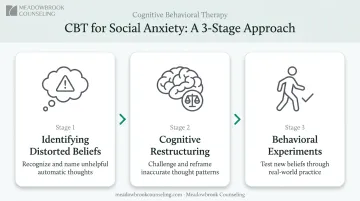
CBT for SAD targets the thought patterns and avoidance behaviors that sustain the disorder. The process typically involves:
- Identifying distorted beliefs — recognizing automatic thoughts like "everyone will think I'm incompetent" or "if I blush, they'll all notice"
- Cognitive restructuring — examining whether those beliefs are realistic, then building more balanced interpretive habits
- Behavioral experiments — testing feared predictions in real situations to gather actual evidence
NICE guidelines specify two well-validated individual CBT protocols: the Clark and Wells model (up to 14 sessions of 90 minutes over four months) and the Heimberg model (15 sessions including one 90-minute exposure session over four months). Group CBT is also effective and remains evidence-based, though individual, disorder-specific CBT holds the stronger guideline position. Both protocols rely heavily on exposure work as the primary mechanism of change.
Exposure Therapy Within CBT
Exposure is how CBT produces lasting results. Clients work through a graduated hierarchy of feared situations — starting with lower-anxiety scenarios and progressing to more challenging ones. Each step desensitizes the fear response rather than reinforcing avoidance.
A SAD-specific meta-analysis found that 12 months or more after completing CBT, social anxiety symptoms continued to improve relative to post-treatment levels (g_av = 0.23). The gains don't just hold — they build.
Meadowbrook Counseling's therapists are trained in CBT and other evidence-based approaches for anxiety, including ACT, EMDR, and mindfulness-based therapy — and the intake team helps match each client with the right fit based on their specific goals.
Medication Options for Social Anxiety Disorder
Medication can provide meaningful symptom relief on its own or alongside therapy. Three medications currently carry FDA approval specifically for SAD:
| Medication | Class | Notes |
|---|---|---|
| Sertraline | SSRI | First-line; well-tolerated |
| Paroxetine | SSRI | FDA-approved for SAD |
| Venlafaxine ER | SNRI | Approved for social phobia/SAD |
SSRIs and SNRIs: What to Expect
These medications work by normalizing neurotransmitter activity. A few practical points:
- Starting doses are intentionally low to minimize initial side effects, and adjustments happen over time
- Full effect takes weeks — NICE notes that assessment for adequate response typically happens at 10-12 weeks
- Some people try more than one medication before finding the best fit; this is normal, not a sign of treatment failure
Short-Term Medication Options
Beta-blockers (propranolol) are used off-label before specific high-stakes events like speeches to reduce physical symptoms (racing heart, trembling). They are not an FDA-approved SAD treatment and a 2025 systematic review found no reliable benefit for social phobia broadly. They are situational tools, not a management strategy.
Benzodiazepines carry an FDA boxed warning for abuse, dependence, and withdrawal risk. NICE does not recommend routinely offering them for SAD. When used at all, it is at the lowest effective dose for the shortest necessary time.
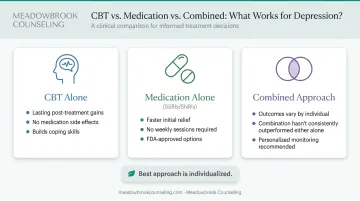
Research shows that CBT, medication, and combined approaches each outperform placebo — but combination therapy has not consistently outperformed either one alone. What works best depends on the individual, which is why treatment plans are adjusted over time rather than set in stone.
Complementary Strategies That Support Recovery
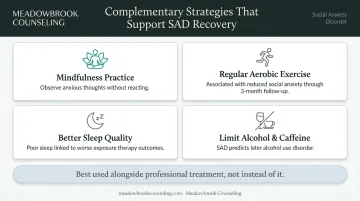
These approaches work best alongside professional treatment — not as replacements for it.
Mindfulness practice has the strongest complementary evidence. A randomized trial of 108 adults with SAD found that mindfulness-based stress reduction (MBSR) improved social anxiety symptoms versus a waitlist, though CBT produced greater improvements. Mindfulness trains the ability to observe anxious thoughts without reacting to them, which directly reinforces the cognitive skills built in CBT.
Regular aerobic exercise offers some measurable benefit as an adjunct. One study comparing MBSR and aerobic exercise in adults with SAD found both were associated with reduced social anxiety through three-month follow-up. However, the broader research base is mixed, and exercise should be seen as a supportive habit rather than a standalone treatment.
Sleep quality directly affects treatment outcomes. A 2021 study found that poorer sleep was associated with worse results from exposure therapy in adults with SAD. A consistent wind-down routine, limiting screens before bed, and regular sleep/wake times are low-cost changes that compound over time.
Limit alcohol and caffeine:
- Alcohol may feel calming in the moment, but a longitudinal study found SAD predicted later alcohol use disorder (OR 1.70) — making it a risky coping habit
- High-dose caffeine has been shown to amplify physical anxiety symptoms, particularly for people with performance anxiety
Used consistently, these habits strengthen the foundation that professional treatment builds on — they work best when layered on top of therapy, not substituted for it.
What to Expect When You Seek Treatment
SAD generally does not resolve on its own. The good news: it responds well to treatment, and most people see meaningful improvement once they find the right approach.
The Treatment Timeline
First sessions focus on assessment and collaborative goal-setting. Therapists at practices like Meadowbrook Counseling typically work at the client's pace, establishing what situations are most impairing and what recovery would look like.
CBT courses generally run weekly before tapering, across roughly four months of active treatment. Improvement builds gradually — early sessions may feel uncomfortable, and that discomfort is part of the process, not a sign that it is not working.
Medications may take several weeks before full benefit is apparent. If a first medication doesn't work well, adjusting the dose or trying a different medication is standard practice.
Finding the right fit — whether that means therapy alone, medication, or a combination — can involve some trial and adjustment. That is normal. A five-year follow-up of adults treated with internet-based CBT found that 48% no longer met diagnostic criteria for SAD at the five-year mark. Remission is achievable — and that outcome is within reach with consistent, well-matched care.
Starting at Meadowbrook Counseling
Meadowbrook Counseling provides anxiety therapy across Utah, Idaho, Massachusetts, Washington, Arizona, Colorado, Florida, Texas, and Wisconsin, with both in-person and telehealth options available. Their dedicated intake team matches clients with therapists whose training and approach align with the client's specific needs — a meaningful step for someone whose anxiety may make even the idea of starting feel daunting.
They accept a wide range of insurance plans — including Aetna, Blue Cross Blue Shield, Cigna, UnitedHealthcare, Medicaid, Medicare Advantage, TriCare, and others — and provide insurance verification before the first session so there are no surprises. To learn more or schedule, call 801-655-5450 or visit meadowbrookcounseling.com.
Frequently Asked Questions
What is the best treatment for social anxiety disorder?
Individual CBT is the most well-researched and guideline-recommended treatment for SAD. SSRIs or SNRIs are often added when symptoms are more severe or when therapy alone provides partial relief. The best approach depends on symptom severity, individual response, and how the person prefers to engage with treatment.
Is social anxiety a mental illness?
Yes. SAD is a recognized mental health condition listed in the DSM-5, distinct from ordinary shyness. Unlike shyness, SAD responds to professional treatment — it doesn't simply resolve through willpower or social exposure alone.
What does social anxiety feel like?
Most people describe intense anticipatory dread before social situations and a fear of being judged or humiliated. Physical symptoms during interactions are common: blushing, a racing heart, trembling, or the mind going blank. The internal experience is often far more distressing than anything visible to others.
Can social anxiety disorder be cured?
"Cure" is not a standard clinical term, but significant and lasting symptom reduction is achievable. Many people complete CBT and maintain long-term remission. Some continue to benefit from occasional booster sessions or ongoing medication.
How long does treatment for social anxiety disorder take?
CBT typically spans roughly four months of weekly sessions. Medications may take 10-12 weeks before full effectiveness is apparent. Duration varies based on symptom severity and individual response — some people see substantial improvement sooner.
What is the difference between social anxiety disorder and shyness?
Shyness is a personality trait that doesn't meaningfully interfere with daily life. SAD is defined by the intensity and consistency of the fear, the avoidance it drives, and the functional impairment it causes — in relationships, work, and routine activities. Shyness alone does not meet clinical criteria.