

This isn't a rare experience. Research on PTSD treatment-seeking populations found trauma-related nightmares in 70.3% of participants with PTSD, compared to just 5.1% of adults in the general population reporting weekly nightmares in a separate community survey (source). That gap creates a punishing cycle: fear of sleep, exhaustion from avoiding it, and nightmares that feel impossible to escape.
This guide covers why PTSD nightmares happen, what to do the moment you wake up from one, and the treatment approaches — including EMDR — that actually address the root cause.
Key Takeaways
- PTSD nightmares are more frequent, vivid, and physically distressing than ordinary bad dreams
- Grounding techniques help you recover after waking, but lasting relief usually requires therapy
- Imagery Rehearsal Therapy (IRT), CBT-I, and EMDR are the most evidence-supported treatment paths
- Sleep hygiene supports treatment but won't resolve nightmares on its own
- Combining professional treatment with self-management techniques often reduces nightmare frequency within weeks
What Are PTSD Nightmares and Why Do They Happen?
PTSD nightmares are vivid, trauma-linked dreams that either replay the traumatic event directly or evoke the same overwhelming emotions — fear, helplessness, panic. They're not the same as an ordinary bad dream.
What sets them apart:
- Higher frequency and intensity than typical nightmares
- Strong physical reactions on waking: racing heart, sweating, shortness of breath
- Abrupt awakenings, sometimes with motor activity (thrashing, shouting)
- Content that mirrors the trauma itself or its emotional core
Why They Happen During Sleep
Nightmares tend to surface during REM sleep, when the brain is normally processing emotional memories and reinforcing fear extinction. In PTSD, sleep researchers describe fragmented REM patterns that may interfere with this process, though this remains a proposed mechanism rather than a fully proven cause (source). In simpler terms: the brain is trying to file away the trauma, but the filing system is jammed.
That jammed filing system helps explain another common point of confusion: nightmares and flashbacks aren't the same experience, even though both replay trauma.
Nightmares vs. Flashbacks
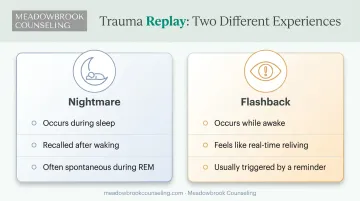
These get confused often, but they're distinct:
| Feature | Nightmare | Flashback |
|---|---|---|
| When it happens | During sleep | While awake |
| Awareness | Recalled after waking | Feels like it's happening in real time |
| Trigger | Often spontaneous during REM | Usually provoked by a reminder |
What Feeds PTSD Nightmares
- Unresolved or unprocessed trauma memories
- Hyperarousal and hypervigilance carrying into the night
- Daytime stress that doesn't get "shut off" before bed
- Trauma-related rumination before falling asleep — one study found this strongly correlated with sleep disturbance in PTSD (source)
Left untreated, these triggers rarely stay contained to nighttime. The cycle bleeds into daytime anxiety, depression, insomnia, and strain on relationships and work performance.
Immediate Coping Strategies When a Nightmare Strikes
You wake up disoriented, maybe still gasping. What you do in the next few minutes matters.
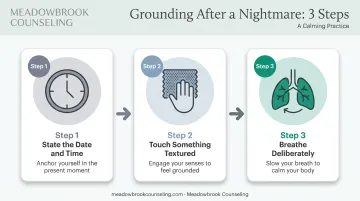
Ground yourself first:
- State the date and time out loud — this pulls your brain back to the present
- Touch something textured: a blanket, the wall, your own hands, anything that reconnects you with physical reality
- Breathe deliberately: slow inhale, longer exhale, repeated until your heart rate settles
Once you're grounded, resist the urge to simply close your eyes and hope the nightmare doesn't return.
The First Step of Imagery Rehearsal
Get up. Write the nightmare down. Then rewrite the ending — something less threatening, something where you have control. This isn't just a distraction technique; it's the foundation of Imagery Rehearsal Therapy (IRT), which we'll cover in more depth below.
A few more in-the-moment tools:
- Progressive muscle relaxation: tense and release each muscle group to calm your nervous system before trying to sleep again
- Avoid your phone — screen light can suppress melatonin and delay your ability to fall back asleep, an effect documented even in healthy adults using e-readers before bed (source)
- Talk it out or journal: putting the nightmare into words, even briefly, can reduce the anxiety it leaves behind
These strategies help you get through the night, but they don't address why the nightmares keep happening. If they're recurring, a trauma-focused therapist can help you work through the underlying cause instead of just managing the aftermath.
Long-Term Strategies to Reduce PTSD Nightmares
Imagery Rehearsal Therapy and Cognitive Approaches
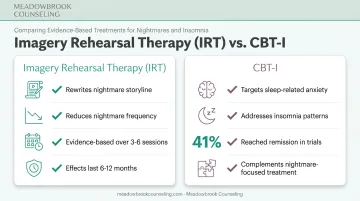
IRT takes the "rewrite the ending" concept from a coping tool into a structured treatment. While awake, you select a recurring nightmare and change its storyline into something less distressing. Then you mentally rehearse the new version daily, often for 10-20 minutes, until it starts to replace the original in your sleep.
The evidence for this is strong. A randomized trial of 168 women with sexual-assault-related PTSD found large reductions in both nightmare frequency and nights disturbed by nightmares after just three IRT sessions, with effects holding at 3- and 6-month follow-ups (source). A later meta-analysis of 13 studies found benefits sustained at 6 to 12 months post-treatment.
Cognitive Behavioral Therapy for Insomnia (CBT-I) works differently. Rather than targeting the nightmare content itself, it addresses the anxiety, avoidance, and behavioral patterns that build up around bedtime — things like dreading sleep or lying awake in fear. One trial found 41% of participants reached insomnia remission with CBT-I versus 0% on a waitlist. It's a strong tool for the insomnia that often accompanies PTSD nightmares, though it's not primarily designed to reduce nightmare content itself.
Both IRT and CBT-I are typically guided by a trained therapist, since tailoring the new dream narrative or restructuring sleep-related anxiety takes clinical skill. Outside of session work, though, daily habits matter too.
Sleep Hygiene and Lifestyle Adjustments
Sleep hygiene changes won't resolve trauma-driven nightmares on their own, but they reduce the noise your nervous system has to fight through:
- Keep a consistent bedtime and wake time, even on weekends
- Cool, dark, quiet bedroom — blackout curtains or a sleep mask help
- Cut screens for at least 30-60 minutes before bed
- Limit caffeine and nicotine in the afternoon and evening
- Skip alcohol close to bedtime — it fragments later sleep stages
- Avoid heavy meals right before turning in
During the day: exercise earlier rather than late in the evening, and build in a mindfulness or relaxation practice. Lowering your baseline hyperarousal during the day means less carries over into the night.
Professional Treatment Options, Including EMDR
Self-care and sleep hygiene can only go so far when the nightmares are rooted in unprocessed trauma. At some point, addressing the source matters more than managing the symptom.
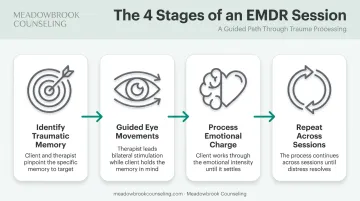
EMDR (Eye Movement Desensitization and Reprocessing) is one of the leading trauma-focused therapies for this. It uses guided eye movements while the client recalls the traumatic memory, helping the brain reprocess memories that seem to be "stuck" in a raw, unprocessed state.
EMDR sessions typically involve:
- Identifying a specific traumatic memory tied to the nightmares
- Following guided eye movements while briefly recalling that memory
- Processing the emotional charge until the memory feels less distressing
- Repeating over multiple sessions until nightmare frequency decreases
The American Academy of Sleep Medicine notes EMDR "may be used" for PTSD-associated nightmares. That's a real endorsement, though more conservative than the stronger evidence base behind Imagery Rehearsal Therapy.
Meadowbrook Counseling has EMDR-certified clinicians across its multi-state network of offices, including practitioners like Rosario Toral, ACMHC. These therapists build treatment plans tailored to each client's specific trauma history and nightmare patterns, rather than applying a one-size-fits-all protocol.
Therapy remains the primary approach for nightmare-specific PTSD symptoms, but some clients also explore medication as a complementary option.
A note on medication: Prazosin has been studied for PTSD nightmares, with mixed results. Earlier trials in smaller groups showed benefit, but a 2018 trial of 304 veterans found no significant improvement over placebo for distressing dreams or sleep quality (source). Given this inconsistency, medication is generally discussed as a secondary option alongside — not instead of — therapy.
When to Seek Professional Help
Some signs suggest self-management isn't enough anymore:
- Nightmares occurring multiple times a week
- Growing daytime anxiety, depression, or irritability
- Avoiding sleep altogether out of dread
- Increasing reliance on alcohol or substances just to fall asleep
Don't wait these out. Persistent nightmares are linked to a higher risk of broader mental health struggles, including suicidal thoughts, independent of insomnia alone.
If you're experiencing thoughts of self-harm, contact 988 or your local emergency services immediately. This goes beyond what outpatient therapy alone can address in the moment.
For everything short of a crisis, reaching out to a licensed trauma therapist is the next step. Meadowbrook Counseling matches clients with trauma-focused therapists across multiple states, offering both in-person and telehealth sessions depending on location.
Their team also verifies your specific mental health benefits before your first session, so cost concerns don't become a barrier to starting care.
Frequently Asked Questions
Do PTSD dreams go away?
With therapy such as IRT or EMDR, consistent self-care, and sometimes medication, nightmares often decrease significantly or resolve. Timelines vary — some people see improvement within a few months, others need longer.
What do PTSD dreams look like?
They can directly replay the traumatic event or evoke the same overwhelming emotions, like fear and helplessness, without an exact replay. Waking up often comes with a racing heart, sweating, or a sense of panic.
What triggers PTSD dreams?
Common triggers include unresolved trauma memories, daytime stress carrying into sleep, hyperarousal, and rumination before bed. Trauma reminders during the day can also increase the likelihood of a nightmare that night.
How do I stop PTSD nightmares immediately?
Grounding techniques and slow, focused breathing can help you recover in the moment after waking. Long-term relief, though, typically requires trauma-focused therapy, such as working with a therapist trained in EMDR or imagery rehearsal, rather than in-the-moment tools alone.
Is EMDR effective for treating PTSD nightmares?
EMDR helps reprocess trauma memories at their source rather than just managing symptoms. Small studies suggest this can reduce nightmare-related sleep disruption, though larger nightmare-specific research is still developing.
Are PTSD nightmares the same as flashbacks?
No. Flashbacks happen while you're awake and can feel like reliving the trauma in real time. Nightmares occur during sleep and are recalled only after you wake up.