According to SAMHSA's 2024 National Survey, 15.4% of adolescents ages 12–17 — roughly 3.8 million young people — experienced a major depressive episode in the past year. Yet because teen depression rarely looks like the textbook picture of sadness, many cases go unrecognized until the situation becomes serious.
The good news: effective, evidence-based treatments exist. This guide walks parents through how to recognize depression in teenagers, what the diagnostic process involves, which treatments work, how families can help, and when to seek professional support.
Key Takeaways
- Teen depression often presents as irritability, anger, or physical complaints — not just sadness
- CBT and Interpersonal Therapy for Adolescents (IPT-A) are the recommended first-line treatments
- Only fluoxetine and escitalopram are FDA-approved specifically for adolescent depression
- Combining psychotherapy with medication delivers the strongest outcomes in moderate-to-severe cases
- Family involvement in treatment directly improves recovery outcomes
How Teen Depression Looks Different from Adult Depression
Most people picture depression as persistent sadness, tearfulness, and low energy. In teenagers, it often looks quite different — which is why so many parents and teachers miss it.
The DSM-5 allows irritable mood to substitute for depressed mood as the primary symptom in children and adolescents. That means a teen who seems angry, easily frustrated, or chronically bored may actually be experiencing a depressive episode — not just a difficult phase.
Warning Signs Parents Commonly Miss
Beyond mood changes, watch for:
- Withdrawal from friends and activities they previously enjoyed
- Declining grades or loss of motivation at school
- Sleep changes, particularly sleeping far more than usual
- Somatic complaints — frequent headaches, stomachaches, or fatigue with no clear medical cause
- Statements of hopelessness or worthlessness, even said casually
- Increased irritability or anger that feels disproportionate to the situation
Risk Factors Worth Understanding
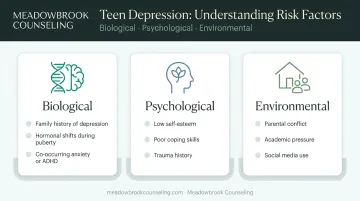
Teen depression rarely has a single cause. Risk factors fall into three broad categories:
| Category | Contributing Factors |
|---|---|
| Biological | Family history of depression, hormonal shifts during puberty, co-occurring anxiety or ADHD |
| Psychological | Low self-esteem, poor coping skills, history of trauma or adverse childhood experiences |
| Environmental | Parental conflict, academic pressure, loss of relationships, substance use, heavy social media use |
On that last point, the U.S. Surgeon General's advisory cited a longitudinal study of over 6,500 adolescents ages 12–15 in which social media use exceeding 3 hours per day was associated with double the risk of poor mental health outcomes, including depression symptoms.
NIMH data shows past-year depression prevalence of 29.2% in females versus 11.5% in males among 12–17-year-olds — a gap that emerges after puberty and reflects a mix of hormonal, social, and stress-related factors. Boys are also less likely to be identified, since their depression more often presents as aggression or risk-taking rather than emotional distress.
Getting a Diagnosis: What the Process Looks Like
A proper evaluation involves more than a questionnaire. Here's what parents can expect.
The Diagnostic Pathway
- Primary care visit first — A physical exam rules out medical causes like thyroid disorders, anemia, or vitamin deficiencies that can mimic depressive symptoms
- Psychological evaluation — Using structured tools such as the PHQ-9 Modified for Teens, the Children's Depression Inventory, or the Reynolds Adolescent Depression Scale
- Clinical interview — Assessing duration of symptoms, level of impairment, and how the teen is functioning across home, school, and social settings
Why Ruling Out Other Conditions Matters
Several conditions overlap with depression and require careful differentiation:
- Bipolar disorder — Antidepressants prescribed without this diagnosis can trigger manic episodes
- Persistent depressive disorder (dysthymia) — Lower-grade but chronic depression with a different treatment approach
- Adjustment disorder — Depression-like symptoms tied to a specific stressor, often shorter-lived
- Anxiety disorders — Frequently co-occur with depression and may be the primary driver
Each of these requires a distinct treatment approach. Misdiagnosis doesn't just delay effective care — it can actively worsen the underlying condition.
Suicide Risk Assessment
Any comprehensive evaluation includes a direct conversation about suicidal thoughts. Parents sometimes worry that asking about suicide plants the idea — but research consistently shows this isn't the case. A randomized study of over 2,300 high school students found that exposure to suicide screening questions did not increase suicidal ideation, even among students already experiencing depression.
Clinicians will ask about thoughts, any plan, intent, and access to means. This is essential safety practice. It opens a conversation that can be lifesaving.
Psychotherapy: The Most Effective First-Line Treatment
For adolescents with mild depression, psychotherapy alone is the recommended starting point. For moderate-to-severe depression, therapy remains an essential part of treatment even when medication is added.
Cognitive Behavioral Therapy (CBT)
CBT is the most well-researched psychological treatment for adolescent depression. It works by targeting the connection between thoughts, feelings, and behavior. Specifically, CBT for depressed teens:
- Identifies and challenges distorted or negative thinking patterns
- Builds practical coping and problem-solving skills
- Uses behavioral activation — gradually re-engaging with activities that bring a sense of accomplishment or pleasure
- Improves emotional regulation over time
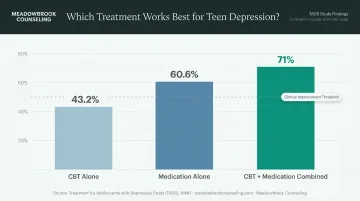
The landmark Treatment for Adolescents with Depression Study (TADS) found that at 12 weeks, 71% of teens receiving fluoxetine plus CBT showed clinical improvement, compared to 60.6% with medication alone and 43.2% with CBT alone. The combination outperformed every other condition — a finding that shaped current treatment guidelines.
Interpersonal Therapy for Adolescents (IPT-A)
IPT-A focuses on the teen's relationships and social functioning rather than thought patterns. It's particularly well-suited when depression is connected to:
- Conflict with parents, peers, or romantic partners
- Grief or loss
- Major life transitions (changing schools, parents divorcing, moving)
- Social isolation or difficulty with peer relationships
- Role disputes or significant changes in family structure
A standard course of IPT-A typically runs 12 sessions over 16 weeks for adolescents ages 12–17. Both CBT and IPT-A are recognized by the American Academy of Child and Adolescent Psychiatry (AACAP) as evidence-based treatments for adolescent depression.
For families ready to act on this, therapist fit matters. Meadowbrook Counseling's clinicians use evidence-based approaches — including CBT and Trauma-Focused CBT — tailored to each teen's history and presentation. This is especially relevant when depression co-occurs with trauma. Families can reach the intake team at 801-655-5450 to discuss therapist matching.
Medications for Adolescent Depression
Medication is typically considered when depression is moderate to severe, when therapy alone hasn't produced improvement after an adequate trial, or when symptoms are significantly disrupting daily functioning — school attendance, sleep, relationships, and self-care.
FDA-Approved Options and Common SSRIs
Two medications carry FDA approval specifically for adolescent depression:
- Fluoxetine (Prozac) — approved for ages 8 and up
- Escitalopram (Lexapro) — approved for ages 12 and up
Both are SSRIs (selective serotonin reuptake inhibitors), which work by increasing serotonin availability in the brain. Most teens tolerate them well, and side effects tend to diminish after the first few weeks.
Clinicians sometimes prescribe sertraline or citalopram as well, though both remain off-label for adolescent depression and have less supporting evidence than the two FDA-approved options.
Tricyclic antidepressants are no longer used in adolescents. A Cochrane review found no evidence they improved response or remission over placebo in this age group, and their side effect profile makes them inappropriate for younger patients.
The Black Box Warning: What Parents Must Know
That last point about side effects leads to the most important safety consideration in adolescent medication treatment. The FDA requires a black box warning on all antidepressants: a small number of children, teens, and young adults under 25 may experience increased suicidal thoughts or behaviors — particularly in the first few weeks of treatment or following a dose change.
What this means in practice:
- This is a warning about increased suicidal thinking, not completed suicide
- AACAP data puts the rates at approximately 3% with antidepressants versus 2% with placebo — a real but small difference
- For most teens with moderate-to-severe depression, the benefits of treatment outweigh this risk
- Never stop medication abruptly without medical guidance — this can cause withdrawal symptoms and rebound depression
Monitoring Protocol When Starting Medication
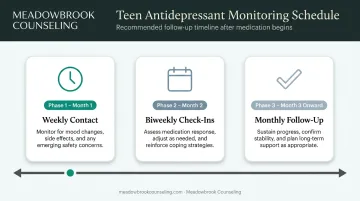
Clinical guidance recommends:
- Weekly contact during the first month of treatment
- Biweekly check-ins during the second month
- Monthly follow-up thereafter, assuming stability
Parents should watch for and immediately report: increased agitation, impulsivity, worsening mood, or any talk of self-harm. If any of these appear, contact the prescribing clinician the same day — don't wait for the next scheduled appointment.
How Families Can Support Their Teen's Recovery
Parents aren't bystanders in this process. Family involvement is one of the clearest predictors of how well teens respond to depression treatment.
What Helps at Home
- Keep communication open and judgment-free. Validate your teen's feelings without minimizing or immediately problem-solving. "That sounds really hard" often goes further than "You'll get through it."
- Support treatment adherence. Help ensure appointments are kept and, if medication is prescribed, that it's taken consistently.
- Promote sleep hygiene. Irregular sleep dramatically worsens depressive symptoms. Consistent bedtimes and limiting screens before bed make a measurable difference.
- Encourage physical activity. Even light, regular exercise has clinical support as a complementary approach to managing depression symptoms.
- Maintain structure and social connection. Isolation feeds depression. Gently support the teen in maintaining at least some social contact, even when they resist.
- Reduce access to means. If there's any concern about self-harm, secure medications, sharp objects, and other items that could be used.
When Your Teen Refuses to Go to Therapy
Even with the best home support in place, getting a teen through the door can be its own challenge. Resistance is common. Many teens feel shame about needing help, or worry that therapy means something is fundamentally wrong with them.
Approaches that tend to work better:
- Frame therapy as a tool for feeling better, not a sign of weakness or punishment
- Acknowledge their reluctance without dismissing it: "I know this feels weird. You don't have to have it all figured out before you go."
- Involve them in choosing a therapist when possible — some agency in the process increases buy-in
- Avoid ultimatums; opt for curiosity instead
GLAD-PC guidelines recommend active monitoring rather than passive waiting when a teen initially declines — scheduled follow-up, continued conversation, and collaborative goal-setting rather than simply hoping they come around.
When and How to Seek Professional Help
Some signs call for immediate action rather than a "wait and see" approach.
Seek professional help right away if your teen:
- Mentions suicide or self-harm in any context — direct, indirect, or joking
- Shows a sudden, dramatic shift in functioning or personality
- Stops eating or sleeping for extended periods
- Withdraws completely from all activities and relationships
- Displays extreme hopelessness, agitation, or psychosis-like symptoms
If your teen is in immediate danger, call 988 (Suicide and Crisis Lifeline) or 911. Meadowbrook Counseling is an outpatient practice and is not a 24/7 crisis service.
Starting the Process
Your teen's pediatrician or family doctor is often the right first call — they can screen for depression, rule out medical causes, and provide referrals. You can also contact a mental health practice directly.
Meadowbrook Counseling works with families across multiple states, offering both in-person and telehealth appointments. Their intake team verifies insurance benefits before the first session, so families know their coverage going in. Therapists specializing in adolescent care — including CBT, TF-CBT, EMDR, and DBT — are available across locations. To get started, call 801-655-5450 or visit meadowbrookcounseling.com/contact.
Frequently Asked Questions
What is the most effective treatment for adolescent depression?
For moderate-to-severe depression, research consistently shows that combination treatment (CBT or IPT-A alongside medication) produces the best outcomes. For mild depression, psychotherapy alone is the recommended first step and is effective for many teens without any medication.
What are the best antidepressants for teens?
Fluoxetine and escitalopram are the only medications with FDA approval specifically for adolescent depression. A prescribing physician determines the right choice based on severity, family history, and individual factors — always starting at the lowest effective dose.
Why is my 15-year-old daughter so sad?
Persistent sadness or irritability in a teenager can signal clinical depression or another mood disorder rather than ordinary teenage moodiness. Rather than waiting to see if it passes, schedule an evaluation with your daughter's doctor or a mental health professional.
Can adolescent depression be treated without medication?
Yes. For mild-to-moderate depression, CBT or IPT-A alone is effective and often the preferred starting point. Medication is typically added when therapy hasn't produced sufficient improvement or when depression is severe enough to significantly impair daily life.
How long does treatment for adolescent depression typically last?
AACAP guidelines recommend continuing treatment for at least six months after symptoms remit to reduce the risk of relapse. Total duration varies based on severity and individual response. Any decisions about tapering should be made with the treating clinician.
How do I get my teenager to agree to therapy?
Acknowledge their hesitation without pressure, and frame therapy as a way to feel better rather than a sign something is wrong. Involving them in choosing a therapist when possible significantly increases the chances they'll engage.